Treat the acquisition as planned, and evaluate end-user automation separately from developer infrastructure.
A folder and an infrastructure layer
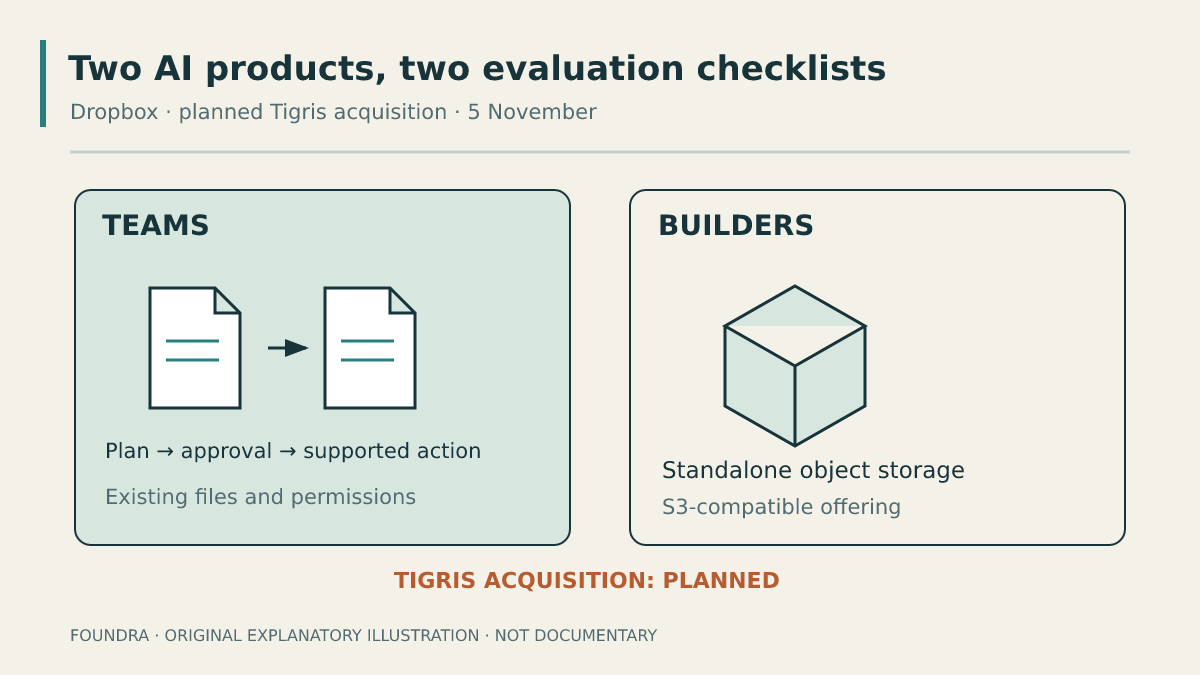
A team asking software to organize its files is not buying the same thing as a developer selecting storage for an AI application. Dropbox's November 5 announcement addresses both. The company unveiled DBX Agent Cloud and plans to acquire Tigris Data while describing AI capabilities for people already working inside Dropbox.
Dropbox's November 5 release is explicit about transaction status: the Tigris acquisition is planned. Crunchbase News's transaction report puts the proposed deal value at $350 million. That figure is attributed to the publication's reporting; neither it nor the product announcements should be used to claim that an acquisition has already closed.
The company describes Tigris as a globally distributed object-storage platform designed for AI workloads. DBX Agent Cloud begins with standalone, S3-compatible object storage, according to the release. These are descriptions of the company's offering and intended role, not Foundra's independent tests of performance, reliability or compatibility.
The existing team product
On the end-user side, Dropbox says customers can request supported tasks on existing content, with a proposed plan presented for approval before changes. It describes permissions, records of actions and the ability to undo supported actions. The qualifier supported matters: this should not be restated as a guarantee that any requested task or every resulting change can be carried out and reversed.
The value proposition is connected work rather than merely generating an answer. In Foundra's analysis, a team product becomes more consequential when it can act on shared files because the result affects what colleagues see and use. That makes approval, permissions and a truthful record of actions part of the product's usefulness, not decorative controls around it.
A hypothetical team evaluation should therefore include conflicting versions, restricted folders and requests that exceed the supported action set. The question would be whether the system respects the boundaries and communicates the result clearly. Foundra has not performed such an evaluation, and the company's description should not be converted into an assertion that every edge case has been resolved.
One announcement, two product contracts
Team workflow
Dropbox describes supported actions on existing files after customer approval.
Developer storage
DBX Agent Cloud begins with standalone S3-compatible object storage.
Planned acquisition
Tigris acquisition is announced as planned, not completed.
Evaluate separately
Workflow safeguards and infrastructure requirements need different tests.
The developer product
The infrastructure buyer has a different checklist. An application team selecting object storage needs evidence relevant to its workload, integration and operating requirements. Familiarity with a compatibility standard can help frame an evaluation, but the phrase S3-compatible alone does not establish the economics or reliability of a particular deployment.
Dropbox says DBX Agent Cloud is designed to work alongside customers' existing clouds and developer platforms. The strategic thesis is that content can remain usable as applications and compute choices change. That is the company's intended positioning, not proof that migration will be effortless or that every application can avoid provider-specific constraints.
The release also describes filesystem and content-processing capabilities as planned next steps. Those belong in the roadmap, not in a list of features presumed already available in the same form as the initial storage offering. An infrastructure buyer should verify the current supported product rather than contract against the broadest description of the eventual platform.
The connection should not erase the difference
There is a coherent idea linking the two sides: AI systems need access to useful content, and users need controls over what happens to that content. But the commercial contracts differ. A team application promises a supported workflow, while infrastructure supplies a component on which another team builds its own application. Success in one does not automatically establish success in the other.
That distinction is also relevant to the planned acquisition. Buying specialized technology can support an infrastructure expansion, but an announced purchase is not itself evidence that integration has been completed. The transaction and the product-delivery milestones should remain separately dated in any follow-up reporting. A product announcement cannot fill a missing transaction confirmation, or vice versa.
Dropbox's new direction is substantial enough without calling every roadmap item a launch. The November 5 evidence supports a planned Tigris acquisition, an announced object-storage offering and a description of supported AI work on existing files. Buyers should evaluate each promise in its own setting—and wait for a separate confirmation before describing the acquisition as completed.
Sources
- Dropbox investor relations ↗ Dropbox investor relations · Primary source
- Crunchbase News ↗ Crunchbase News
Have additional information? Request a correction.