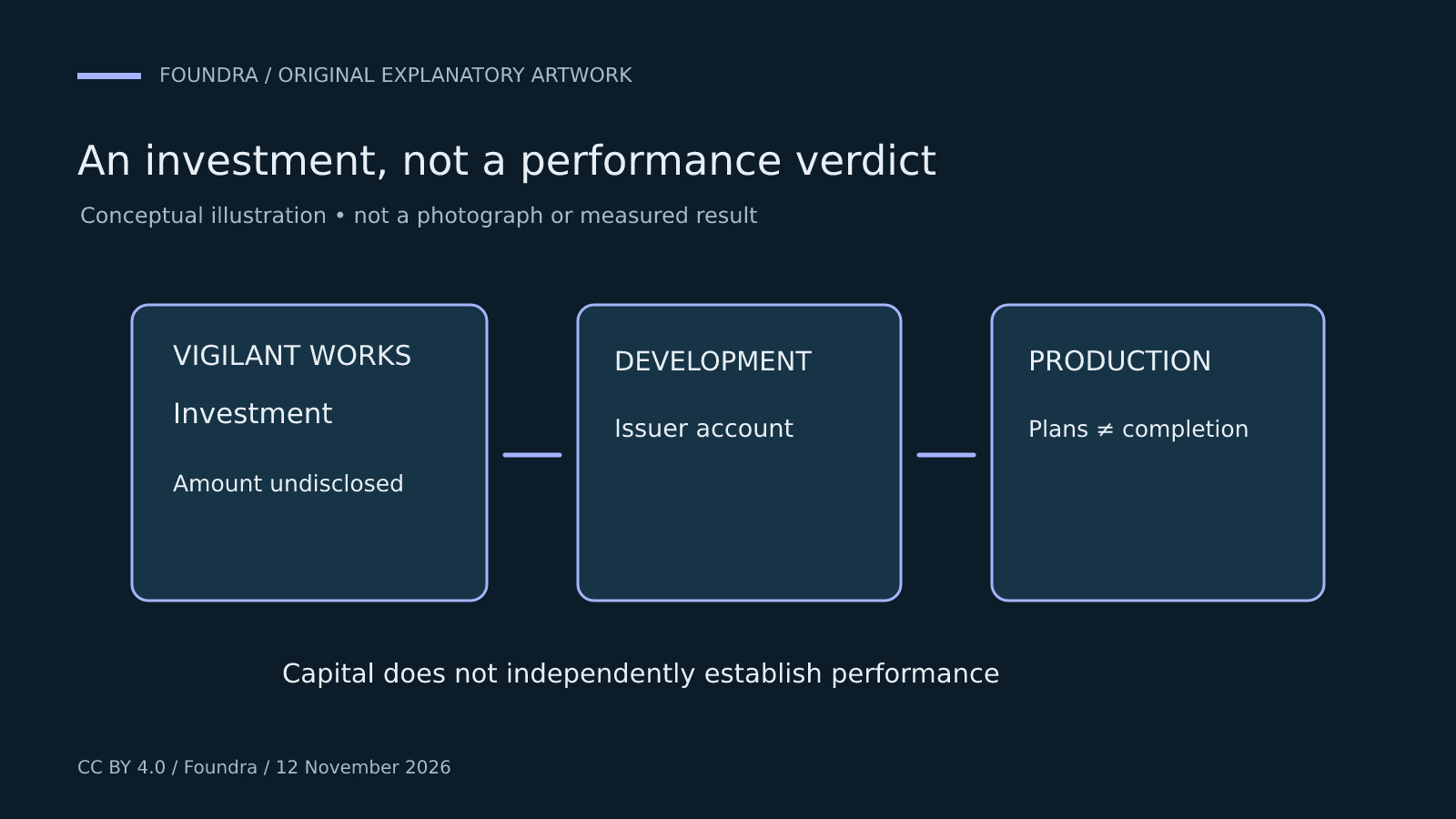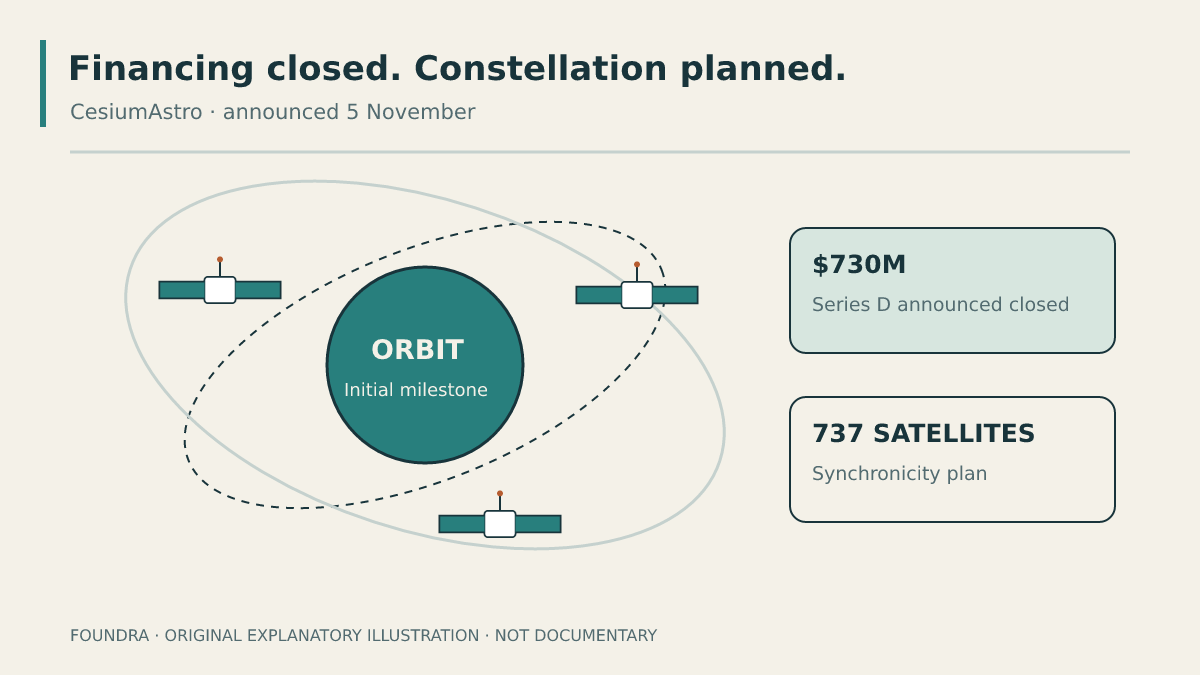
The new capital supports an infrastructure ambition; it does not establish that the proposed constellation has been deployed.
The operator sits above the supplier
CesiumAstro is putting a new commercial layer on top of its space-communications technology. Its November 5 announcement pairs a closed $730 million Series D financing with Synchronicity, a planned 737-satellite network that the company intends to develop and operate itself.
CesiumAstro's financing announcement gives a valuation above $4.5 billion and names Janus Henderson as the equity-round leader. It describes $100 million of debt financing alongside the equity financing. This article retains the release's $730 million Series D presentation rather than inventing a different aggregate amount or an equity-debt split.
The operator role is the strategic change. A supplier delivers a component or spacecraft into someone else's system. An operator combines the system into a service. CesiumAstro's proposal is to occupy more of those layers with technology it controls, while keeping the 737-satellite programme explicitly a plan rather than an existing constellation.
One architecture, several control points
In its Synchronicity description, the company outlines multi-beam, multi-frequency communications, edge processing and multi-orbit operations. It identifies Ku-, Ka- and V-band communications and says AI is intended to help allocate communications resources and adapt the network to changing requirements.
Its integration list is unusually broad: custom silicon, active phased arrays, software-defined payloads, processors, spacecraft, mission software and terminals. These are the company's architecture descriptions. They are not independently measured network-performance results.
The list reveals the organizational question within the engineering proposal. A change at one layer may need coordination with the others. Owning more of the stack creates an opportunity to make those decisions together, but also gives the operator responsibility for maintaining the interfaces between them. Integration is a specific design choice here, not a synonym for automatic reliability.
The stack CesiumAstro wants to operate
Components
The company describes custom silicon and active phased arrays.
Spacecraft
Its proposed stack includes payloads, processors and complete spacecraft.
Mission control
Mission software and AI are intended to coordinate network resources.
Service interfaces
Synchronicity plans include terminals for different customer settings.
Three acquisitions explain the expanded stack
The release identifies three businesses acquired to extend the portfolio. Jariet Technologies contributes mixed-signal semiconductor and radio-frequency capabilities; 1Aardvark contributes mission software, algorithms and systems engineering; Vidrovr contributes multimodal signal analysis and AI capabilities. These descriptions are attributed to CesiumAstro, including its claims about the benefits of the acquisitions.
The three businesses sit at different points in the proposed system. Semiconductor capabilities concern what happens inside the communications hardware. Mission software concerns how the system is directed. Signal analysis concerns what it can interpret and respond to. The acquisitions therefore help explain the breadth of the operator ambition rather than merely adding three names to a corporate history.
What remains uncertain is how those capabilities perform together in the intended service. The announcement supplies the integration thesis, not a measured comparison with another network. That limitation need not obscure the concrete change in CesiumAstro's job description: it wants to coordinate a larger technology portfolio around infrastructure it operates.
Element-1 is a different programme
CesiumAstro reports that Element-1 launched and began on-orbit operations in October 2026. It describes Element-1 as the first of eight planned Element spacecraft. Synchronicity is the separate, much larger 737-satellite ambition; the two counts should not be combined into a claim of an already deployed network.
Element provides a company-reported flight milestone for the underlying technology stack. The release's statement about its success is not an independent audit of telemetry or validation of every Synchronicity capability. Keeping the programmes named separately gives readers a more useful map of what the company says has flown and what it proposes to build.
Manufacturing becomes part of the service model
The same release describes an announced $500 million, five-year headquarters expansion in the Austin area, including the purchase of 270,000 square feet of manufacturing space. The company associates the expansion with electronics, spacecraft manufacturing, integration and testing. It is a facilities investment plan, not evidence that all the proposed production capacity is operating.
Those functions connect the financing story to the network story. CesiumAstro needs more than a communications architecture if it intends to deliver its own satellite infrastructure; it also needs an organization capable of producing, integrating and supporting it. The November 5 announcement lays out how it wants to assemble that organization. Its next phase is best followed through the named programmes and capabilities, rather than treating every number in the release as another measure of the same achievement.
Sources
- CesiumAstro newsroom ↗ CesiumAstro newsroom · Primary source
Have additional information? Request a correction.