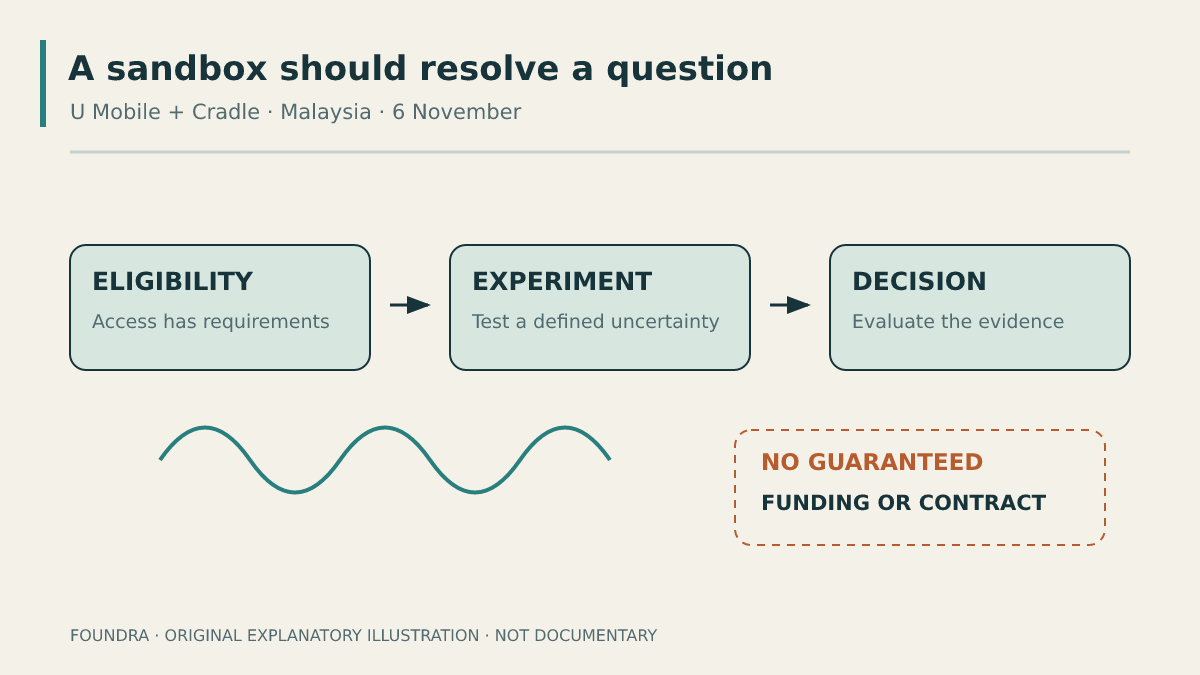
A test environment is valuable when it resolves a business uncertainty; it is not equivalent to financing or a customer contract.
The useful promise is narrower than the headline category
Startup support can mean equipment, expertise, access, introductions or money. Treating those things as interchangeable makes an announcement less useful. U Mobile and Cradle's latest collaboration is especially clear about the distinction: it offers a route toward technical testing and industry engagement, while expressly declining to guarantee funding or commercial opportunities.
U Mobile's November 6 release says its Enterprise Innovation Platform is strengthening work with Cradle to help Malaysian startups develop and validate 5G-Advanced and AI solutions. It describes a sandbox environment, technical capabilities and industry connections. The announcement distinguishes potential funding pathways from committed financing. The EIP Hub is described as an environment for eligible technical testing and demonstrations.
Under the release's access conditions, support is qualified rather than universal. Specific sandbox capabilities and support depend on relevant engagement and technical requirements. This is not a statement that every startup can immediately use every facility without conditions. The announcement identifies an opportunity and a framework, not an unconditional entitlement.
What a sandbox can settle
A good pilot begins with an uncertainty that the environment can actually help resolve. In Foundra's analysis, that might be whether a proposed application behaves adequately under a relevant network condition or whether an enterprise workflow can use its output. Those are hypothetical evaluation goals, not results U Mobile says any particular participant has already achieved.
This matters because a demonstration can look successful without answering the buyer's question. A startup could show that a system functions in a controlled setting while leaving deployment constraints or operating requirements unresolved. The appropriate next step is to identify those remaining gaps, not to present participation in the sandbox as commercial validation.
For founders, the programme's value should therefore be assessed against the work it makes possible. Access to a useful environment may save effort or expose a problem earlier, but Foundra has not measured those effects here. The reviewed release does not establish a typical cost saving, a conversion rate to contracts or a funding success rate for participants.
A pilot should produce a decision
Qualify for access
Specific sandbox support is subject to engagement and technical requirements.
Test the uncertainty
Use the environment to assess technical feasibility and business fit.
Evaluate evidence
Compare outcomes with the requirement the pilot was designed to resolve.
Decide next steps
Funding and commercial opportunities remain separate and are not guaranteed.
Access should come with an experiment plan
A hypothetical application team could prepare a short pilot plan that states the requirement, the test conditions and the decision that follows from the result. Without that plan, technical access can produce a collection of demonstrations rather than evidence. A defined experiment is also easier for a potential customer to assess than a general claim that the startup has been supported by a major partner.
The plan should distinguish technical success from commercial fit. A solution can work as intended and still fail to address a sufficiently important customer problem. Conversely, a customer may have a serious problem that the current version cannot yet solve. Industry engagement is useful when it reveals which of those situations applies, not when it simply adds a logo to a presentation.
The same discipline should apply to data and permissions. A testing environment is not blanket authority to use an enterprise's information or move from a demonstration into live operations. A startup should establish the relevant permissions and limits for its own pilot. Those are suggested diligence practices; this article is not asserting a specific data-policy deficiency in the announced collaboration.
U Mobile describes the combination of Cradle's ecosystem and potential funding pathways with its technical resources. The word potential must survive the summary. A pathway toward a financing discussion is not a committed investment, and an introduction to an enterprise is not a signed customer agreement.
That distinction does not make the initiative unimportant. Early-stage teams often need evidence before they can make a credible financing or sales case. A well-matched technical environment can help generate that evidence. The resulting business decision still belongs to the relevant investor, customer or programme, under terms this announcement does not establish.
The November 6 development is a more connected testing and engagement route for eligible Malaysian startups. Its success should be judged by what participants can demonstrate and learn, not by an assumed number of future deals. For a founder considering the opportunity, the first question should be concrete: which unresolved requirement would this sandbox allow the team to test?
Sources
- U Mobile newsroom ↗ U Mobile newsroom · Primary source
Have additional information? Request a correction.