A smaller approval interface must still make the proposed action and its consequences understandable.
The shortest gesture can carry a long consequence
A thumb movement can be small while the action it authorizes is not. Aina's newly unveiled AI ring puts that tension at the center of a consumer-hardware proposal: make interactions with agents easier without requiring people to repeatedly unlock a phone. The important question is whether easier approval also remains informed approval.
YourStory's launch report, visibly dated November 6, describes a ring combining a color display, voice commands and gesture controls. It reports a standard price of $499, with limited early-bird pre-orders starting at $399, and expected shipments in January 2027. StartupTalky's account says pre-orders opened on November 5. Pre-orders are not evidence of completed customer deliveries.
The reporting identifies Aina founder Apoorv Shankar and describes the device as an interface to agents and connected applications. Foundra did not attend the launch, speak with the founder or test the ring. Any demonstrations described by the publications remain their reporting; no claimed hands-on experience is being adopted here.
A prediction should remain a proposal
YourStory describes three interaction modes named Cues, Voice and Remote. In the company's proposition, contextual information can produce suggested actions, voice can issue commands and the ring can control connected devices. Claims that the system anticipates a user's needs are company claims, not a measured prediction result independently established by Foundra.
The distinction is especially important for actions involving another person or a transaction. As a hypothetical example, approving a message should require clarity about its recipient and content. Approving a booking should require clarity about the proposed service and cost. A device can reduce the physical effort of giving permission without reducing the information a person needs before giving it.
That creates a design question for any small agent interface. If the relevant information cannot fit comfortably on the device, the system needs some other way to convey it. A glanceable prompt may be sufficient for a familiar, reversible action and insufficient for an unfamiliar, consequential one. This is an analytical distinction, not a claim about which safeguards Aina has implemented.
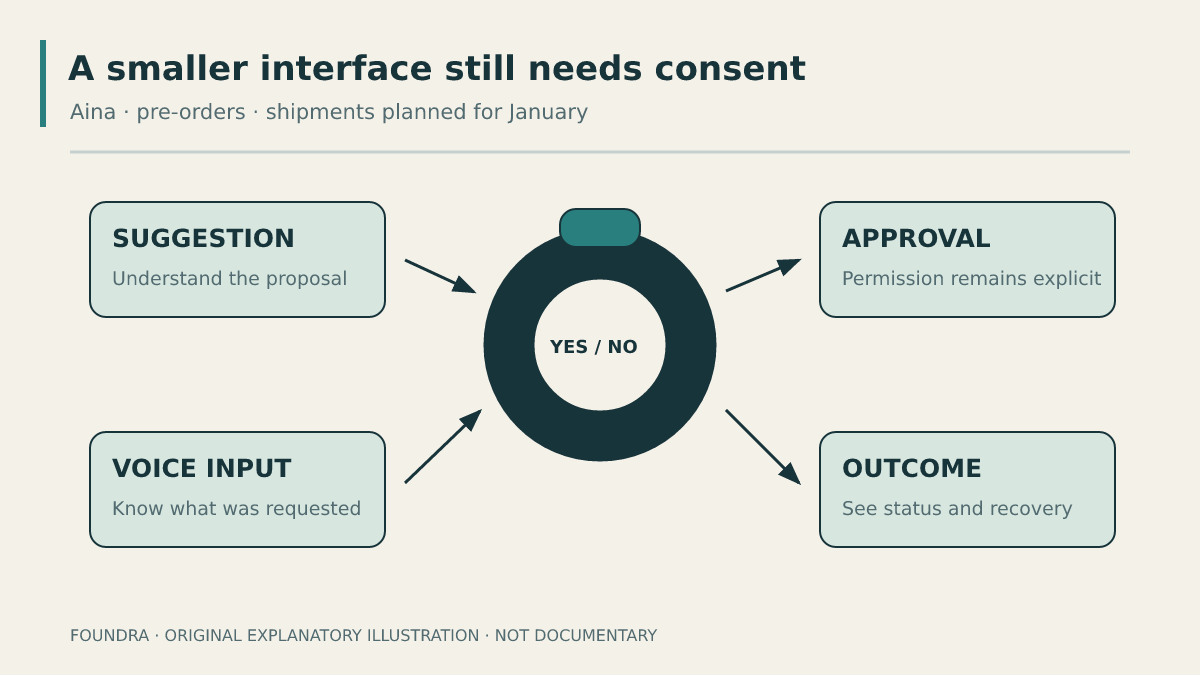
A suggestion is not permission
Context
Aina says connected-device information helps suggest an action.
Proposal
The user needs to understand the action, recipient and consequence.
Approval
A physical control can approve or reject; small size does not remove this boundary.
Outcome
An executed action still needs visible status and a recovery path.
Convenience needs a failure path
Hardware discussions often emphasize what happens when the intended gesture works. A useful evaluation should also examine ambiguous input, accidental approval and incomplete execution. A hypothetical testing program would ask whether the user can distinguish a suggestion, an accepted instruction and a completed action. Those states should not collapse into one reassuring vibration.
The same evaluation should consider recovery. A mistaken music-control action and a mistaken external communication do not have identical consequences. An agent interface therefore needs more than a general promise that actions can be approved. It needs appropriately scoped confirmation and a truthful account of what can be reversed. Foundra is proposing these criteria, not reporting test results.
Compatibility is part of the promise
YourStory says the launch materials described initial iOS and Mac support. That is a reported compatibility scope, not a guarantee that every named application or agent integration will be available in the same form at shipment. Buyers should distinguish a showcased interaction from a documented, supported integration they can actually use.
The developer proposition comes after the device proposition
The reporting also describes Aina's intention to provide an open developer platform. That could matter if outside developers find useful interactions that the startup cannot anticipate on its own. But a platform promise is not evidence of a large developer ecosystem, established application distribution or dependable support arrangements.
For a startup evaluating such a platform, the sensible questions would concern interfaces, permission boundaries, supported devices and the cost of maintaining an integration. A consumer's question is simpler: does the ring reliably improve a recurring task enough to justify another device? Neither answer follows automatically from the availability of a pre-order page.
The fresh news is the announced product and ordering stage, with shipments still planned for January. The more durable question is about the interface contract between a person and an agent. If Aina can make a proposed action easier to understand and approve, its small form factor may have a useful role. If it merely makes approval faster, the hardware would be solving only half the problem.
Sources
- YourStory ↗ YourStory
- StartupTalky ↗ StartupTalky
Have additional information? Request a correction.