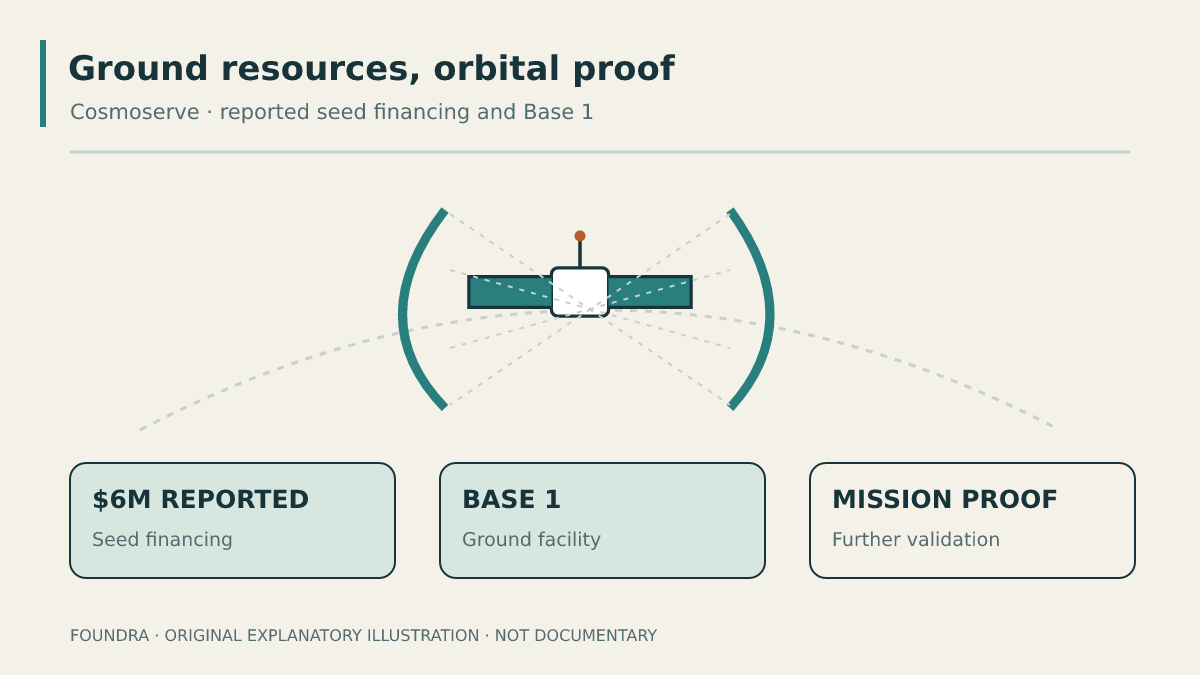
Funding and a ground facility are milestones; a repeatable orbital capture service needs separate proof.
The petals did not open
Cosmoserve's first flight test produced a mixed result. Indian Startup News reports that the capture system survived launch and that its actuation system and onboard software worked. But the robotic petals did not open in orbit. Inc42 separately reports that the petals failed to deploy as intended.
That is the technical context for the startup's latest financing, not an incidental qualification. Inc42's November 5 reporting describes a $6 million seed round led by Rebright Partners and the opening of Base 1 in Hyderabad. Indian Startup News's follow-up on November 6 corroborates the financing and supplies the more detailed account of what reportedly worked on the earlier flight.
The startup develops a soft robotic capture system intended to remove defunct satellites and orbital debris. Its company website describes that focus, but the new financing and the flight-test account in this article are attributed to the publications. Foundra has not reviewed flight telemetry or independently inspected the hardware.
What the failed deployment changes
Inc42 identifies the earlier demonstration as Mission Embrace-1, carried aboard Skyroot Aerospace's Vikram-1. The reported objective was to test the soft robotic capture system. Launch survival and functioning controls are relevant results, but the failure of the petals to deploy prevented the intended capture mechanism from completing that part of the demonstration.
The distinction is specific. It would be inaccurate to describe the whole test as proving capture, and equally inaccurate to omit the reported functions that did work. The two publications give readers a partial technical result, not a complete operational success or a blanket finding that the entire system failed.
According to Inc42, Cosmoserve founder Chiranjeevi Phanindra says the team has identified and addressed potential issues involving the thermal release mechanism and low-temperature effects. That is the startup's diagnosis and claimed corrective work. It is not evidence that a later flight has already verified the correction.
The planned repeat is Embrace-2, with an upgraded capture mechanism. Inc42 says the mission is expected in the coming months; Indian Startup News also describes a repeat flight and further demonstrations. Those are plans. This article does not assign a confirmed launch date or describe the repeat as completed.
The earlier flight: mixed reported results
Launch survival
Indian Startup News reports that the capture hardware survived launch.
Controls
The same report says actuation and onboard software worked.
Petals
Both reports describe the robotic petals failing to deploy as intended.
Repeat test
An upgraded Embrace-2 is planned; claimed fixes still need demonstration.
Why the new money has a defined task
Inc42 says the fresh capital will support technical demonstrations, two upcoming missions and the Hyderabad facility's operations. Rebright leads the reported round, with Aranya Holdings, Naandi Ventures, AUM Ventures and Shakti VC also participating. The funding is development capital for a programme with an identifiable unresolved deployment step.
Base 1 was inaugurated alongside the financing announcement, according to the November 5 report. The facility gives the story a ground-development milestone, distinct from the orbital result. A facility opening cannot resolve the failure of a mechanism to deploy in flight; it can support work toward the next attempt.
This is where the technical account makes the financing more informative. Readers know not merely that another space startup raised money, but which part of its reported demonstration needs to be repeated and why additional missions matter. The next result can be compared with the earlier deployment problem instead of being judged only against a broad promise of satellite removal.
The commercial schedule follows the test programme
Inc42 reports the founder's ambition to finish demonstrations by 2027 and begin commercial operations by 2028. Neither year is a completed operating milestone. The publication also reports letters of intent; this article does not convert those expressions of interest into paid service contracts or a forecast of mission revenue.
The relevant commercial question is how the eventual service depends on the capture programme. Cosmoserve needs evidence for the mechanism it intends to use, and an operator considering the service needs to understand what the demonstrations establish. The named repeat mission makes that dependency more concrete than a generic statement that space engineering is difficult.
The $6 million round is new funding for that work. The prior flight account is essential context: hardware survived, controls reportedly worked, and the petals did not deploy. A useful follow-up will say whether the upgraded system resolves that last failure, while retaining the same precision about which functions were actually demonstrated.
Sources
- Inc42 ↗ Inc42
- Indian Startup News ↗ Indian Startup News
- Cosmoserve company website ↗ Cosmoserve company website · Primary source
Have additional information? Request a correction.