Persistent memory needs provenance, correction and expiry—not just a bigger store of previous conversations.
The second life of a conversation
A conversation can end while its mistakes remain useful-looking. That is the uncomfortable premise behind persistent AI-agent memory: a note that helps a system avoid repeating work can also let yesterday's misunderstanding steer tomorrow's decision. The problem is not merely storing more text. It is deciding what status that text should have when it returns.
Anthropic's engineering note, published on November 6, describes a separation between capturing experience and reorganizing it later. The company discusses agents recording salient information in notes and using offline reflection, which it calls dreaming, to organize memory. These are accounts of Anthropic's engineering work, not an independent guarantee that persistent agents reliably remember everything that matters.
The distinction in its definition of agent memory is important. Anthropic means knowledge retained between sessions as readable context. It distinguishes that from changing model weights, learning within a single conversation and compaction used to keep a conversation going. An application can therefore add persistent notes without claiming that the underlying model has been retrained.
Useful context is not a new chain of command
For a startup building a customer-support agent, the practical question is whether a saved note can be traced to the ticket that produced it. Consider a hypothetical note saying that a customer has a particular entitlement. If the agent inferred that entitlement rather than reading an authoritative account record, persistence would make the inference easier to repeat, not more correct. Memory design should preserve that distinction.
This is Foundra's analysis, not a result established by the company's evaluations: a memory system needs separate rules for factual evidence, user preferences and operating instructions. A retrieved conversation is evidence about what was said. It should not silently become authority to change an account, reveal information or ignore a current constraint. The ability to recover context and the permission to act on it are different functions.
That separation also changes how teams should think about correction. Editing one note may not remove summaries derived from it, cached versions of it or later conclusions that used it. A useful correction mechanism would identify those dependencies. Otherwise a mistaken claim could disappear from the main store while continuing to influence the application through a second representation.
A memory should earn its next use
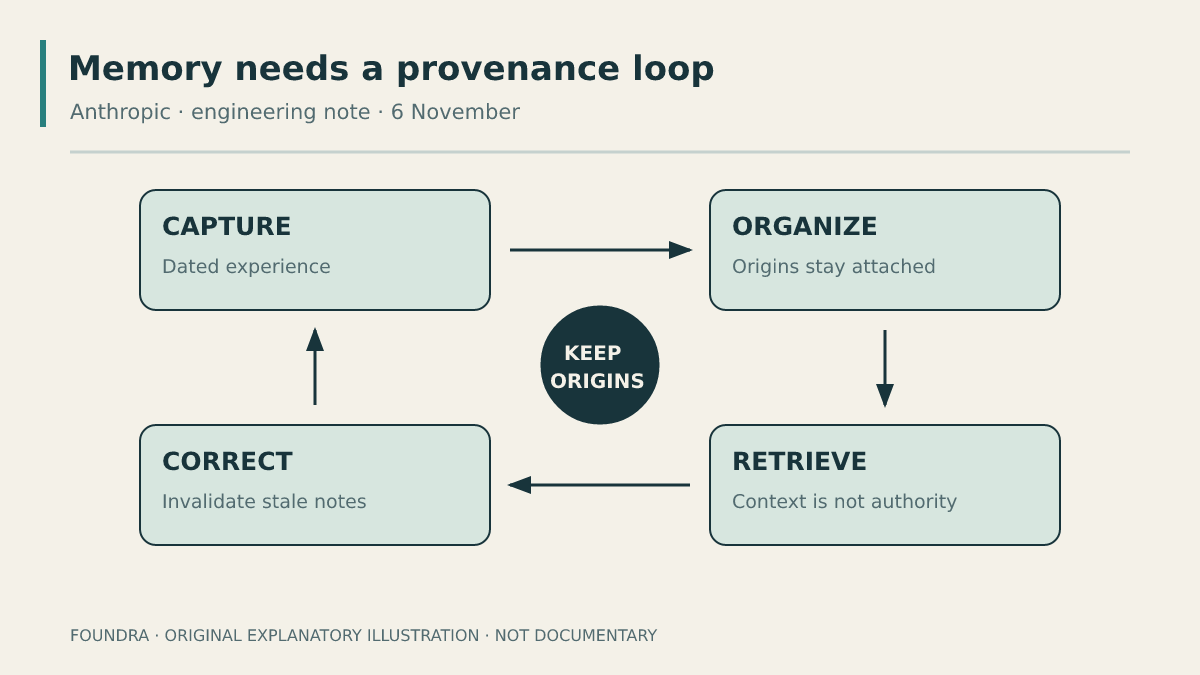
Capture
Keep a dated task record rather than treating an agent conclusion as verified truth.
Consolidate
Organize notes, retaining their origins and unresolved uncertainty.
Retrieve
Load relevant context without promoting it above current instructions.
Correct
Invalidate stale or mistaken notes and test the effect on later tasks.
What an evaluation needs to disturb
An engineering demonstration can show that relevant information was recovered. A production evaluation should also ask what happens when relevant information conflicts. A hypothetical test set could contain an outdated policy, a corrected customer preference and a misleading passage from an external document. Success would mean handling the conflict appropriately, not retrieving the largest amount of material.
Another test should change the task after a note has been written. Memory is partly a prediction about future relevance, as Anthropic explains. That prediction can be reasonable at the time and still fail when the workflow changes. Teams should measure whether the agent can recognize that a once-helpful rule no longer applies instead of rewarding consistency with an obsolete answer.
The cost of reorganizing
There is also an operational trade-off in reorganizing memory between sessions. Reflection consumes resources, and its output can require validation. A team should compare the improvement in completed tasks with the extra computation, the time spent resolving incorrect notes and the burden of explaining the system's decisions. Foundra has not measured those costs or tested Anthropic's implementation.
Remembering less, more deliberately
The product opportunity is not a universal promise of perfect recall. It is the possibility of making selected recurring workflows more coherent while keeping a visible record of what the system knows, where that knowledge came from and when it should stop using it. That is a narrower promise, but it is one a buyer can evaluate.
An enterprise pilot could start with a bounded set of repeatable tasks and a deliberate expiry policy. Notes about temporary conditions should expire differently from durable preferences, and neither should be treated as more authoritative than current account data. Those are proposed design criteria, not descriptions of controls Anthropic says it has deployed.
The November 6 note makes memory organization an engineering subject rather than a metaphor about human recollection. The next procurement question should be equally concrete: when an agent remembers something wrong, can the operator locate it, correct it and demonstrate that the correction actually changes the next task?
Sources
- Anthropic engineering ↗ Anthropic engineering · Primary source
Have additional information? Request a correction.