The lab’s progress needs mission-specific defensive evaluation, not a generic model benchmark or credit for results before delivery.
A lab defined by what it must deliver
The UK government’s new AI Biosecurity Lab has a narrower initial delivery agenda than the breadth of its name might suggest. Its original October 24 announcement identifies two priorities: detecting emerging biological threats earlier, and accelerating vaccines, treatments and other medical countermeasures.
The government says the lab will be backed by £100 million in government funding and up to £200 million in company commitments from OpenAI and Anthropic. The public amount and the ceiling on company commitments should not be merged into a claim that £300 million is already in the lab’s bank account. Nor is this a startup’s venture round.
The announcement’s structured publication timestamp is October 24 at 00:01 British Summer Time. That original date, rather than the date of a news aggregator entry, is the basis for this story. The government describes the lab as part of a National AI Biosecurity Initiative, intended to bring frontier AI and biological-science expertise together with public-sector, academic and industry partners.
Detection and response are different products
Earlier detection is valuable only when it connects to an appropriate response. A system that identifies a possible threat and a system that helps develop a medical countermeasure solve different problems. Our reading of the announcement is that placing both missions in one institution creates an obligation to define their interfaces, not an excuse to measure them with a single generic AI benchmark.
For detection, an evaluator would need to ask whether the system supplies usable information to an authorised partner. For countermeasures, evaluation would need to concern the particular development task and the evidence required to advance it. These are high-level defensive questions. The announcement does not establish a deployed detector’s accuracy or a treatment’s clinical effectiveness.
The government presents increasingly capable AI as both an opportunity for scientific progress and a source of changing biological risk. That dual framing is important. It means the lab is not being justified solely by a promise that a more capable model will make research faster. The institution also has to consider how capabilities are used, evaluated and controlled.
The announcement specifically places the work alongside the UK’s national biosecurity centres and life-sciences industry, building on the Biological Security Strategy. Those connections describe the intended institutional setting. They do not establish that every partnership is contracted or that a jointly developed capability has already been deployed.
Here, claims about future speed require special restraint. A useful research suggestion is not a validated medicine. A model result is not a completed clinical evaluation. This article does not describe experiments, pathogen manipulation or operational methods; the relevant news is the institution, its financing commitments and the defensive purposes set out by the government.
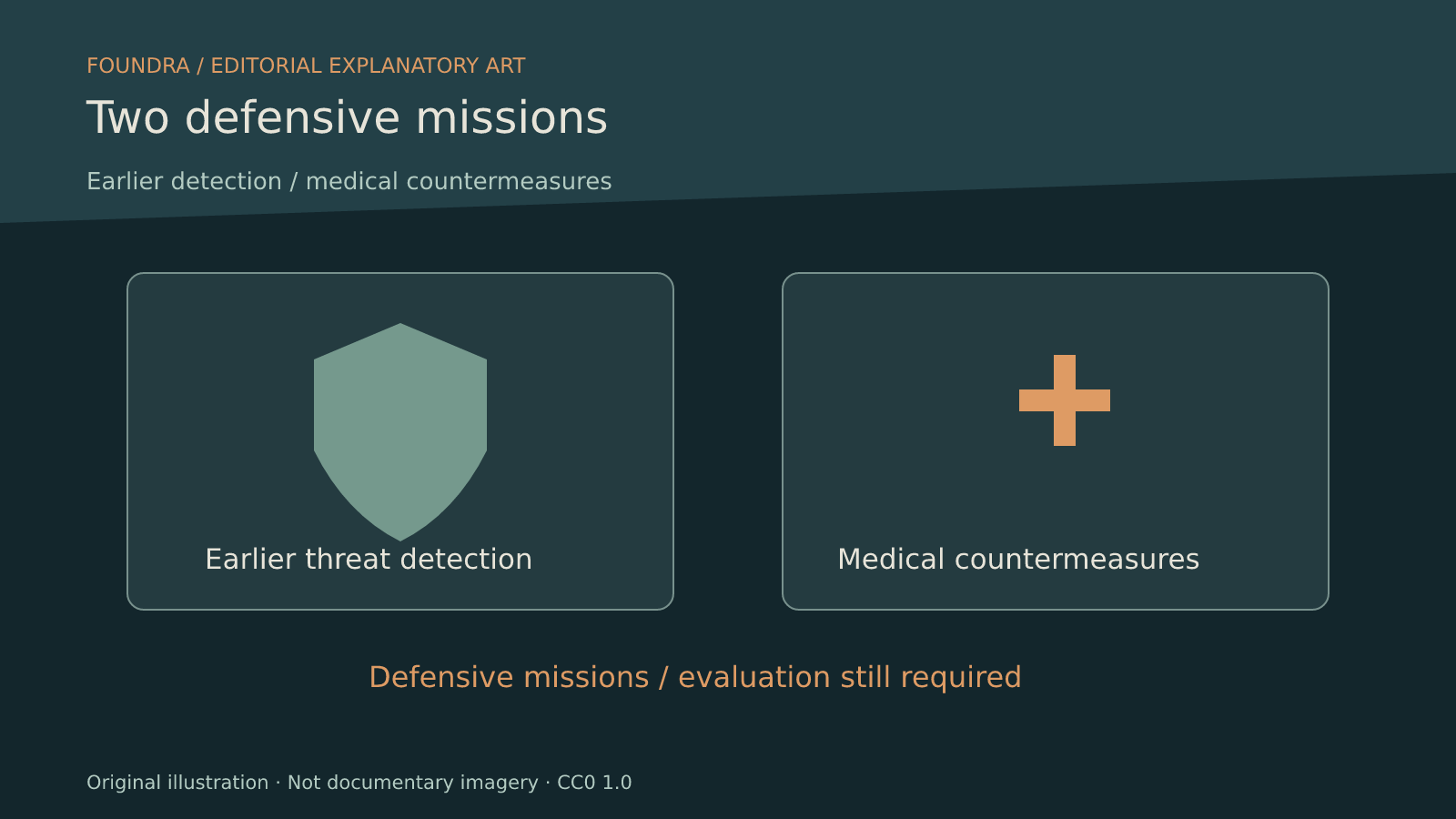
Two defensive missions
Detection
Earlier warning is an initial defensive priority.
Countermeasures
Medical development is a separate task.
Evaluation
Judge each mission with appropriate evidence.
Partnerships do not remove the need for boundaries
The intended partnership model could help connect expertise that otherwise sits in separate organisations. It also raises practical governance questions. Which partner defines a task? Who decides that an output is reliable enough to use? How is uncertainty communicated to someone making a consequential decision? These questions follow from the announced mission; they are not evidence of a governance failure at the new lab.
For startup founders working on defensive life-sciences tools, the announcement may create a relevant institutional setting to follow. It does not establish an open procurement programme, a grant available to every company or a promise that a particular vendor will be selected. No such commercial opportunity should be invented from the existence of public funding.
The company commitments are not described as cash grants. The announcement specifies £100 million in compute and model credits from OpenAI, alongside trusted model access, and up to £100 million in model credits from Anthropic, alongside trusted access and technical support. These disclosed forms of support matter: credits and access are not cash available for unrestricted spending. Detailed delivery schedules and contractual terms are not supplied here.
Britain has announced an institution with two initial defensive missions and substantial stated backing. The meaningful next evidence will be institutional and task-specific: a clear delivery programme, appropriate evaluation and outputs that authorised partners can use responsibly. That is a more demanding measure of progress than calling the lab a world first. Its news value lies in the work it is being set up to do, not in awarding it results before that work is shown.
Sources
- UK government: original October 24 AI Biosecurity Lab announcement ↗ UK government: original October 24 AI Biosecurity Lab announcement · Primary source
- UK government: October 24 broader AI plan context ↗ UK government: October 24 broader AI plan context · Primary source
Have additional information? Request a correction.