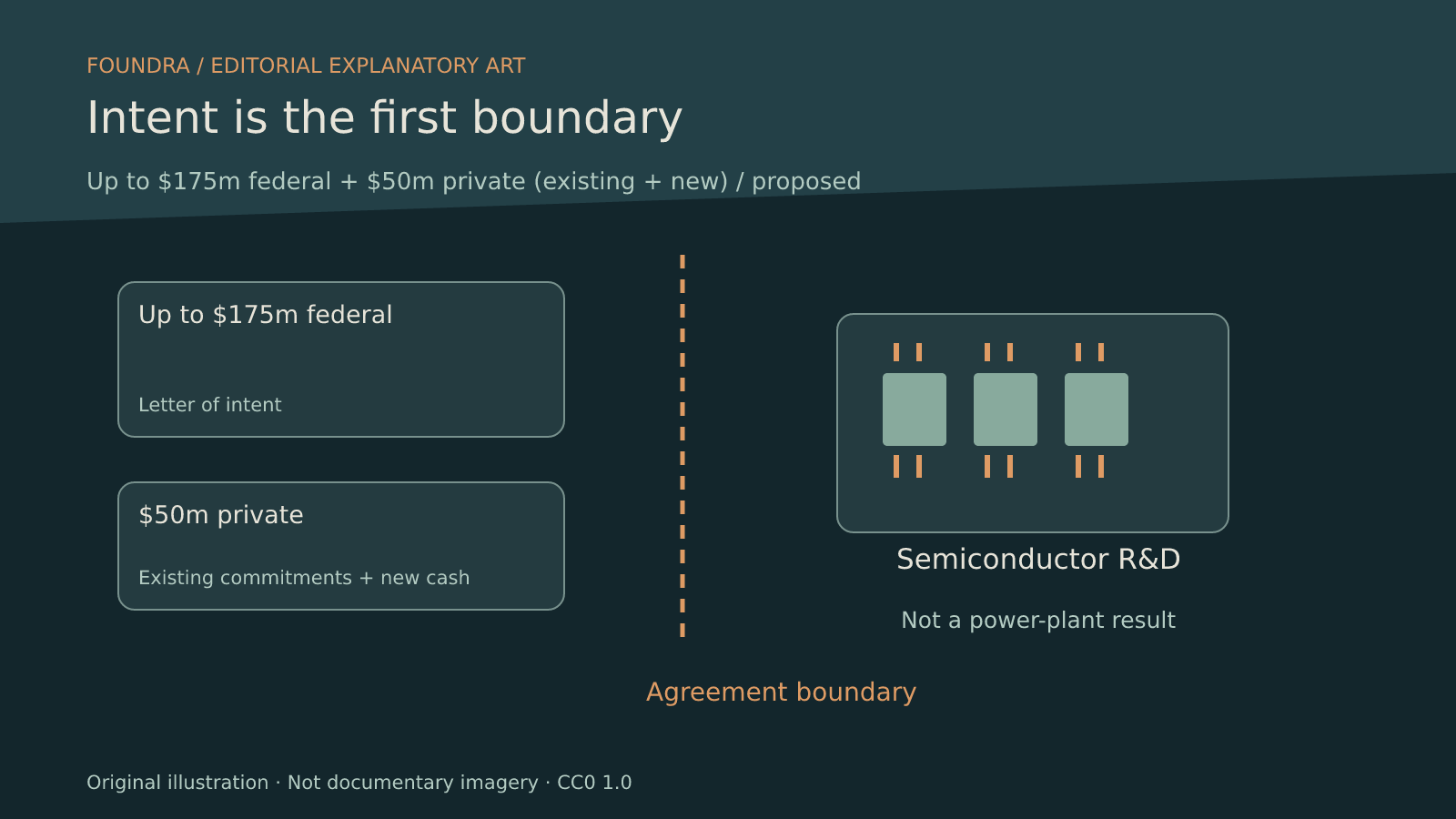
Track the award agreement, semiconductor development and eventual power-plant evidence as separate milestones.
Power modules, before the power-plant verdict
Helion’s latest announcement is about semiconductor research and manufacturing capability, not a declaration that commercial fusion electricity has arrived. On October 22, the company said it signed a letter of intent with the US Department of Commerce for up to $175 million through the CHIPS Research and Development Office.
The original Helion release describes an expected federal award alongside $50 million in private investment. GeekWire’s October 22 report clarifies that this private component includes both money already committed to Helion and new cash; CEO David Kirtley did not disclose the split. The $225 million figure is the proposed package at the maximum federal amount, not $225 million of newly closed financing or independently verified disbursements.
Helion says the work would support next-generation semiconductor technologies, advanced packaging and manufacturing capability relevant to commercial fusion. Its release names Everett, Washington, and work with an industry partner in Burlington, Vermont. These are project plans announced by the company, not sites this publication has visited or manufacturing lines it has inspected.
The bottleneck described in the release
The company’s case is that developing and manufacturing fusion systems at scale requires better semiconductor power devices and modules. Our analysis is that this shifts attention from a single experimental machine to the repeatability of the components around it. A machine that can demonstrate an effect and a supply chain that can reproduce its equipment are different achievements.
Advanced packaging is one of the named work areas. The release describes integrating multiple semiconductor devices into deployable packages. That helps explain why the proposal is not simply an order for more standard computer processors: its stated subject includes the physical organisation of devices that handle power, alongside tooling and process development.
The intended benefits include better efficiency, reliability, cost and supply-chain resilience, according to Helion. They should remain attributed objectives. We have not reviewed tests establishing the proposed modules’ performance or a manufacturing cost model proving the claimed improvements. The announcement identifies what the company wants to develop; it does not supply the completed engineering evidence.
This distinction is particularly useful in deeptech coverage. A financing or incentive can be significant because it creates a route to pursue difficult engineering. Giving it credit for completing that engineering would erase the risk that makes the programme necessary in the first place.
Intent is the first boundary
Agreement
An intent letter precedes a definitive award.
Components
Semiconductor R&D has its own milestones.
System
A power-plant verdict needs separate evidence.
There is also an ownership condition
Helion’s release says that, upon entering a definitive award agreement, the Department of Commerce would receive a $175 million non-voting interest based on the company’s most recent Series G preferred-stock valuation. That statement describes a proposed condition tied to a later agreement. It is not evidence that the government has already acquired that interest.
The condition makes this more complicated than a simple grant-versus-equity choice. The public support would be associated with an ownership interest while serving the stated R&D purpose. Without a definitive agreement, readers should not infer voting rights beyond the announced non-voting description, a final ownership percentage, or the detailed economics of the transaction.
The private component needs the same disciplined treatment. GeekWire’s interview reporting distinguishes existing commitments from new cash, so the whole $50 million cannot be called fresh financing. The reviewed sources do not disclose the split or complete transaction terms. We do not fill those gaps by assuming this is a conventional new venture round.
What would make the industrial argument persuasive
For an evaluator, the semiconductor programme offers milestones that can be examined separately from the eventual power plant. Is a device or module qualified for its intended task? Can its packaging be produced consistently? Does a manufacturing process reduce a demonstrated constraint? These are suggested evaluation questions, not reported achievements at Helion.
A positive answer to one would still not establish all the others, or prove commercial fusion economics. But progress at this layer could matter even while the larger system remains under development. That is the reason to cover the intent letter carefully rather than dismiss it as paperwork or inflate it into a completed energy breakthrough.
The announcement gives a specific account of prospective funding, intended semiconductor work and a contingent government interest. Each has its own next step. Keeping those steps separate makes the news more useful: readers can follow an industrial programme without mistaking its opening financing posture for its final engineering result.
Sources
- Helion: original October 22 CHIPS letter-of-intent announcement ↗ Helion: original October 22 CHIPS letter-of-intent announcement · Primary source
- GeekWire: October 22 potential Helion award report ↗ GeekWire: October 22 potential Helion award report
Have additional information? Request a correction.