Follow the repeatability of the detector, its tests and its integration—not just the size of the seed round.
A small round with a hardware-shaped job
For SpectraGaze Systems, external capital follows customer-funded engineering. Indian Startup News describes the Ahmedabad company spending its first three years on programmes financed by customers before taking its first outside round. That sequence puts a specific question behind the new money: which parts of programme-by-programme development can become a repeatable product business?
Ahmedabad-based SpectraGaze Systems has raised ₹3.7 crore in seed funding led by GVFL, with angel participation, according to YourStory’s October 23 roundup and an October 24 Indian Startup News report. Both identify the business as a developer of optical imaging sensors and electro-optical payloads for space, defence and scientific applications. This is a financing report, not evidence that a new satellite or defence system has entered service.
The reports say former ISRO scientist Arup Banerjee founded the company in 2023. They describe customer-funded programmes preceding the external round and plans to strengthen engineering, product development and testing. That combination makes the announcement more interesting than the size of the cheque alone: it places capital behind the work of turning customer-specific engineering into a more repeatable business.
YourStory lists ISRO, the Physical Research Laboratory and Kaynes Technology as customers, and reports an infrared detector and test-system delivery to ISRO. These are reported customer relationships rather than procurement documents examined by Foundra. Their relevance is that the business is described through specific engineering programmes, not merely through an undifferentiated promise to enter the space market.
The product is also the evidence around it
Consider a hypothetical instrument buyer comparing two detectors. A promising specification might open the conversation. It would not, by itself, answer whether either detector behaves consistently, can be integrated into the buyer’s system, or will arrive with sufficient documentation to diagnose a problem. Those are separate questions, and their answers need not improve at the same pace.
This is the useful lens for reading SpectraGaze’s funding. The reported spending priorities include testing infrastructure and existing customer projects. In our analysis, these are not incidental expenses around a finished product. They can be part of what makes an optical component commercially usable. A buyer needs to evaluate an instrument, not just a fundraising story about one.
The same distinction matters when a startup presents customer relationships. Both reports name institutional customers, but this article does not independently verify their procurement records or infer the scope of those relationships. A reported delivery or development contract should not be converted into a claim that every product is qualified for every application. Nor does an institutional customer establish that the supplier has solved manufacturing at larger volumes.
There is a second tension here. Custom work can reveal what customers genuinely need; it can also pull a small engineering team in several directions. The commercial question is which parts of that work become reusable: a detector design, a calibration method, an interface, or a test procedure. We cannot determine that balance from the announcement, and the round should not be read as if it provides the answer.
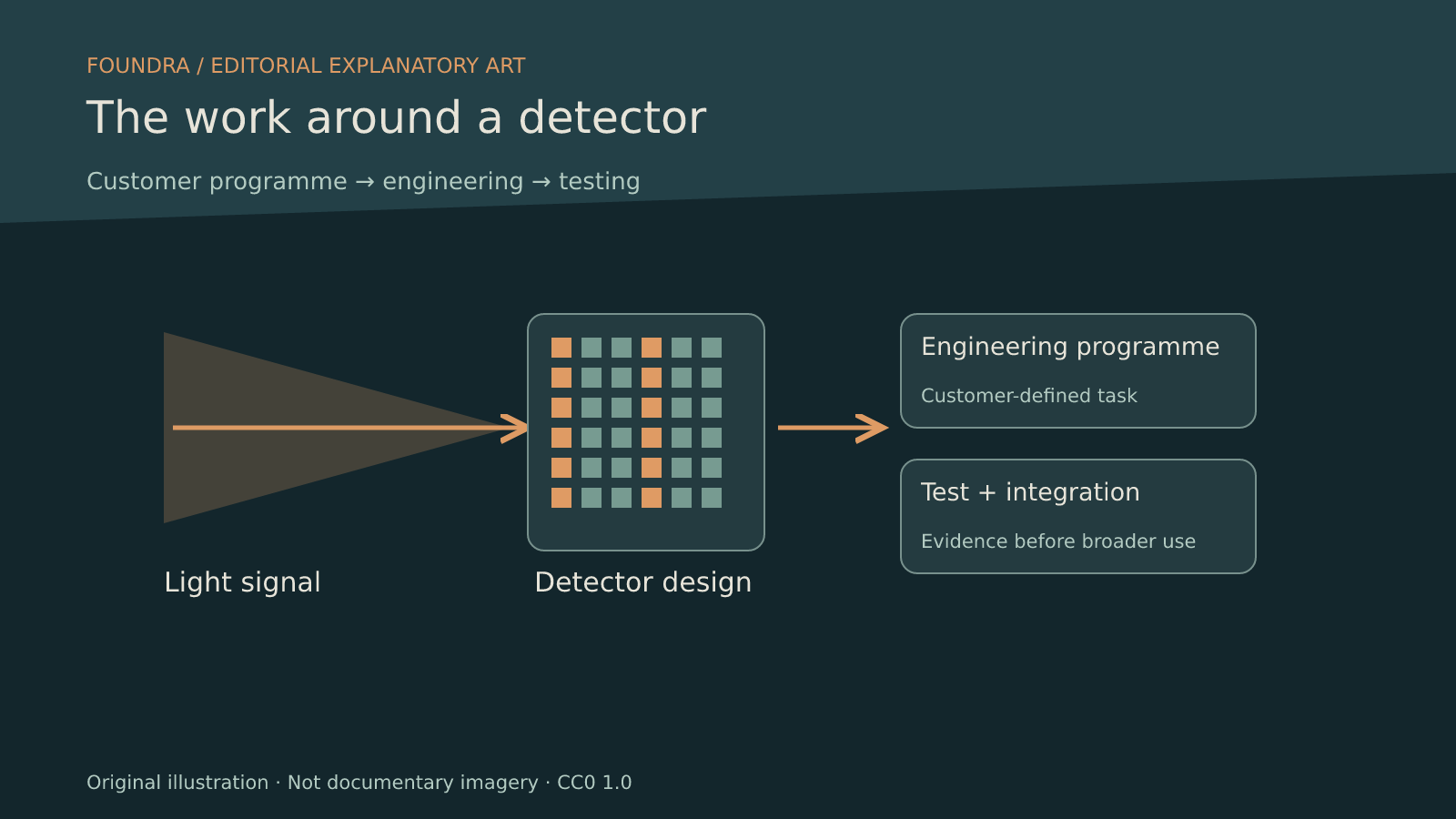
The work around a detector
Programme
Define the customer’s instrument task.
Engineering
Develop the component and integration.
Evidence
Test before expanding the claimed application.
What indigenous capability would have to mean
The company’s stated ambition, as reported by Indian Startup News, is to reduce reliance on imported imaging technology. That is a goal, not a demonstrated supply-chain outcome. Local design, domestic manufacturing, component sourcing and continuing technical support are different dimensions of capability. A product might make progress on one without resolving the others.
For founders building similarly specialised hardware, the lesson is therefore about sequencing rather than nationalism as a sales pitch. A credible route might start with a tightly defined customer problem, proceed through verified performance in that application, and only then widen the product’s addressable uses. This is an analytical framework, not a description of milestones SpectraGaze has already completed.
The ₹3.7 crore round buys the possibility of moving that sequence forward. Its significance will depend on what becomes repeatable after the money is spent: consistent components, clearer integration, more robust testing, or a stronger delivery process. None of those outcomes should be credited in advance. The next useful evidence will be about the detector and the system around it, rather than a bigger number attached to the company.
Sources
- YourStory: October 23 original startup roundup ↗ YourStory: October 23 original startup roundup
- Indian Startup News: SpectraGaze seed financing report ↗ Indian Startup News: SpectraGaze seed financing report
Have additional information? Request a correction.