Restaurant expansion should be followed through the connection between storefronts and the production system behind them.
Dining and bakehouse are different formats
Harajuku Tokyo Café’s reported $3 million pre-Series A is financing an expansion plan with two food-service formats, not simply more copies of one restaurant. Entrackr’s October 23 report distinguishes the full-service café from Harajuku Bakehouse, a quick-service format for Japanese breads, desserts and savoury snacks.
Indian Startup News’s October 22 report and Entrackr say Zero W led the round, with Indian Angel Network and Samved VC participating again. The latter two co-led a $2 million seed round in August 2025. That earlier financing is background, not another fresh event for this edition.
The company’s ₹100 crore revenue ambition for the current financial year is a target, not a verified result. StartupTalky’s October 22 roundup also lists the $3 million pre-Series A; that corroborative listing should not be confused with independent examination of the financing contracts.
What management says the next phase contains
The reports describe intended spending on outlets, central kitchens, teams and operations. Entrackr reports a plan for ten outlets over the next two quarters, alongside entry into Bengaluru and Chandigarh. It says the company aims to operationalise central kitchens in Mumbai and Bengaluru by December 2026. That is a target deadline, not a verified opening month. These are announced plans, not facilities Foundra has verified as open.
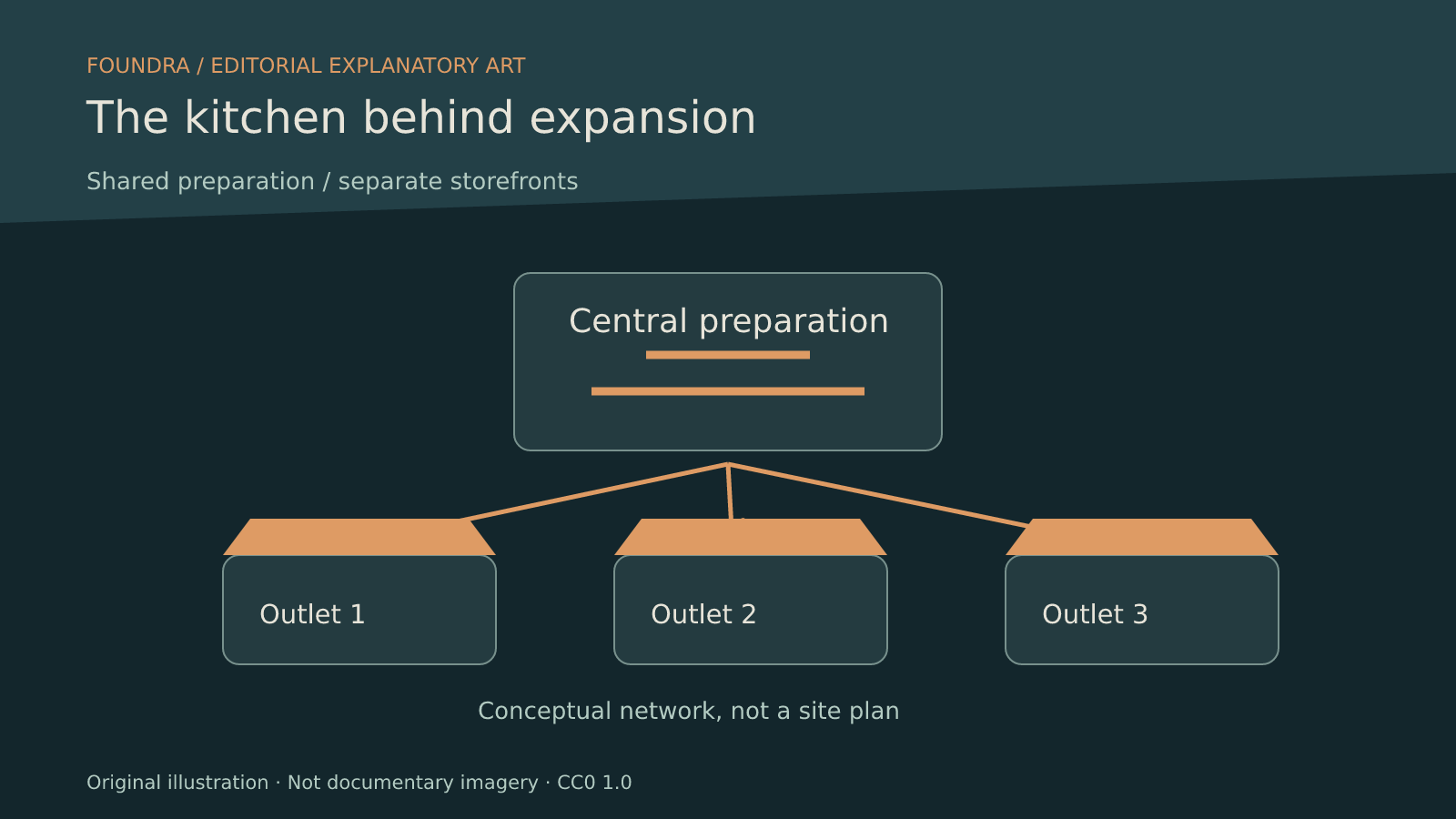
Entrackr says the proposed kitchens would supply Bakehouse outlets and support packaged-food production for western and southern India. That detail connects a specific part of the operating plan to a specific format. It also explains why a kitchen investment belongs in a story whose visible face is a café brand.
Our reading is that the two formats should be evaluated separately even if they share capabilities. A full-service meal and a quick-service bakery purchase create different service expectations. A shared production network may support the second without making its operating model identical to the first. This is a comparison of the announced formats, not a finding about their profitability.
The kitchen behind expansion
Preparation
Decide which work belongs centrally.
Outlets
Preserve the intended customer experience.
Evidence
Distinguish expansion plans from open sites.
Keep the plan separate from trading results
The reviewed reporting does not give audited financial results or a complete allocation of the new money. We do not convert the dollar round to a fixed rupee figure without a stated exchange-rate basis, or infer that all the proceeds have already been spent.
The next meaningful update would identify which announced facilities and outlets actually begin operating, and how they connect to the intended formats. Revenue targets and an outlet plan can describe the direction of travel; they cannot establish consistency, service quality or sustainable unit economics on their own.
This bounded brief follows the financing and the concrete expansion plan. It does not offer an unsupported verdict on the restaurant network. The distinction between café, bakehouse and production infrastructure is already more informative than treating every planned location as the same growth unit.
Sources
- Indian Startup News: original October 22 Harajuku report ↗ Indian Startup News: original October 22 Harajuku report
- Entrackr: October 23 Harajuku financing corroboration ↗ Entrackr: October 23 Harajuku financing corroboration
- StartupTalky: October 22 funding roundup ↗ StartupTalky: October 22 funding roundup
Have additional information? Request a correction.