Signing a transaction and validating a hiring system are different tasks; neither should be treated as complete in advance.
An agreement, not a completed acquisition
Dayforce announced on October 23 that it signed an agreement to acquire Ribbon AI. The original Dayforce release is explicit about that status. BetaKit’s same-day report says the purchase price and completion timeline were not disclosed. This article therefore does not report the acquisition as closed or attach an invented valuation to it.
The buyer says Ribbon would add agentic recruiting capabilities, including conversational voice and video technology for interviews. Its announced product direction is to connect sourcing, screening and candidate engagement. That is the business significance of the agreement: a specialised recruiting tool could become part of a broader human-capital platform rather than remain a separate step in the hiring workflow.
Dayforce describes Ribbon as capable of generating interview questions and a scoring rubric from a job description and relevant past interviews. It says the product evaluates candidates using interview transcripts. These are company descriptions of the technology, not findings from a Foundra product test. We have neither conducted candidate interviews with it nor established the validity of its assessments.
Moving a tool changes the accountability question
Our analysis is that the importance of this deal lies partly in where an output goes next. A standalone interview summary might be reviewed by a recruiter. A deeply integrated assessment can potentially influence a larger sequence of decisions. Integration makes it more important to understand what the output represents and what a human decision-maker can challenge.
An interview transcript and an assessment score are different artefacts. The transcript records material that can be inspected; the score interprets it according to some criteria. A responsible evaluation would ask whether those criteria fit the job and whether the supporting evidence is visible. This is an analytical standard, not a claim that Ribbon currently meets or fails it.
Dayforce’s release also describes integrity checks involving audio, gaze and response timing. It presents these as ways to detect unusual patterns. That marketing description should not be converted into a finding that the system can establish dishonesty. An unusual pattern is not, by definition, evidence of misconduct, and an automated signal requires appropriate interpretation.
The possible advantage of integration is that context and review can travel with the output. The possible risk is that an apparently convenient score moves through a workflow without enough scrutiny. Which outcome occurs would depend on actual configuration and use, neither of which can be determined from an acquisition announcement.
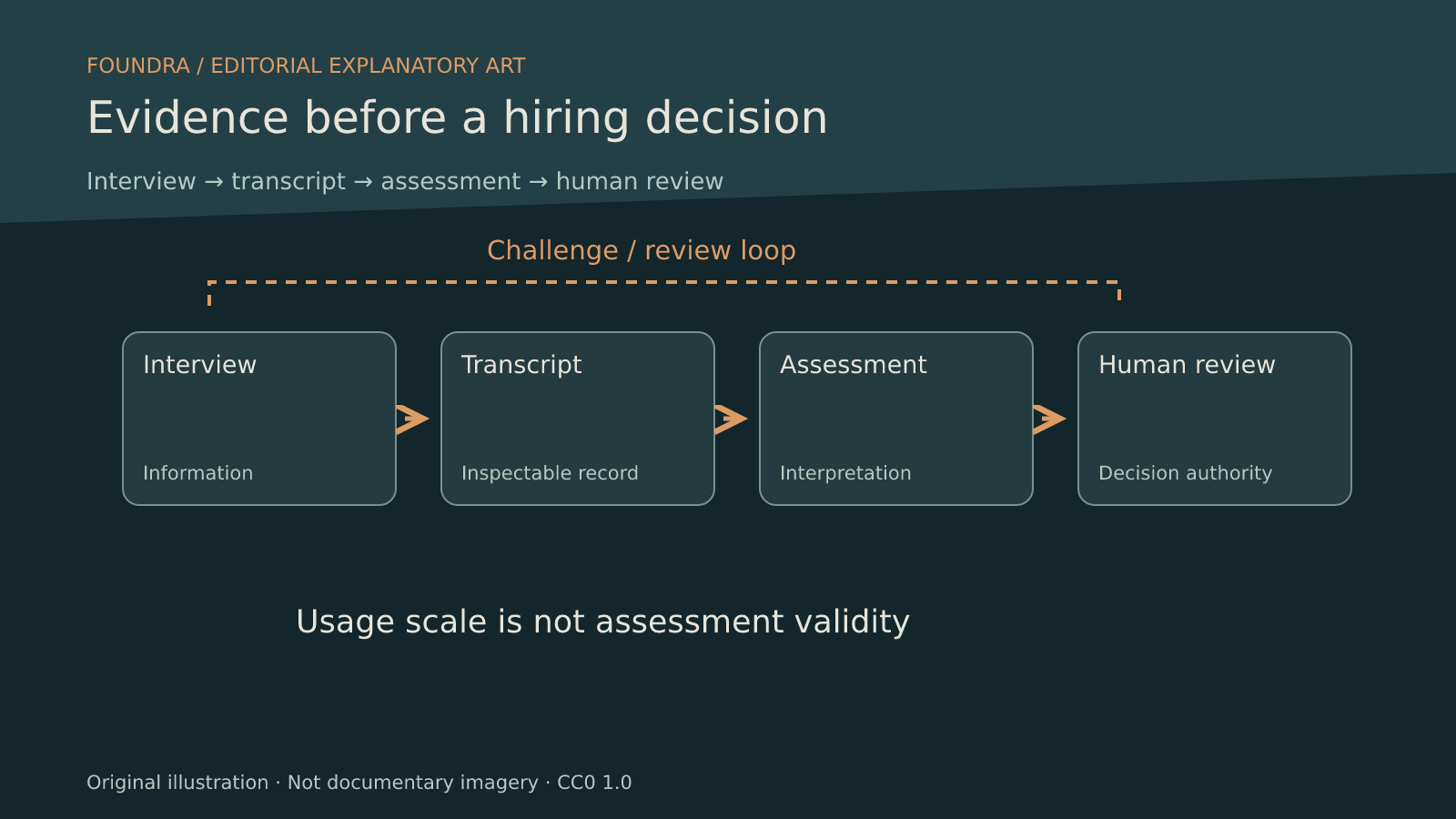
Evidence before a hiring decision
Transaction
An acquisition agreement is not a closed deal.
Evidence
A transcript differs from a score.
Authority
Human review remains a diligence question.
Scale does not validate a hiring decision
Dayforce says Ribbon has completed more than one million interviews and serves hundreds of customers. Those are attributed company claims. They describe asserted usage, not independently verified assessment quality, candidate satisfaction or fairness. This article does not treat them as proof of those different outcomes.
The distinction is particularly important for high-volume recruitment. Faster screening may be useful, but a useful product must still be evaluated against the task. A recruiter would need to know what information is being collected, how it is interpreted and what happens when a candidate cannot use the expected interaction mode. Those are suggested diligence questions, not undocumented observations about candidates on Ribbon.
Nor should automation be described as replacing every human hiring decision. Dayforce frames the technology as taking on manual, time-sensitive work while recruiters focus on engagement and decisions. That is the company’s intended division of work. The precise responsibilities after integration remain something to verify through the delivered product and customer practice.
Examine the artefacts in order
A product evaluator can separate three questions without assuming access to the system. First, what did the candidate actually say? Second, how did the tool interpret that material against the job? Third, how did the employer use the interpretation? The first concerns a record, the second an assessment method and the third a decision process. A convincing answer at one layer does not establish the quality of the other two.
In a hypothetical disagreement, a recruiter might find that an assessment overlooks relevant experience described in the transcript. A reviewable workflow would need to make that discrepancy visible and allow an authorised person to respond. This is an illustration of why preserving evidence matters, not a reported incident involving Ribbon or a claim about an existing override feature.
The acquisition announcement is consequently not enough to choose a recruiting configuration. It tells readers what capabilities the buyer wants to add. It does not supply the employer’s policy, the evaluation evidence for a particular role or the candidate-facing process. Those would be necessary inputs to a separate implementation decision. Reading the deal at this level avoids conflating a larger distribution channel with a more valid hiring judgment.
The next evidence has two layers
The transaction needs its own follow-up: a completion announcement or other verified change in status. The product needs a different one: what Dayforce actually integrates, how users review the output and which features become available to which customers. Signing the agreement settles neither layer in advance.
For founders in recruiting software, the development illustrates a route from a specialised workflow into a larger platform. For employers, it highlights a more concrete question than whether hiring is becoming agentic: does the system preserve the evidence, context and human authority needed for a defensible decision? That is the standard by which the promised integration should be examined, once there is an integration to examine.
Sources
- Dayforce: original October 23 Ribbon acquisition-agreement announcement ↗ Dayforce: original October 23 Ribbon acquisition-agreement announcement · Primary source
- BetaKit: October 23 Ribbon agreement report ↗ BetaKit: October 23 Ribbon agreement report
Have additional information? Request a correction.