The allocation, application process, fund selection and startup investment are distinct stages—not a closed C$1.75 billion round.
What changed on October 22
Canada’s October 22 announcement combines a newly opened application process with a clearer allocation of startup investment support. It should not be read as a closed C$1.75 billion financing round for Canadian companies, or as if every dollar represents a new budget commitment made that day.
Innovation, Science and Economic Development Canada announced C$1 billion for the Venture and Growth Capital Catalyst Initiative, or Growth VCCI, and opened expressions of interest for its Fund-of-Funds stream. The release also sets out the C$750 million Early and Growth Stage Investment Strategy. The separate strategy page notes that the latter was announced in Budget 2025; BetaKit’s October 22 reporting describes the newly revealed breakdown.
The fresh October 22 developments are the fund-of-funds call and the newly detailed C$750 million strategy breakdown. BetaKit reports that Growth VCCI’s commitment was initially announced in late 2024 and its three-stream allocation was revealed earlier in 2026. These programmes are intended to work with private capital; this announcement is not evidence that managers are selected, expected private money has arrived or startups have received investments.
Compare the routes, not just the totals
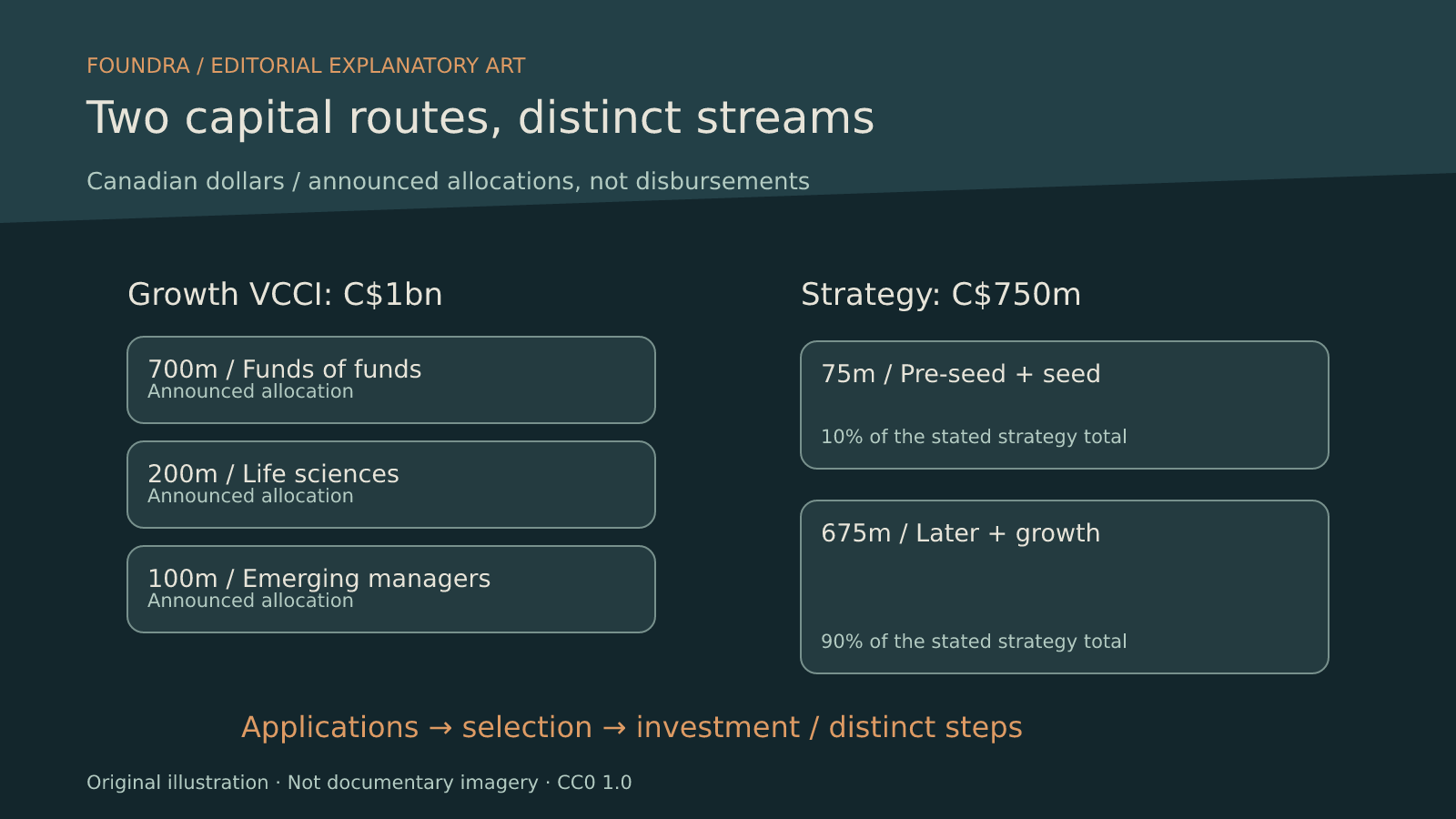
Growth VCCI has three announced streams: C$700 million for funds of funds, C$200 million for life sciences and C$100 million for emerging managers. The C$750 million strategy has two: C$75 million for pre-seed and seed investment, and C$675 million for later and growth stages. These are separate programme architectures, even though they appear together in the announcement.
The difference matters for a founder reading the headline. A fund-of-funds programme directs capital through intermediaries rather than functioning as a simple application for a company’s next round. A life-sciences stream has a sector purpose. An emerging-manager stream concerns who is building investment capacity. Adding these amounts together conveys scale, but it does not tell a particular startup which route is relevant to it.
Within the C$750 million strategy, C$675 million is 90 percent of the stated total, calculated directly from the government’s allocations. The weighting makes the later-stage emphasis visible without requiring a claim that the remaining early-stage allocation is unimportant. They address different points in a company’s development, and the quality of their deployment will matter as much as the split.
Our interpretation is that the policy is trying to strengthen both the pipeline of young companies and the capital available when companies become more expensive to scale. That is the announced policy intention, not a finding that the financing gap has already been closed. A government allocation and an investable fund are different steps in the process.
Two capital routes, distinct streams
Allocation
Read the two programme architectures separately.
Applications
The fund-of-funds call targets intermediaries.
Deployment
Selection and actual investment follow later.
The intermediary is not a minor detail
A fund of funds invests through other funds. That structure inserts another selection layer between the public programme and a company seeking capital. In our analysis, the policy’s effect therefore depends not only on the announced amount but on which managers are selected and how the subsequent investment decisions are made. This is a description of the route, not a prediction about a particular manager’s performance.
The Life Sciences and Emerging Manager streams introduce different priorities within Growth VCCI. The government describes the first in terms of Canadian venture fund managers supporting life-sciences companies, and the second as support for emerging fund managers, including those outside traditional venture hubs. Neither description means that every eligible organisation has an allocation, or that the same assessment process applies across all streams.
For a founder, this distinction can prevent a common reading error: turning the existence of a policy programme into a near-term financing assumption. The relevant relationship may eventually be with a selected investment manager, rather than with the government call itself. Until those selections and commitments are evidenced, the announced support should not be counted as cash available to a particular business.
The programme can still matter at this earlier stage. Clearer allocations and an open call give potential intermediaries a more concrete process to examine. The point is to recognise that operational development without claiming the later investment outcomes. That is a useful middle ground between treating the announcement as merely a headline and treating it as completed fundraising.
An open call is an operational milestone
The Fund-of-Funds expressions-of-interest call is the part of the announcement with an immediate application process. The official release says it is open until January 21, 2027. The reviewed call document supplies detailed terms for fund-of-funds applicants; it should not be recast as a direct startup grant or as a promise of approval to any applicant.
There is also a consultation on the later- and growth-stage design, with written feedback invited until November 23, 2026. Consultation and investment deployment are not the same thing. The existence of a feedback period indicates that some design work remains a matter for stakeholder input, rather than a finished transaction announced to a portfolio company.
The government says the two programmes are anticipated to attract and leverage at least C$3.8 billion in private capital. That is a forecast stated in the announcement. It is not a measured fundraising result, and this article does not infer the final size or performance of any participating fund from it.
What founders can actually take from the announcement
The useful immediate exercise is to identify the stage, sector and intermediary involved in each route. A founder’s interest in early funding does not make a fund-of-funds call directly accessible to that company. A later-stage business likewise cannot treat a policy allocation as capital committed to its own balance sheet.
The next evidence should concern programme design, selected managers and actual investment commitments. Later still, the question becomes whether those investments help companies build durable businesses. That sequence keeps policy ambition separate from results without dismissing the significance of opening a route for capital.
Canada has supplied a more concrete map, not a completed journey. Reading the streams separately makes that map usable: it shows which institutional mechanisms are being pursued, which part is now accepting applications and where further design and deployment still have to happen.
Sources
- ISED Canada: original October 22 Venture and Growth Capital Plan release ↗ ISED Canada: original October 22 Venture and Growth Capital Plan release · Primary source
- ISED Canada: Early and Growth Stage Investment Strategy ↗ ISED Canada: Early and Growth Stage Investment Strategy · Primary source
- ISED Canada: dated fund-of-funds call terms ↗ ISED Canada: dated fund-of-funds call terms · Primary source
- BetaKit: original October 22 capital-programme report ↗ BetaKit: original October 22 capital-programme report
Have additional information? Request a correction.