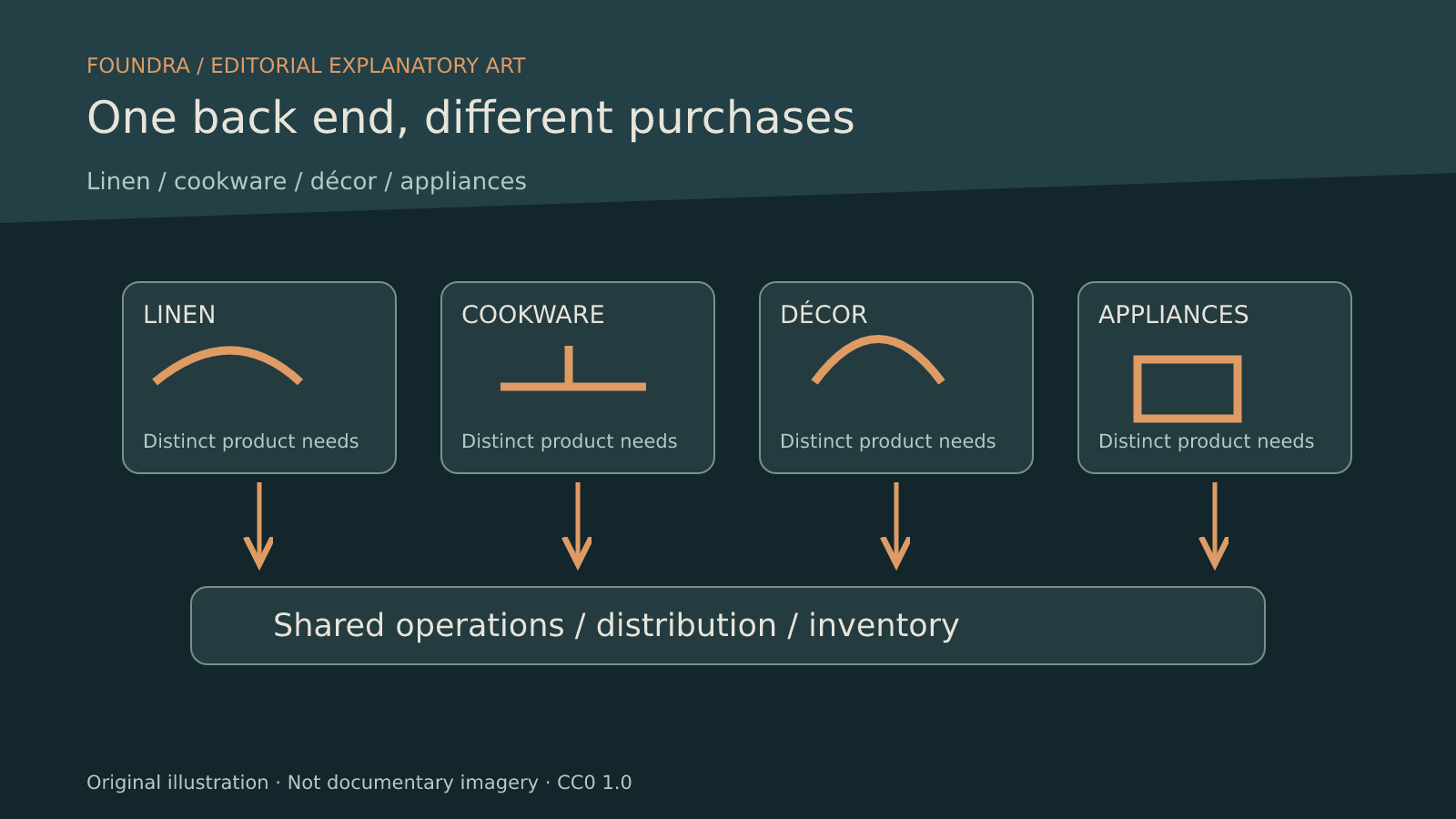
Shared operations and distinct product propositions are different tests for a multi-category home portfolio.
HOKIPO is the starting point
Chapter Home’s reported ₹63 crore financing supports a home-and-kitchen business whose first launched category is home furnishings through HOKIPO. Entrackr’s October 22 report places that brand inside a broader plan for several consumer categories. This is not a report that every category in the plan is already operating at the same scale.
The financing combines equity and debt, according to Entrackr and Indian Startup News. The reports name Bessemer Venture Partners, Stride Ventures, Tanmay Bhat and family offices among participants, and put the valuation close to ₹1,000 crore. The precise pre-money or post-money mechanics and the debt/equity breakdown are not disclosed in the reviewed reports.
Founded in 2025 by former PharmEasy executives, the company is reported to be pursuing a shared operating platform rather than a completely separate organisation for each brand. The funding priorities include product development, new categories, technology, brand building and distribution. Initial physical retail touchpoints are planned, not independently verified as open by this publication.
Shared infrastructure is different from a shared identity
Entrackr describes the platform’s functions as sourcing, supply chain, content, technology and distribution. Indian Startup News’s report describes the company organising brands for different parts of the home. These accounts give a more concrete basis for understanding the portfolio than simply labelling it a collection of direct-to-consumer products.
Our comparison is between what can be shared operationally and what still needs a distinct product proposition. A sourcing or distribution capability can be useful to several brands without making their customers’ reasons for purchasing identical. Home furnishings and cookware belong in related shopping territory, but the portfolio still needs to explain the value of each product.
The reported product and channel plans should be kept in that development context. They do not establish that every new brand is launched, that all announced channels are available or that shared capabilities have already produced a particular cost advantage. Those are outcomes to evaluate separately from the financing.
One back end, different purchases
Products
Different categories solve different purchases.
Operations
Identify genuinely shared capabilities.
Retail
Test what a physical channel teaches.
The retail move is still a plan
The proposed physical touchpoints add a different channel to examine alongside the digital business. For a home-product company, a physical presentation can make materials and dimensions easier to compare. Whether that benefit outweighs the cost and complexity of a location is an analytical question; the reports do not supply store economics that would settle it for Chapter Home.
This is why the reported valuation is not the most useful operating measure in the announcement. The practical development agenda is to connect the existing starting category, the shared platform and the proposed new channels. The financing gives the company capital to pursue that agenda, but it does not establish its completion.
The story is deliberately bounded to those reported developments. No audited revenue, category-level profitability, debt terms or completed store rollout is available in the reviewed evidence. A broader verdict about the portfolio would go beyond what these financing reports support.
Sources
- Entrackr: original October 22 Chapter Home report ↗ Entrackr: original October 22 Chapter Home report
- Indian Startup News: Chapter Home financing report ↗ Indian Startup News: Chapter Home financing report
- StartupTalky: October 22 funding roundup ↗ StartupTalky: October 22 funding roundup
Have additional information? Request a correction.