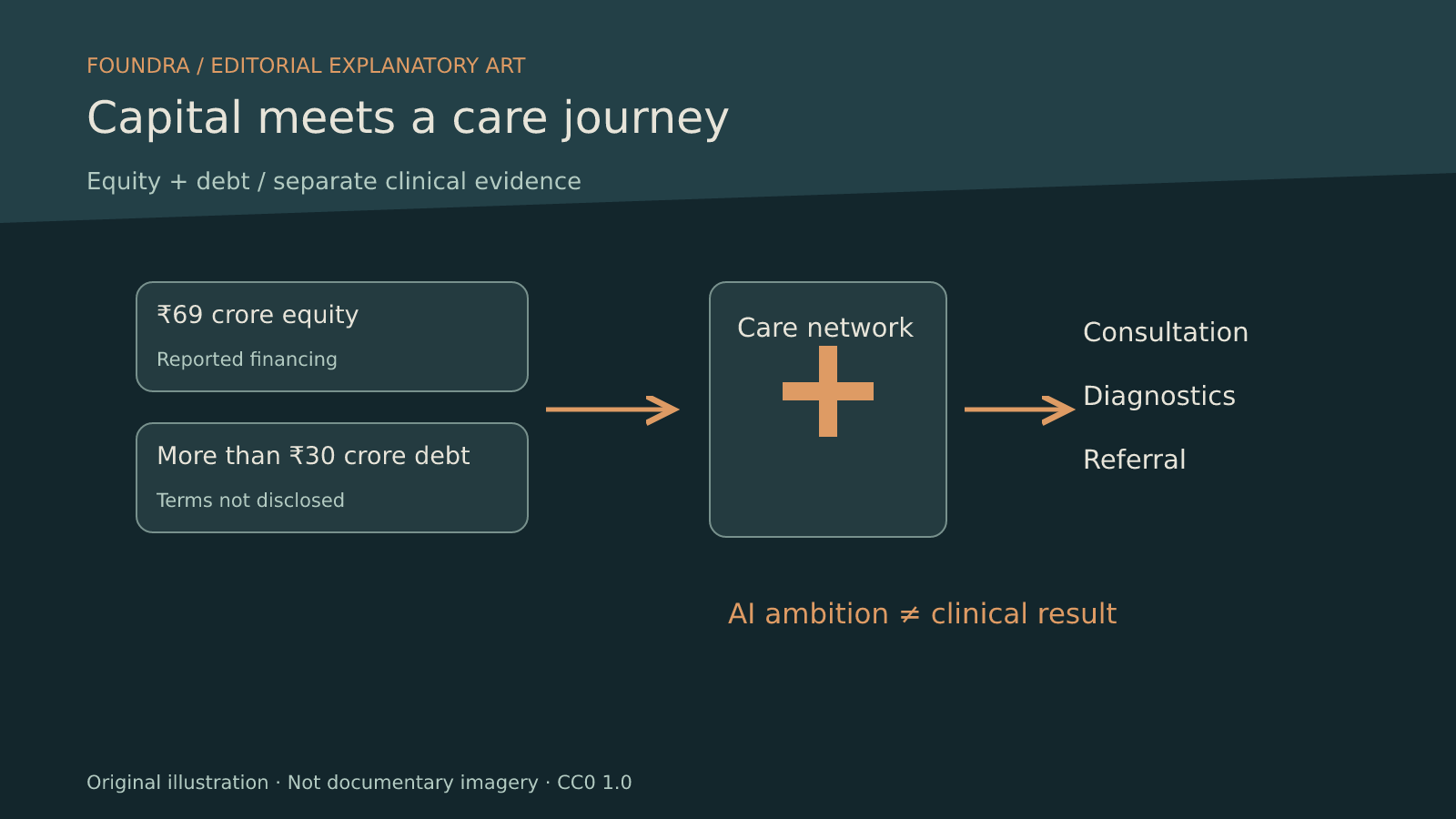
A financing package can support a care network without establishing a clinical result or an AI system’s effectiveness.
Two kinds of capital, one care network
CureBay’s new financing is not a ₹100 crore equity cheque. The distinction changes how its expansion should be understood. Entrackr and Indian Startup News reported on October 22 that the rural healthcare company raised approximately ₹100 crore in a pre-Series C round: ₹69 crore in equity and more than ₹30 crore in debt.
IvyCap Ventures led the equity portion alongside existing investors, while the reports identify Trifecta Capital, Alteria Capital and VentureSoul Partners as debt providers. They describe plans to broaden the company’s healthcare network, including entry into Andhra Pradesh, and strengthen its technology and artificial-intelligence capabilities. StartupTalky’s October 22 funding roundup separately corroborates the financing and its mixed structure.
The headline amount brings these sources of money together. It does not make them economically interchangeable. Equity can absorb uncertainty without a scheduled repayment obligation; debt introduces contractual obligations whose actual terms are not disclosed in these reports. We should not infer rates, collateral, covenants or a repayment schedule. We can, however, distinguish a financing package from a single undifferentiated growth budget.
Expansion is a chain of services
The reporting describes CureBay as operating technology-enabled clinics in underserved areas, connecting services such as consultations, diagnostics and medicines. That is a network model rather than simply an application downloaded by a patient. Our analysis is that its usefulness must be assessed across the whole care journey, not at the first digital interaction.
Entrackr identifies doctor consultations, medicines, diagnostic services and surgery facilitation among the network’s services. It dates the company’s founding to 2021. Those details help define the proposed expansion: it involves connecting several kinds of healthcare activity, with different providers and handoffs, rather than replicating one isolated software feature in another geography.
A hypothetical patient can complete a screening successfully and still face difficulty obtaining a diagnostic test, reaching a clinician or following a treatment plan. An expansion decision therefore raises operational questions alongside software questions. Which services are available locally? How is a referral completed? Who handles a missing result? These examples illustrate what would need scrutiny; they are not allegations about CureBay’s current service.
Mixed financing makes that scrutiny especially relevant. If a network has predictable cash-generating activities, some borrowing might fit those activities. If a new location takes longer to establish, the same obligations might become harder to carry. Without the company’s financial disclosures, we cannot say which situation applies. The reported equity and debt split gives readers a better starting point than treating all capital as equally patient.
Nor should expansion into a new state be counted as accomplished because financing has been announced. The reports describe the intended use of proceeds. They do not establish that every planned clinic is operating, or that the clinical outcomes in a new geography will match those elsewhere. Network breadth and service quality need separate evidence.
Capital meets a care journey
Capital
Separate equity and debt obligations.
Service
Follow consultations, diagnostics and referrals.
Evaluation
AI ambition is not a clinical result.
An intelligence layer is not a clinical result
Indian Startup News says CureBay intends to develop what it calls an Intelligence Layer for screening, health insights and clinical decision support. Entrackr likewise reports technology and AI investment. Those are the company’s development ambitions. Neither financing report establishes diagnostic accuracy, clinical benefit or readiness for unsupervised medical decisions.
For a care network, a potentially useful AI capability might help organise information for a qualified clinician or flag an incomplete workflow. Its value would still depend on the quality of the input, the appropriateness of the task and the human process that follows. This is a possible evaluation approach, not a claim about the performance or regulatory status of CureBay’s system.
The expansion and the AI ambition should consequently be tracked on different scorecards. The first needs evidence of dependable services and viable operations. The second needs task-specific evaluation, appropriate oversight and clear responsibility when a recommendation is wrong. Adding an AI label does not remove any of the obligations of delivering healthcare.
What this round establishes is a reported financing package and a set of priorities. It does not establish a clinical breakthrough. For readers following the business, the most revealing next update would connect capital to specific service improvements while keeping technology claims bounded by actual evaluation. That would make a stronger case than either a clinic-count headline or an unexplained claim of intelligence.
Sources
- Entrackr: original October 22 CureBay financing report ↗ Entrackr: original October 22 CureBay financing report
- Indian Startup News: October 22 CureBay report ↗ Indian Startup News: October 22 CureBay report
- StartupTalky: October 22 funding roundup ↗ StartupTalky: October 22 funding roundup
Have additional information? Request a correction.