The proposed support concerns the electronics around fusion. A funding intent does not establish a power plant’s performance.
The announcement is a letter of intent
The important word in Commonwealth Fusion Systems’ October 22 announcement is “proposed.” The company says it has signed a letter of intent with the US Department of Commerce for $85 million in federal incentives. That is not the same thing as an $85 million grant already paid, and it is not a newly closed venture-capital round.
In its original company post, chief science officer Brandon Sorbom connects the prospective award to microelectronics for fusion. TechCrunch reported the development on October 23. The company’s account is the controlling source for the conditional status here: it describes funding that would support projects, not a completed transfer that we can independently verify.
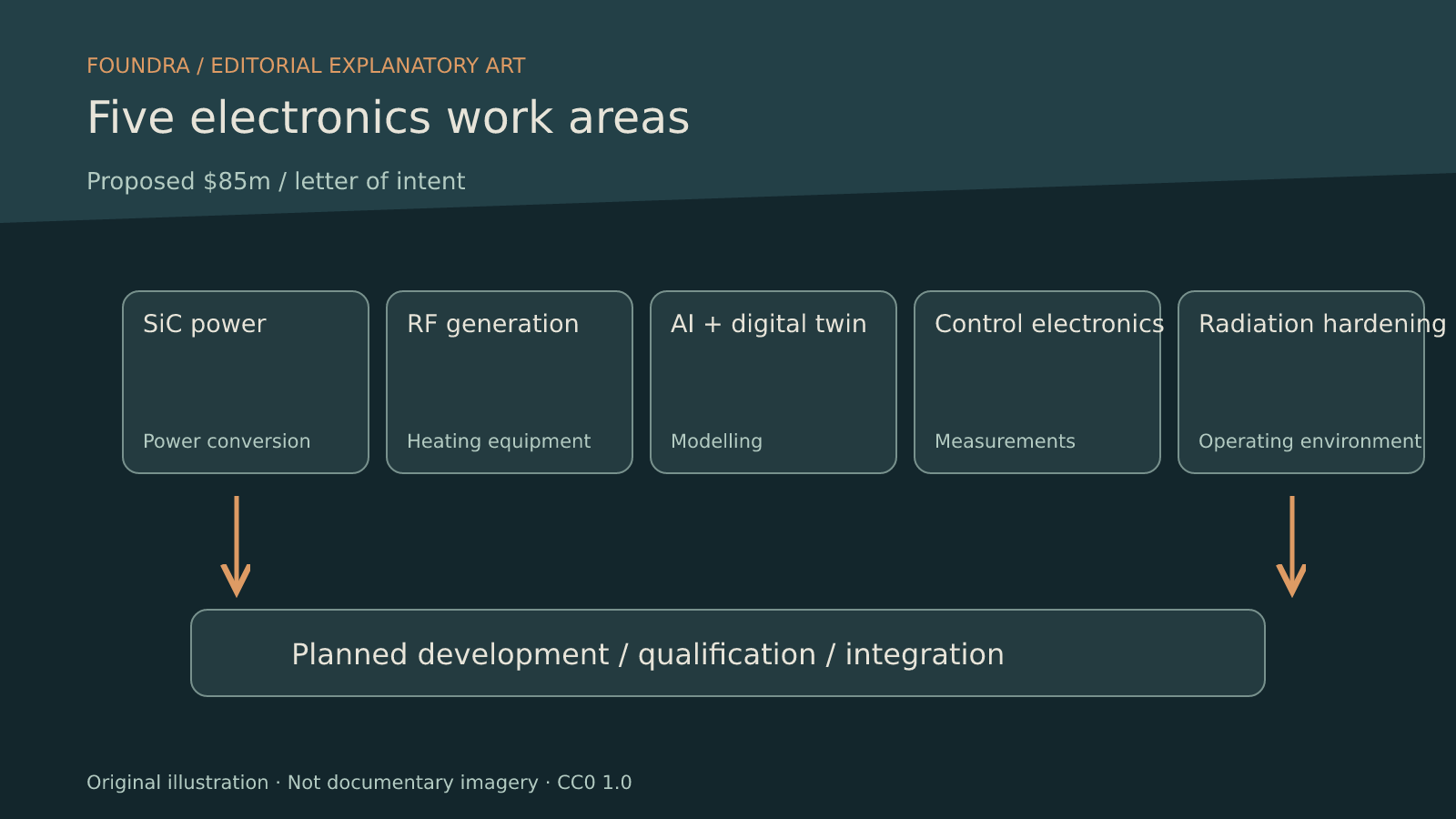
The proposal is notable because the company does not present electronics as a peripheral accessory to its fusion programme. It identifies five areas: silicon-carbide power electronics, radio-frequency power generation, AI and digital twins, faster control electronics, and radiation-hardened electronics. Those categories span supplying energy, modelling the machine and operating equipment in demanding conditions.
A reactor has more than one kind of chip problem
The easiest mental picture of fusion is a machine in which fuel releases energy. CFS’s proposal directs attention to the equipment that supplies, measures and controls that machine. Our interpretation is that this makes the prospective award an industrial-development story as well as an energy story.
Power electronics and computing electronics have related but different jobs. One handles the movement and conversion of electrical power; the other processes information. The company’s project list includes both. Treating every semiconductor in the proposal as an AI accelerator would therefore misdescribe the announcement, just as treating it solely as a reactor-construction subsidy would miss its stated microelectronics purpose.
CFS says its proposed work would support SPARC and its planned ARC power plants. That is the company’s account of intended applications. It does not establish that the new components have already been qualified, that ARC is operating, or that the company has achieved commercial electricity production. Those would require different evidence from a financing proposal.
The same care is needed with claimed wider benefits. Sorbom’s post points to applications beyond fusion. A component developed for one demanding task might prove useful elsewhere, but potential applicability is not a customer order. The case for spillovers will be stronger when it includes demonstrated performance and an actual route to adoption, rather than a list of markets that could conceivably benefit.
The project descriptions themselves help separate the engineering jobs. CFS places silicon-carbide devices in the power-supply work and describes radio-frequency generators as equipment for heating fusion fuel. It puts radiation hardening in the context of electronics operating around the neutrons produced by fusion. Each is an intended application from the company’s post, not a performance result established in this article.
That separation also offers a practical way to read subsequent updates. A radio-frequency component announcement would not automatically resolve the qualification of a controller. A digital-twin result would not demonstrate the lifetime of radiation-hardened electronics. Connecting the work areas in a programme is reasonable; combining their evidence into one claim of readiness would be much less informative.
Five electronics work areas
Intent
The proposed $85m is not disbursed funding.
Development
Five electronics work areas are announced.
Qualification
Component and system evidence remain separate.
Why the digital twin belongs beside the hardware
One of the five work areas combines AI with a digital twin of SPARC. CFS describes surrogate models that could stand in for slower simulations. It is an ambition to make modelling and operations more effective, not a published benchmark demonstrating the improvement promised in the post.
Analytically, a faster model is valuable only within an understood boundary. It can help explore options, but the user still needs to know where it agrees with the underlying system and where it fails. If an approximation is used in a consequential decision, speed alone cannot establish fitness for that decision. This reasoning applies to the stated project; it does not claim that CFS has deployed an unsafe controller.
Placing modelling, controls and physical components in the same programme also exposes an integration question. Improvements in one part may depend on capabilities in another. Better calculations do not replace a dependable power supply. More capable hardware does not remove the need to interpret measurements correctly. The programme’s breadth makes those interfaces important to evaluate.
For an industrial customer outside fusion, the evaluation would start again with its own task. The fact that CFS sees possible wider applications does not make a component suitable for every advertised setting. This is where a specific technical description is more useful than a broad claim of spillover: it gives a future buyer something that can be compared with a defined requirement.
Follow the industrial milestones, not just the headline amount
The next financing milestone would be a definitive award rather than a letter of intent. Beyond that, useful development evidence would concern specific components, manufacturing capability, qualification and the intended systems in which those components work. The reviewed announcement does not establish the completion of any of those steps.
For the wider startup ecosystem, this is a reminder that an ambitious energy technology can depend on specialised suppliers and less visible engineering work. A public incentive directed at those layers may be consequential without being proof of a power plant’s performance. CFS’s proposed $85 million belongs in that category: a conditional attempt to develop the electronics around fusion, whose value must ultimately be shown in hardware and operations.
Sources
- Commonwealth Fusion Systems: original October 22 proposed-award post ↗ Commonwealth Fusion Systems: original October 22 proposed-award post · Primary source
- TechCrunch: October 23 report on CFS microelectronics proposal ↗ TechCrunch: October 23 report on CFS microelectronics proposal
Have additional information? Request a correction.