The partners describe a path to Korean AI infrastructure; integration, deployment and measured service performance remain distinct milestones.
The verbs in the agreement matter
Rebellions plans to connect its next-generation R200 neural processing units to Nvidia’s infrastructure using NVLink Fusion. SK Telecom plans to deploy the resulting systems. Those are the essential verbs in the November 8 collaboration announcement published by Nvidia. They describe an intended integration and deployment path. They do not say that the combined infrastructure is already in production or provide a verified operating result.
The announcement identifies Nvidia’s MGX rack architecture as part of the planned system development and says the collaboration is supported by Korea’s Ministry of Science and ICT. It also gives a planning horizon: Rebellions’ R200 systems are expected to be ready for deployment in 2028. That is an attributed readiness expectation, not an exact launch date or a completed installation. Ministry support is not presented here as a disclosed procurement order or a verified customer contract value.
For a chip startup, the significance is the system surrounding the processor. A component may be designed for an intended workload, but the route from that component to an operating service includes other hardware, networking, software and a deployment operator. The partners have publicly described how they intend to connect several of those layers. Foundra has not tested the integration or verified the performance of a completed configuration.
A component promise becomes a system question
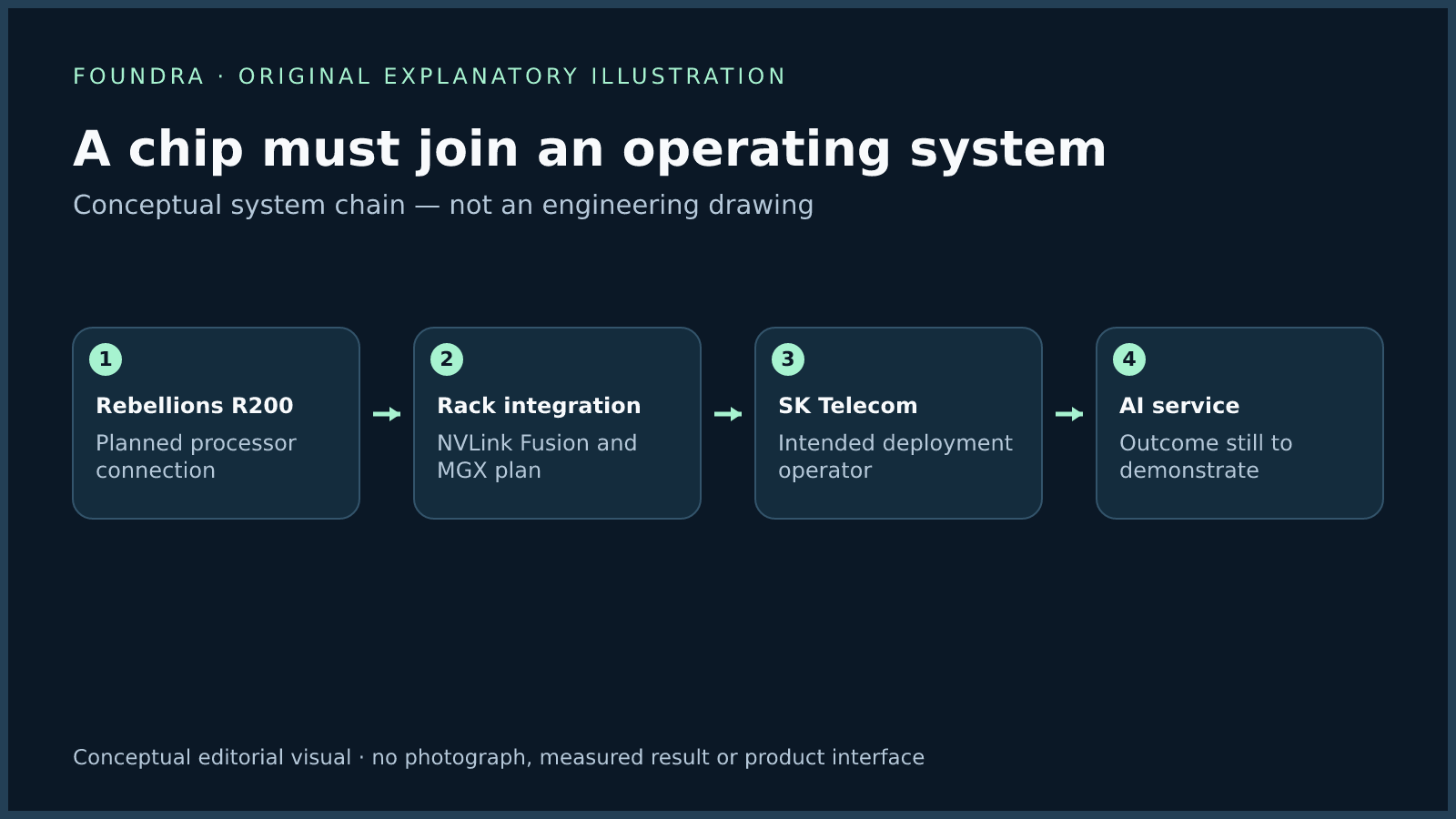
The partners describe different roles in the route from silicon to service. Rebellions supplies the intended R200 processor connection; Nvidia’s platform and rack architecture provide the surrounding integration framework; SK Telecom is the planned deployment operator with models and services. This division makes the proposal a system partnership rather than a standalone component launch. It does not establish that the engineering and support responsibilities have all been resolved in a publicly documented operating arrangement.
The 2028 readiness expectation is particularly important to that distinction. A reader considering the announcement as an infrastructure option should not assume it is a system available for immediate production use. The partners have announced a development path and an expected horizon. Neither a collaboration announcement nor a readiness year specifies a customer delivery schedule, contractual service level or the conditions under which a deployment would be supported.
The release includes the partners’ expectations about low latency and energy-efficient inference. Those remain issuer claims about the intended result, not measurements independently established by Foundra. A meaningful future comparison would identify the workload, configuration and operating conditions before reporting a result. Without that information, it would be inappropriate to turn an efficiency aspiration into a quantified saving or to declare superiority over an unspecified alternative.
A chip must join an operating system — editorial conceptual explanation
Rebellions R200
Planned R200 connection; systems expected ready for deployment in 2028.
Rack integration
NVLink Fusion and MGX plan
SK Telecom
Intended deployment operator
AI service
Outcome still to demonstrate
Sovereignty is a stack of choices
The partners frame the agreement as supporting sovereign AI in Korea. Their described design combines Korean processors, an international infrastructure platform and a Korean deployment operator with models and services. That combination makes the word sovereignty more specific than a claim of complete technological independence. The announcement does not establish that every part of the supply chain is domestic, nor does it claim that no external technology is involved.
For a hypothetical national or enterprise buyer, the relevant questions could include who controls the workload, who can access data, which components require outside support and what happens if a component must be replaced. Different buyers may prioritize different forms of control. This is an analytical framework, not evidence that the partners have answered every question or that their proposed configuration meets a particular government requirement.
Evidence for the next milestone
The partnership places a Korean chip startup within a publicly described rack-scale development plan, with R200 readiness expected in 2028. That horizon makes the story one of system building, not an installed-base report. A future integration, deployment or measured service result would each be a distinct development. For now, the significance is the division of roles: chip design, infrastructure integration and operations are being connected rather than discussed as if a processor alone were a complete AI service.
The release also supplies no customer-specific service obligation from which a reader could infer guaranteed availability or a supported operating schedule. A deployment report would need to state those limits separately.
Sources
- Nvidia — Rebellions and SK Telecom collaboration announcement ↗ Nvidia — Rebellions and SK Telecom collaboration announcement · 2026-11-08 · Primary source
Have additional information? Request a correction.