A familiar software interface can make another accelerator worth evaluating. Measure correctness, unsupported paths and operational costs before treating it as a production substitute.
A familiar interface becomes the route to another chip
For an AI startup, changing the chip beneath a model can be a software decision long before it becomes a hardware order. The model, training script and surrounding libraries may express years of engineering choices. A new accelerator is easier to consider if those choices do not all need to be rewritten. That is the problem Amazon’s TorchNeuron announcement is trying to address.
On October 19, Amazon announced TorchNeuron as a way to run existing PyTorch code on its AWS Trainium chips with a configuration change rather than a rewrite. That is Amazon’s compatibility claim, not a universal result established by this publication. GeekWire’s report says the software is opening to all developers as a public beta on October 19, after a private-beta period.
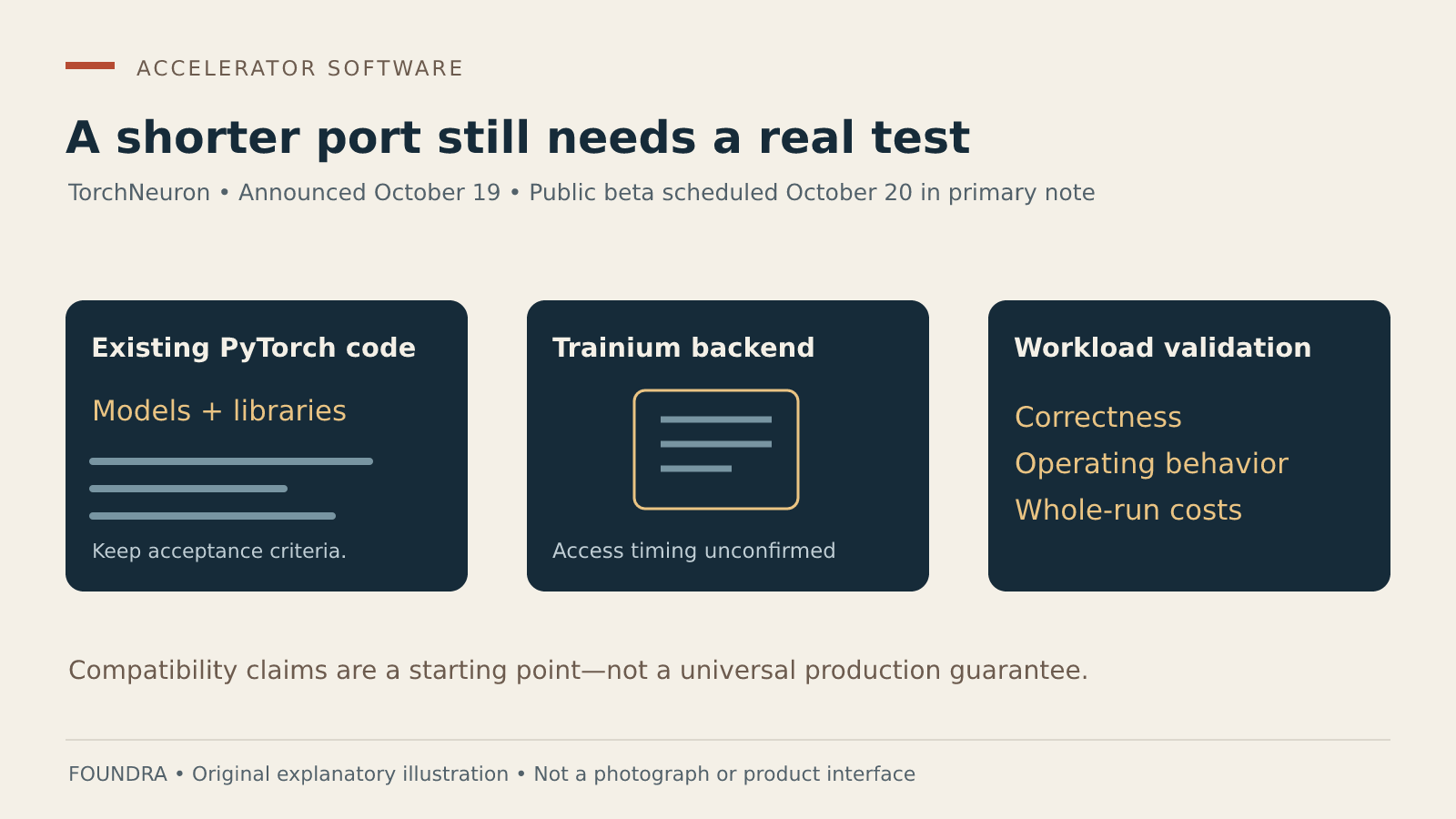
The primary PyTorch technical announcement, however, schedules public beta for October 20 and says the accompanying resources will go live then. That conflicts with the report’s timing. Current public access is unconfirmed in this article; we have not tested access. Amazon also schedules an open-source release for October 20. Public access, source distribution and production readiness remain different statuses.
The announcement’s significance is a potentially lower barrier to evaluating Trainium once access is established. If a team can begin with familiar code, it can spend more of its initial effort examining behavior and less on a wholesale port. Whether that produces a good purchasing decision still depends on the workload. A claim about the ease of entry does not answer every question about the destination.
The technical note also marks a boundary
A contributor-written PyTorch technical announcement describes support for eager execution, compilation and custom kernels on Trainium2 and Trainium3. It is primary technical material, not an independent performance audit. It also explicitly says TorchAO and FP8 support are in private beta and planned for general availability in the next release.
That detail makes the broader announcement easier to interpret. Even when the scheduled public beta opens, it would not mean every named component has the same availability. A startup whose intended workload depends on a separately gated feature would need to establish its access and status before assuming it can reproduce a demonstration or migrate a production pipeline.
The useful question is therefore narrower than whether PyTorch “runs.” Which version, which libraries, which operations and which execution paths does the particular application use? A familiar interface gives developers a starting point for that inventory. It does not remove the inventory, and this article does not assert that every library or custom operation is covered.
For a hypothetical startup experimenting with a new training method, the first test might be a small run that exercises its unusual operations. For a hypothetical service with a fixed production model, the first test might compare output quality and serving behavior under a representative request load. Those are different evaluations because the products depend on different kinds of stability.
A bounded accelerator evaluation
Inventory the workload
List the actual libraries, operations and separately gated features.
Keep acceptance fixed
Compare outputs and operating behavior against existing criteria.
Measure the whole run
Record runtime, utilization, engineering effort and recovery before deciding.
No rewrite is not the same as no validation
Code that executes is only the first checkpoint. A migration evaluation should examine whether the results remain acceptable, whether errors are handled predictably and whether the system meets the product’s operating requirements. This is proposed evaluation practice, not evidence that TorchNeuron fails any of those checks.
A team can make that comparison more useful by preserving its existing acceptance criteria. If a training job has a target quality threshold, keep that threshold fixed. If a service must respond within a particular latency budget, test the budget rather than merely record a favorable average. Changing the success definition during the trial would make the comparison less informative.
The cost question should be measured separately. A lower hardware rate would not by itself establish a lower cost per accepted result. Runtime, resource utilization, engineering effort and recovery all influence the economics of a deployment. This article reports no independent TorchNeuron cost measurement, and it does not infer one from the compatibility announcement.
The operational checklist matters too. A developer should be able to inspect failures, reproduce a problematic run and understand the path back to a known-good configuration. During a beta evaluation, keeping the incumbent workflow available can limit the consequences of an unexpected incompatibility. That is a precaution a buyer can choose, not a promise that Amazon supplies an automatic fallback.
A more practical form of accelerator choice
For founders, software compatibility can change the order of a procurement decision. Instead of first funding a large port and only then learning whether another platform suits the product, a team may be able to gather evidence earlier. That is the opportunity suggested by this release. The size of the opportunity remains workload-specific.
The announcement should not be read as hardware independence. A backend aimed at Trainium offers a route to that platform; it does not establish that every infrastructure dependency disappears. A responsible trial would document the integration work still required and the assumptions that would need to remain true as the product evolves.
TorchNeuron’s October 19 announcement gives developers a candidate to consider, with public beta and an open-source release scheduled for the following day in the primary material. The October 19 access report does not settle that timing conflict. A bounded evaluation can follow confirmed access; a production substitution should follow evidence of correctness, performance and operating economics—not simply an attractive compatibility claim.
Sources
- Amazon — original TorchNeuron announcement ↗ Amazon — original TorchNeuron announcement · Primary source
- PyTorch — contributor-written technical announcement ↗ PyTorch — contributor-written technical announcement · Primary source
- GeekWire — public-beta reporting ↗ GeekWire — public-beta reporting
Have additional information? Request a correction.