A risk score matters only if the systems an agent uses can enforce the resulting permission change. Startups building enterprise workflows should treat narrowed access as an operating condition, not an exceptional crash.
The workflow after permission disappears
Consider a hypothetical payroll assistant that has prepared a batch of changes but has not submitted them. A security control removes its write access while leaving its ability to read intact. The assistant can still describe the batch; it cannot finish the task. Whether that interruption protects the employer or merely creates confusion depends on the application around the assistant: what it records, what it retries and what it tells the person waiting for an answer.
That is the practical startup question behind Microsoft’s October 19 security announcement. The company introduced Dynamic Permissions, Dynamic Agent Risk and Dynamic Conditional Access for agents, alongside new Guardian Agents in Project Perception. GeekWire separately reported the announcement that Monday. It says the new features are in private preview, with broader availability planned for Microsoft’s Ignite conference in November. That is a planned rollout, not a completed general launch or independently demonstrated effectiveness.
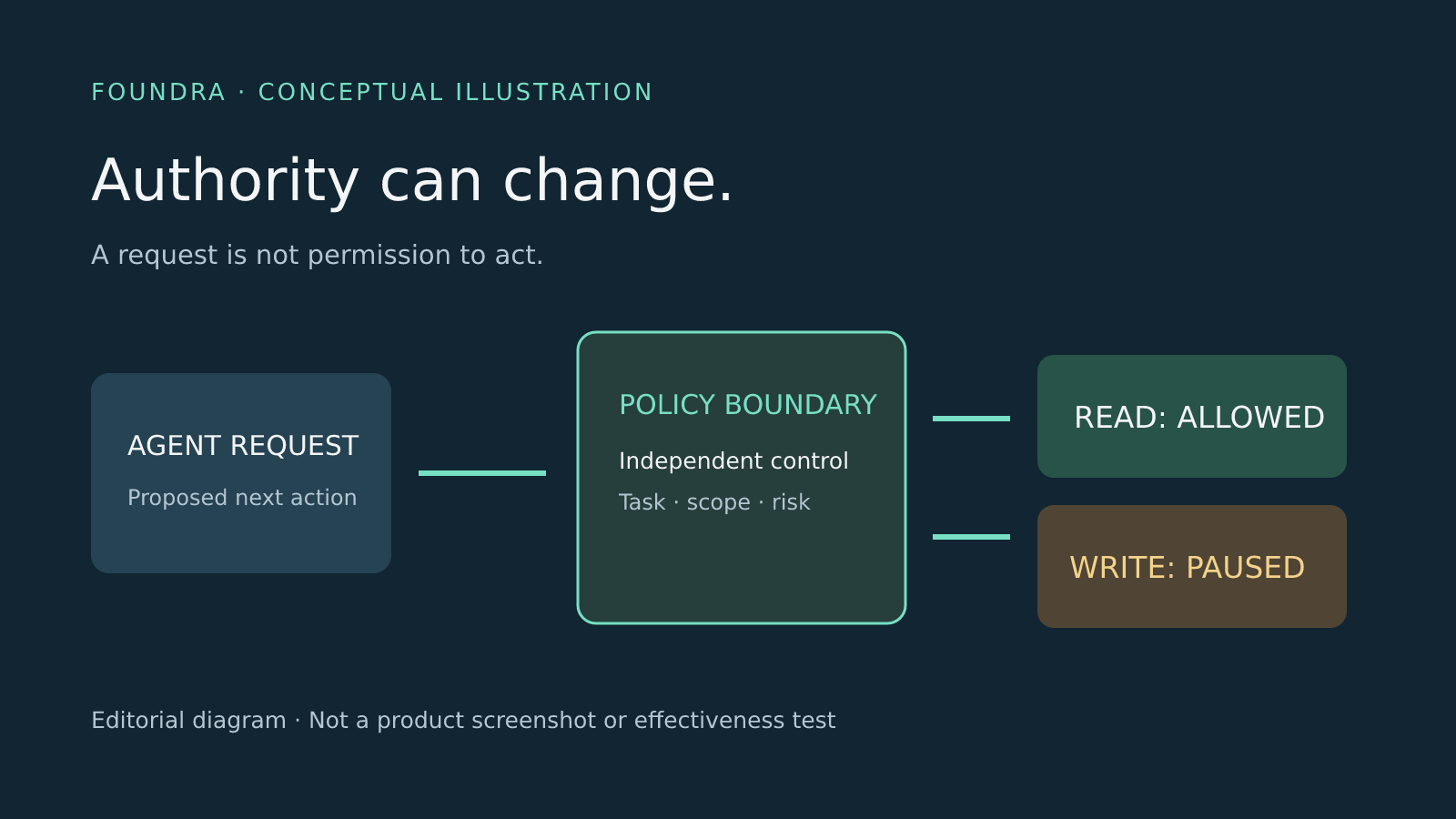
Microsoft describes authority that can be scoped to a task, limited in duration and reduced when risk changes. Its conditional-access approach can distinguish reading from writing rather than simply allowing or stopping an entire agent. The company also says local-agent discovery is expanding from 25 supported types to 60. Those are product disclosures. They do not establish how completely an enterprise can discover its actual agent estate.
For a startup selling an agent-enabled service, the distinction between a successful model response and an authorized business action becomes harder to ignore. A model can produce a plausible instruction after the permission to execute it has disappeared. The surrounding service needs to recognize that difference and present an accurate result instead of reporting a task as complete.
An identity is not a business transaction
Microsoft’s account emphasizes giving agents identities separate from their sponsoring users. That separation is valuable in principle because it creates a place to attach ownership and permission policy. But an identity alone does not explain the business meaning of an action. Updating a draft payroll record and submitting a payment instruction may both look like writes while carrying very different consequences.
The analysis for application builders is therefore more specific than “add an agent login.” They need to decide which operations remain reversible, which commit an external effect and where fresh authorization belongs. An approval tied to one batch should not silently authorize a later batch with different recipients. That is a design criterion, not a claim that Microsoft’s new controls automatically enforce the semantics of every customer application.
Interruption also creates an accounting problem. In the hypothetical payroll workflow, some preparatory changes could have succeeded before access narrowed. Repeating the entire batch might duplicate work; assuming it all failed might erase the record of a real change. Useful safeguards would include explicit action status, durable transaction identifiers and a resumable path for a person to resolve incomplete work. Their suitability depends on the underlying system; none is a universal security guarantee.
This is where an enterprise software startup may retain room to differentiate even when a large platform supplies agent identity and policy machinery. The startup knows its customers’ workflow, including which decisions need an accountable human and how an unfinished task should appear in the product. Integrating a platform control is a dependency. Making that dependency intelligible to the customer is part of the product itself.
Three checks for an interrupted agent workflow
Authorize the action
Match authority to this task, resource and consequential step.
Record the result
Distinguish completed changes from work denied or still pending.
Resume deliberately
Let an accountable person resolve the interruption without silently broadening access.
Ask to see the interrupted case
A procurement demonstration could test the uncomfortable path instead of only the happy one. Start a task with legitimate access, change the allowed scope, and observe what happens to the next consequential action. Does the application stop before committing it? Does the user receive a clear explanation? Can an authorized person inspect what already happened without handing the agent broad standing access again?
Those questions turn a general promise of adaptive protection into observable behavior. They also separate the risk signal from enforcement. Detecting suspicious activity is not the same as preventing an action, and preventing an action is not the same as recovering a partly completed workflow. Buyers should ask which components supply each function and which limitations remain.
Microsoft describes shared signals and an agent registry across Project Perception and Agent 365, with security responses coordinated across enforcement points. The scope is ambitious. The announcement and GeekWire’s coverage do not provide an independent end-to-end effectiveness test, a false-positive rate or evidence that the planned rollout is complete. It would be premature to convert that architecture into a claim that agent risk has been solved.
The immediate lesson for founders is narrower and useful: permissions may change during a task, not just before it starts. A service that treats access denial as a rare error will have a different operating experience from one designed to pause, explain and resume safely. The next convincing enterprise-agent demonstration should show what happens when the system says no.
Sources
- Microsoft Security Blog ↗ Microsoft Security Blog · Primary source
- GeekWire ↗ GeekWire
Have additional information? Request a correction.