Separate the signed collaboration from its proposed generating capacity. The commercial interest is real; construction, operation and power delivery are different milestones.
An agreement enters the power-development pipeline
A signed agreement can give an energy project direction without giving the grid a single new megawatt. Amazon’s October 19 Indiana announcement belongs in that category. It connects a potential power buyer, a reactor developer and a utility around a proposed project. The important news is the collaboration being organized—not an operating plant being switched on.
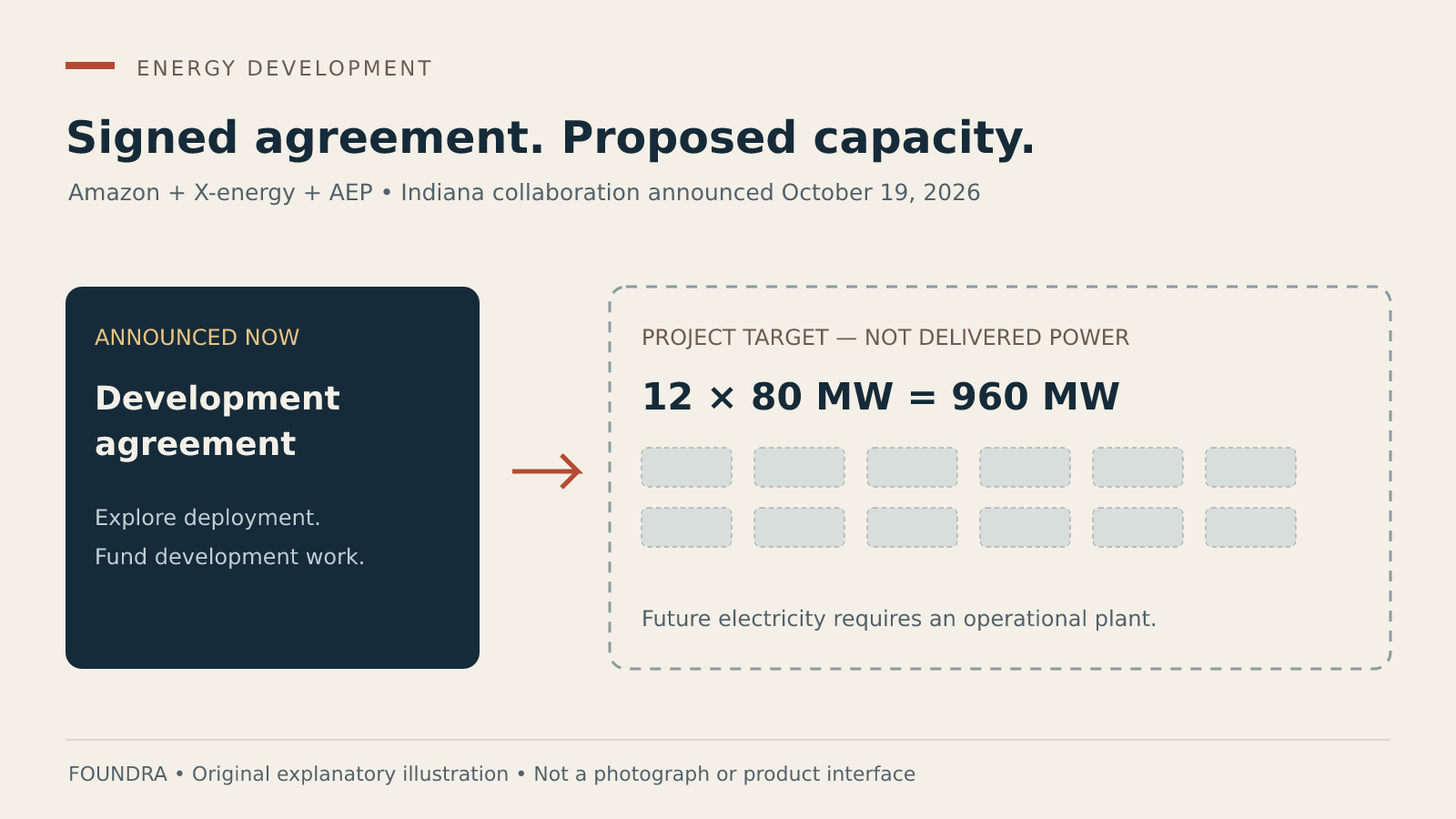
Amazon says it, X-energy and American Electric Power have signed an agreement to explore deployment of X-energy’s small modular reactors in Indiana. The target is 12 Xe-100 units and 960 megawatts of capacity. Amazon would fund project development and be the first customer to purchase power from the plant once it is operational. Those conditional words are central to the story.
X-energy’s separate announcement identifies a joint development agreement with AEP to advance feasibility work. It places the proposed plant near the former site of the retired Breed Generating Station in Sullivan County, on an AEP-owned brownfield site, and describes Amazon’s development capital as milestone-based. Those details locate the proposal and its funding approach; they do not establish that redevelopment or construction is complete.
The scale is easy to misunderstand. Megawatts measure power capacity, not a guaranteed amount of energy supplied over a year. Actual electricity production would depend on operation over time. The 960-megawatt target should therefore stay attached to the proposed project, rather than be described as a present contribution to Indiana’s grid or to Amazon’s data centers.
The customer is part of the development story
Amazon’s stated role combines development funding with prospective demand. Those are related but distinct functions. Funding can support work needed to advance a project. A future customer can give that work a commercial purpose. The announcement does not turn either role into a completed generating asset, and it does not disclose enough here to infer every allocation of cost or risk.
For an emerging energy company, the analytical significance is that technology development and customer development need not happen in separate sequences. A potential buyer can participate before power exists. But that makes the project’s next questions more concrete: which work is being funded, what must happen before the buyer receives energy, and who carries the consequences if the plan changes?
Those questions are especially relevant when a customer wants power for a long-lived computing operation. A developer’s technical roadmap, a utility’s system requirements and a buyer’s demand timetable are not interchangeable. An agreement can bring the parties together, but it cannot by itself prove their schedules will align. This is a development risk to analyze, not an assertion that the Indiana partners have encountered a delay.
Amazon describes the proposal as the second project in a broader collaboration with X-energy targeting more than five gigawatts of new U.S. nuclear capacity by 2039. That is a stated ambition across the collaboration, not capacity already online. Treating the larger number as a completed result would erase the same distinction that matters at the Indiana project level.
For other deeptech founders, the transferable lesson is about the shape of a commercial relationship, not an instruction to imitate nuclear economics. When a product depends on major physical infrastructure, the first customer may also help organize the path to deployment. Investors should still ask what has been demonstrated, what has been contracted and what remains a proposal.
Read each project milestone on its own evidence
Announced now
Agreement to explore an Indiana project; 12 reactors and 960 MW are targets.
Still to establish
Project-specific execution milestones, approvals and operating readiness.
Not delivered capacity
Electricity production and customer delivery require an operational plant.
Twelve units do not collapse twelve sets of assumptions
The proposed configuration is 12 units of an 80-megawatt reactor design, which explains the announced 960-megawatt total. That arithmetic is useful because it distinguishes a unit from the whole project. It does not establish a construction schedule, a production rate for reactor components or a guarantee that all units would enter service together.
The term “small modular reactor” can make a large undertaking sound like a simple procurement exercise. A modular design may describe how a technology is organized; it is not evidence that the surrounding project has no integration work. Siting, permissions, financing, construction and connection to the power system remain separate categories of questions a reader should track.
There is also a difference between a technology explanation and a safety finding. Amazon’s release describes the Xe-100 design and makes claims about its characteristics. This article does not convert those claims into an independent assessment of this proposed site. Readers should look for the relevant project-specific documentation as the plan advances, rather than infer approval from a general description.
A clear status ladder helps: agreement first, then evidenced project decisions and implementation, then verified operation and delivery. Those are editorial distinctions, not a reported timetable for Indiana. A future announcement could establish progress on one step without establishing every later one. Keeping each milestone separate makes it possible to report genuine advances without repeatedly describing the same ambition as new power.
What would make the next announcement different?
The next meaningful development would change what can be known about execution. Project-specific decisions, disclosed commercial terms or independently verifiable work on the proposed facility would be more informative than another restatement of the target. That is a framework for following the story, not a claim that any particular milestone has already been reached.
A reader assessing grid implications should also keep proposed capacity separate from the division of future output. Amazon says the project would serve both the regional grid and its data centers. That statement does not quantify how electricity would be allocated in every operating condition. Nor does a capacity headline alone establish effects on household bills or the timing of supply.
The agreement is consequential because it identifies parties and a proposed scale, bringing a reactor developer into a concrete power-development relationship. Its limits are equally consequential. Indiana does not acquire 960 megawatts merely because the target appears in a release. Until later evidence establishes more, the accurate description is a signed collaboration exploring a project, with Amazon positioned as development funder and prospective first customer.
Sources
- Amazon — original Indiana project announcement ↗ Amazon — original Indiana project announcement · Primary source
- X-energy — original partnership announcement ↗ X-energy — original partnership announcement · Primary source
Have additional information? Request a correction.