Vessla is proposing connected execution across property software, not a replacement for every property-management decision. Its stated human-judgement boundary is part of the product proposition.
The division of work is explicit
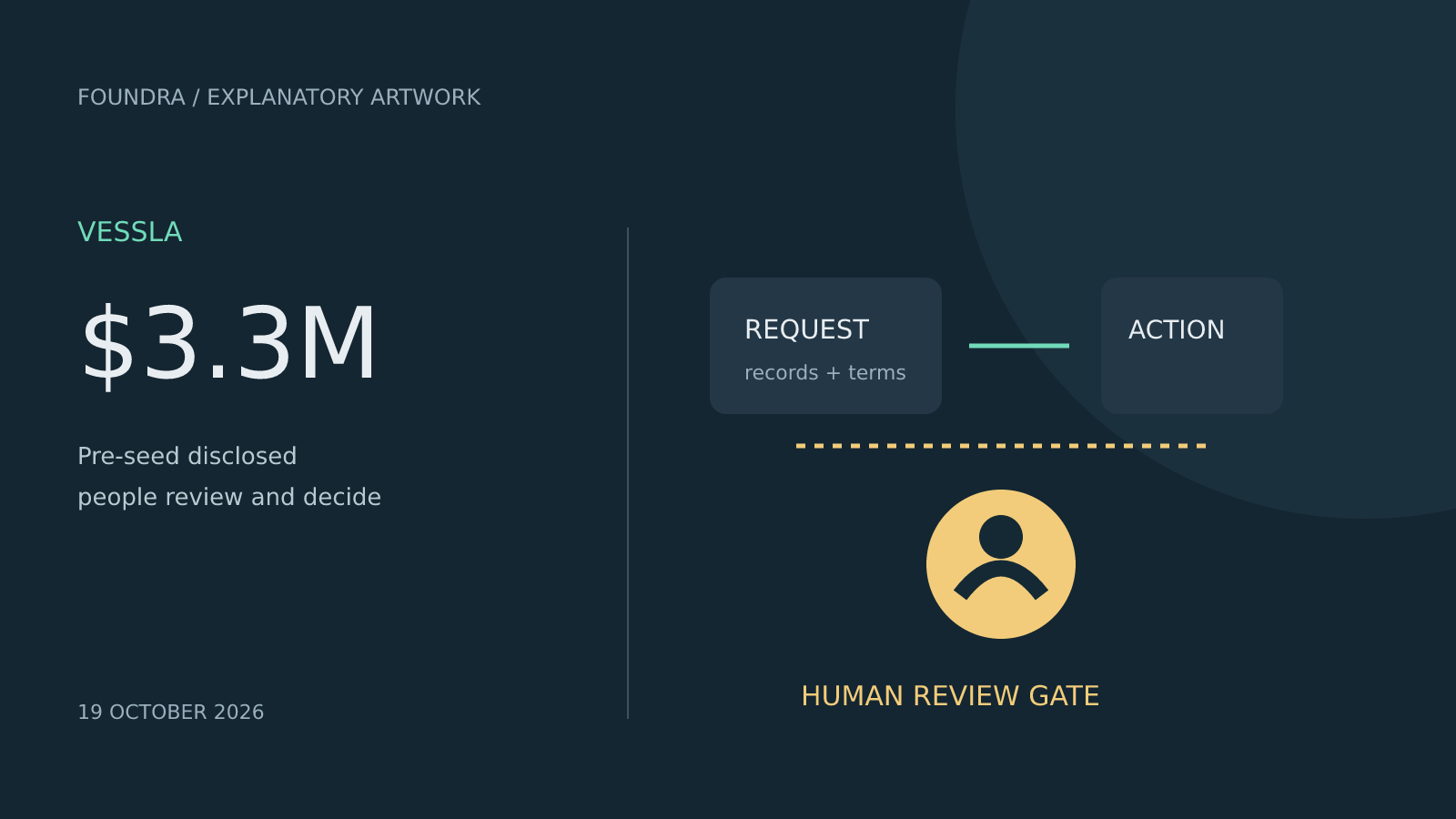
People review and decide; agents help perform the work. That is the division Vessla describes on its website, and it is more specific than a claim to automate an entire property business. The new company is aiming to connect the software and records a property organisation already uses, while preserving a human role in judgement calls.
Seedcamp’s October 19 announcement says Vessla has emerged from stealth with a $3.3 million pre-seed round led by the investor. Tech.eu separately reports the round and identifies Vessla as Stockholm-based. The disclosed participants also include Inception Fund, Tiny VC, operators from Lovable and OpenAI, and other founders and angels. Neither employees’ participation nor a former role makes their employers an announced investor.
Seedcamp describes Vessla as a shared AI platform spanning residential and commercial property workflows. Agents retrieve information, apply the organisation’s operating rules and help carry out tasks through connected software. The investor says humans retain ownership of judgement calls. Those are descriptions of the proposed operating arrangement, not independent evidence of its reliability.
A context layer rather than a new isolated inbox
The company site identifies several inputs to that arrangement: Microsoft 365, property-management systems, enterprise-resource-planning and customer-relationship-management systems, alongside calls, contracts and files. A shared workspace is intended to preserve history and handoffs between owners, operators and subcontractors.
This makes the product proposition different from a standalone assistant that only answers questions about a document. Vessla is describing a layer that joins context with execution across existing systems. The material product boundary is whether a task is being assembled, performed or referred to a person for a decision.
The website describes agents surfacing obligations from contracts, emails and calls, including commitments, deadlines and service levels. Seedcamp’s account extends the intended scope to leasing, building operations and investment planning. These are different types of property work, and a broad scope should not be mistaken for proof that every possible process is supported.
The distinction between a recorded obligation and a business decision is particularly important. Finding a deadline in a document is not the same as resolving a disputed interpretation or choosing a commercial course of action. Vessla’s stated human role leaves room for that difference instead of claiming that every judgement should disappear into automation.
No tenant incident, maintenance job or customer transaction was observed for this article. The product account comes from the investor announcement and company description. In particular, the evidence does not specify a complete permission model, a list of production integrations or independently measured reductions in errors or costs.
The investor says Vessla is already working with large Nordic commercial and residential property owners and operators, but does not name those customers in the retrieved announcement. That supports an attributed statement about early activity, not an independently verified customer roster.
A hypothetical request, with a review boundary
Receive
Identify the request and relevant property records.
Assemble
Connect contract terms and proposed next steps.
Review
A person checks decisions and authority.
Record
Retain the action and its evidence trail.
The team and the commercial proposition
Seedcamp identifies CTO Kasper Janehag as having worked on NASA’s Mars 2020 mission and enterprise AI transformations at QuantumBlack. It describes chief scientist Arash Dabiri’s experience at Andon Labs and QuantumBlack, and CEO Orman Gazvini’s work advising software businesses at McKinsey and experience at Pophouse. These are investor-provided biographical statements, not independently checked employment histories in this account.
The relevance is the kind of problem Vessla is attempting: executing work inside organisations that already have systems, rules and exceptions. The biographies offer context for the team’s stated experience. They do not certify the product or supply a performance result.
Seedcamp frames the economic goal as stronger net operating income and long-term asset performance. That is a goal, not an achieved financial measure reported for customers. A product that connects records and completes tasks may contribute to such an outcome, but the outcome would still need its own evidence.
Vessla’s launch puts a clear proposal into the property-software market: retain the existing systems, add shared context and let agents participate in execution while people remain responsible for decisions. The human boundary is not a footnote to that proposal. It is what keeps the phrase “operating system” from being read as a promise to replace the property organisation itself.
Sources
- Seedcamp ↗ Seedcamp · Primary source
- Tech.eu ↗ Tech.eu
- Vessla ↗ Vessla · Primary source
Have additional information? Request a correction.