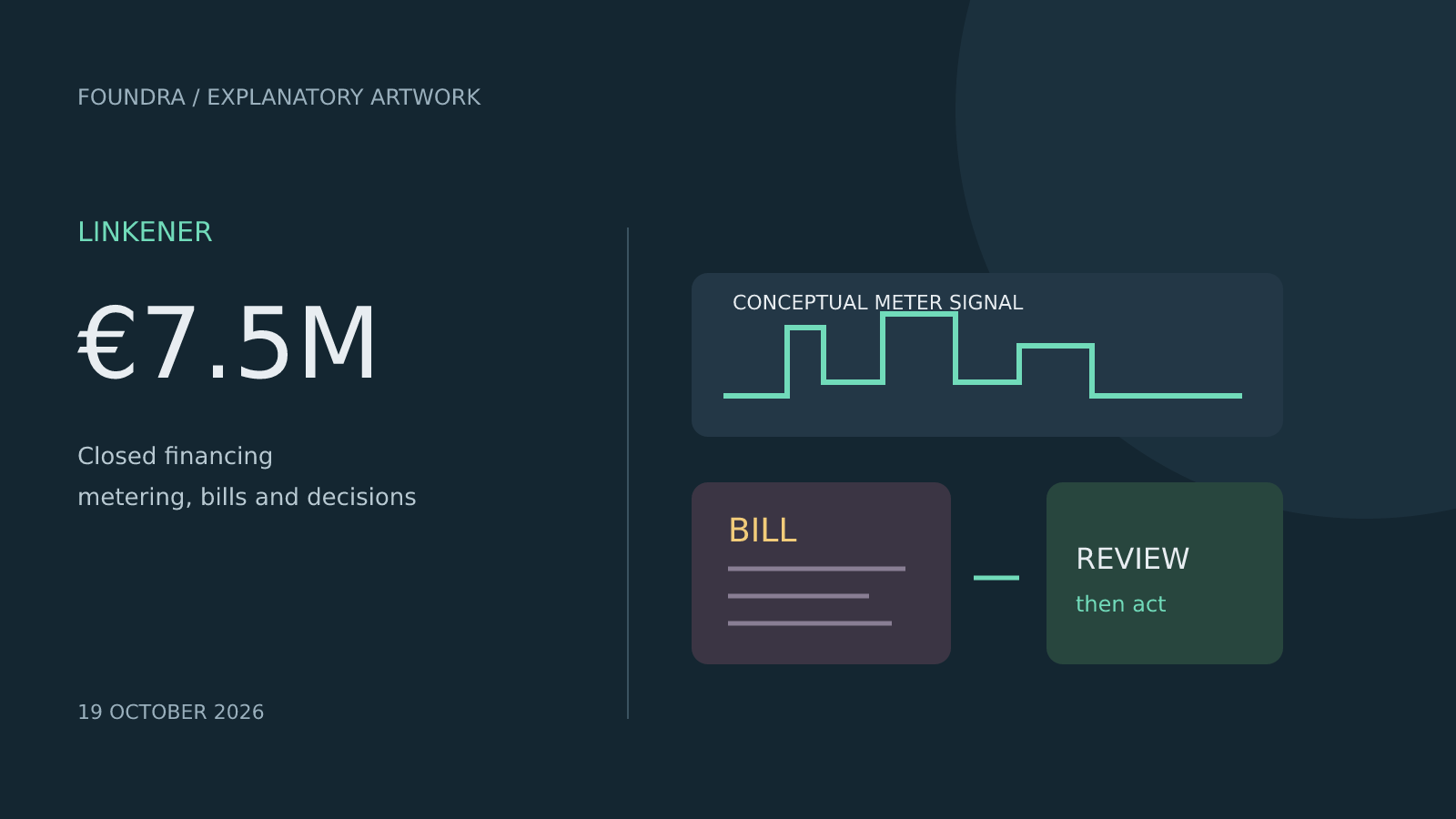
Linkener’s scope reaches beyond a dashboard: metering, bill validation and physical projects have different evidence requirements and should not be collapsed into a single savings promise.
A software company with physical projects in the account
More than 400 solar and energy-storage projects appear alongside the software in Linkener’s new financing announcement. That company-reported activity is important to understanding the business: Linkener is not describing a dashboard-only service. It combines remote metering and energy analysis with engineering work intended to turn identified opportunities into projects.
On October 19, Linkener announced that it has closed a €7.5 million investment round led by Klima Energy Transition Fund, Alantra’s energy-transition fund, with GoHub Ventures continuing. Tech.eu separately reports the financing. The company says the money will develop its product and AI capabilities and support expansion.
Linkener reports more than 2,000 customers, 10,000 supply points and 1.7 TWh of annual energy under management. Those are company-reported measures of the service’s reach. They are not figures for electricity generated, energy saved or emissions avoided.
This operating scope explains why the funding story belongs at the intersection of SaaS and energy services. The software handles records and analysis; the engineering work can involve equipment and site-specific implementation. Reading one as a substitute for the other would miss part of the announced business.
Three improvements that should not share one label
First, a bill can be corrected. Linkener describes checking invoices, consumption data and contracts as part of its system. If the correction changes what a customer pays, it is a cost result. It does not necessarily mean the customer consumed less electricity.
Second, an operation can use energy differently. Metering can help identify patterns, while an engineering project may change equipment or how a site operates. Establishing a consumption improvement requires comparing defined periods and accounting for relevant changes. A graph of readings is an input to that comparison, not the conclusion.
Third, a project can carry an environmental claim. That claim needs a stated method for translating the activity into an environmental result. A smaller bill cannot silently stand in for an emissions calculation, because prices and contract terms can change independently of consumption.
These distinctions are especially useful for the combined service Linkener describes. Invoice validation and a solar or storage installation may both improve a customer’s finances, but through different mechanisms. A procurement decision should identify which problem is being addressed before combining possible benefits into a headline figure.
Linkener also reports annual customer savings of more than €15 million in its announcement. That remains a company claim here. The retrieved release does not provide a customer-by-customer calculation or enough detail to independently reproduce the aggregate. The number should therefore be read with its attribution, not as an independently audited outcome or a forecast for another buyer.
Do not merge these outcomes
Bill correction
Changes an invoiced amount; consumption may be unchanged.
Operational saving
Requires a documented change in energy use.
Climate claim
Requires its own methodology and stated assumptions.
AI and acquisitions sit inside the same expansion plan
Linkener says it plans proprietary AI models and specialised algorithms to automate analysis and validation of bills, consumption data and contracts, detect anomalies and provide more useful recommendations. These are the stated development priorities. The financing announcement is not a controlled evaluation of newly released software.
The company also says it intends to combine organic growth with acquiring and integrating complementary technology and services businesses. No named acquisition, signed deal or completed purchase is established by the announcement. The supported fact is a growth strategy that includes acquisitions, not an acquisition event.
That strategy fits the breadth of the existing proposition. A metering capability, an analytical system and an engineering service solve related problems, but each brings its own integration work. Expansion through another business would add another set of systems and operating practices to that combination. This is a business-model implication, not a claim that an integration has already happened.
The €7.5 million round funds development of that combined offering. Its significance is the attempt to connect software analysis with practical energy work, rather than the addition of AI as an isolated label. The comparison to keep in view is concrete: a validated bill, a documented change in consumption and a substantiated climate result are three different outputs. A useful account of Linkener should keep all three legible.
Sources
- Linkener ↗ Linkener · Primary source
- Tech.eu ↗ Tech.eu
Have additional information? Request a correction.