Galaxy has begun shipping, according to BetaKit. Tenstorrent’s new financing backs volume manufacturing and a broader commercial operation, alongside its separate IP-licensing business.
Commercial delivery has already begun
Tenstorrent is not raising money for a server that exists only on a drawing board. BetaKit reports that its Galaxy servers have begun shipping commercially. The new financing is intended to expand that activity: volume manufacturing, wider deployment and continued work on the technology underneath the systems.
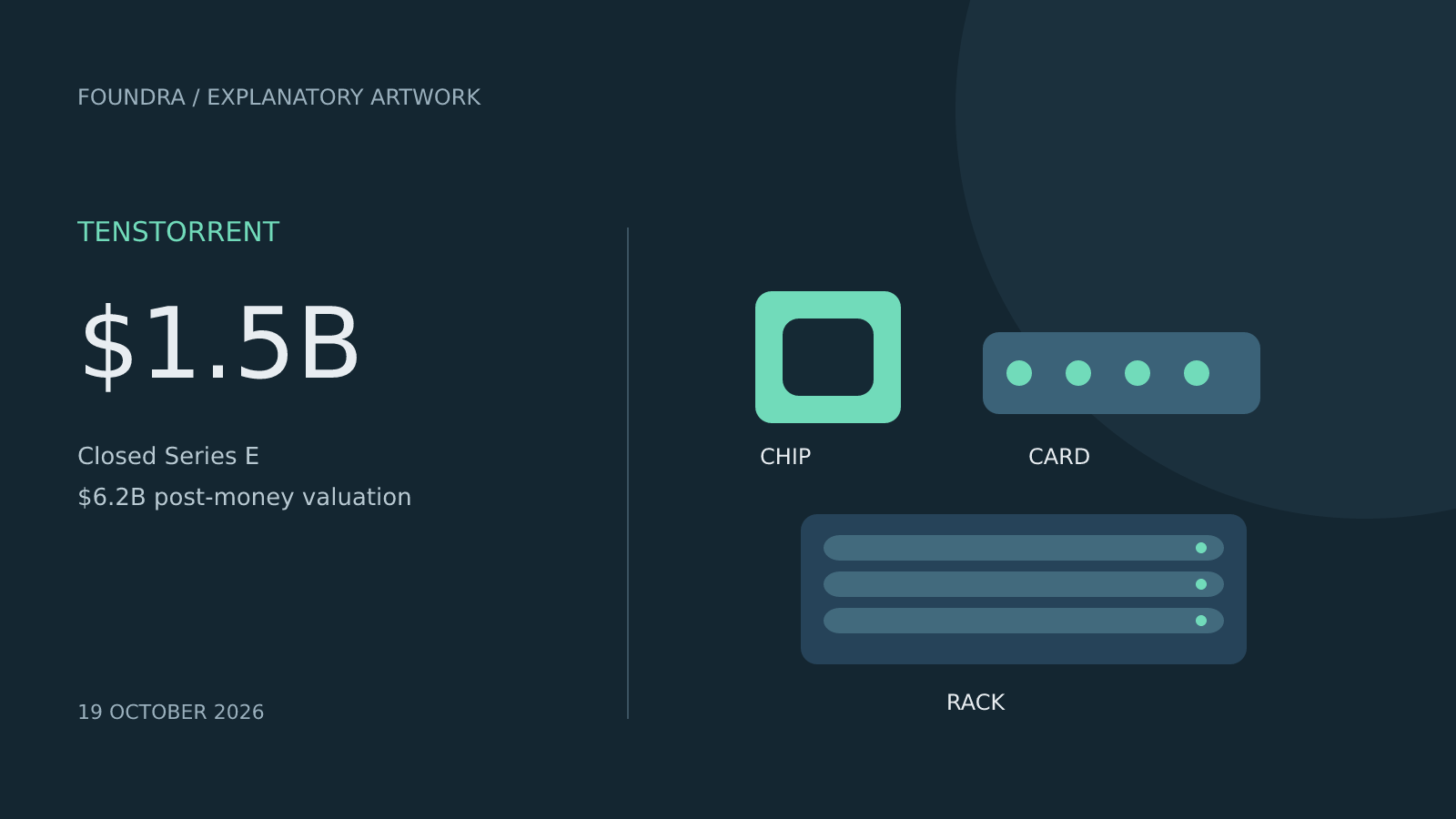
In its October 19 announcement, Tenstorrent says it has closed $1.5 billion in Series E equity funding at a $6.2 billion post-money valuation. Trace Capital and Innovation X led the round. The company’s wording establishes a closed financing, not a planned raise. BetaKit independently reports the round and identifies manufacturing, hardware development and hiring among its intended uses.
That distinction changes the industry story. An alternative compute supplier is moving further into commercial delivery, rather than simply unveiling another architecture. Reported shipments are a concrete milestone. They do not tell us the volume shipped, the reliability of each installation or the economics of serving a particular customer.
One supplier, several buying decisions
Tenstorrent’s announcement describes a product range spanning a single card or workstation, racks, larger clusters and custom intellectual property. The company is therefore seeking customers who want to buy equipment as well as chip designers who want to build their own silicon. Those are connected businesses, not interchangeable sales.
The distinction matters to the revenue proposition. A complete-system buyer is purchasing usable compute with a set of hardware and software dependencies. An IP licensee is purchasing technology to integrate into a design of its own. A relationship in the second category should not automatically be counted as a Galaxy deployment.
Tenstorrent says it licenses its TT-Ascalon RISC-V CPU and Tensix AI cores to chip designers including Samsung and LG. Those are company-described licensing relationships. The announcement does not disclose their individual commercial terms or establish how much of the new valuation is attributable to licensing rather than system sales.
The two routes also have different milestones. Manufacturing and delivering repeatable systems is central to the equipment business. Successful design integration is central to licensing. A single company can pursue both without every milestone proving the same thing.
Three routes, three proof points
Cards and workstations
Supported software and usable individual systems.
Galaxy deployments
Manufacturing, delivery and dependable operation.
Licensed IP
Integration into another designer’s silicon.
What the open stack promises
The software strategy is part of the hardware pitch. Tenstorrent describes an open-source software stack and says the new capital will help deploy Galaxy at scale for open-weight language models and video generation. Open software and open-weight models are separate descriptions: one concerns the surrounding code, the other the availability of model weights. Neither phrase alone defines a complete deployment licence or operating cost.
For a developer, access to the stack can make inspection and adaptation possible. The value of that access still depends on the tools being maintained and on the workload being supported. Porting effort is part of a compute decision even when the software itself is available to inspect.
Tenstorrent’s release makes strong claims about latency and throughput. This article does not turn them into established comparative performance. No server was tested and no benchmark was reproduced. A comparison that omits the model, precision, batching and service requirements would leave too much unspecified to support a useful buying conclusion.
The investor roster is broad; the transaction is specific
The company lists new and existing participants including ARK Invest, Cadence Ventures, Eclipse, Fidelity Management & Research Company, Morgan Stanley, Sandisk and Tether Investments, among others. The roster shows the disclosed participants, not the amount each invested or the rights each received.
Likewise, $6.2 billion is the stated post-money valuation of the financing. It is not revenue, cash generation or a performance score for Galaxy. Keeping that label intact prevents a large funding headline from becoming an unsupported commercial ranking.
The announced use of proceeds is more operationally revealing than an inferred ranking: Tenstorrent is putting capital behind manufacturing, deployment and its AI-and-CPU IP business. That is a substantial scope for a supplier competing on an integrated hardware-and-software approach.
A manufacturing phase, not a fresh starting line
The most precise reading is that Galaxy’s commercial phase has begun and Tenstorrent now has more resources to expand it. Shipping, scaling and dependable operation are different observations. BetaKit’s report supports the first; the new financing and company plans concern the second; this evidence packet does not independently measure the third.
For the industry, the consequence is another supplier with capital to pursue equipment buyers and silicon licensees at the same time. The financing does not erase the work between those routes. It makes that work central to Tenstorrent’s next commercial phase.
Sources
- Tenstorrent ↗ Tenstorrent · Primary source
- BetaKit ↗ BetaKit
Have additional information? Request a correction.