Separately priced access to web content is useful infrastructure, not a substitute for source verification or controlled agent execution.
Two releases, one agent workflow
A coding agent that can write an application still needs to know which documentation is current. DeepSeek’s October 17 announcement addresses both sides of that problem: a refreshed DeepSeek-V4.1-Flash-1017 model and newly opened Search and Fetch APIs. The combination is more interesting than a model update alone because it separates the generation of an answer from the acquisition of outside information.
DeepSeek says the checkpoint is available through its website, app and API. It describes improved benchmark performance, faster task completion and shorter outputs compared with the preceding version. Those are the supplier’s claims, not independently established results from Foundra. The release’s project demonstrations likewise show what the company chose to present; they do not establish reliability across unfamiliar repositories.
The retrieval announcement has a different job. Search returns structured results for a query, while Fetch retrieves an individual page as Markdown, according to the documentation. These are distinct operations. An agent can discover a promising source without yet possessing its contents, and possessing those contents does not settle whether they are accurate, relevant or safe to follow.
The price belongs to the call, not the answer
The documentation prices each endpoint at $0.75 per 1,000 successful requests. Billing requires an HTTP 200 response and a result: a non-empty results array for Search or page content for Fetch. Failures, empty search results and timeouts are not billed. Server-side calls through DeepSeek Harness, Claude Code and Codex are currently free for DeepSeek API users, with billing beginning October 31 at 16:00 UTC. That exception is not indefinite free access across every integration.
For a product team, a per-call price is only the first line of a retrieval budget. A workflow may search more than once, fetch several results and then ask a model to process the material. Its effective cost depends on how that sequence is designed. Comparing only the headline retrieval tariff can conceal the expense of redundant searches or unnecessarily large context windows.
A sensible evaluation would therefore count useful completed tasks as well as requests. A support assistant that fetches the wrong version of a manual has not become economical simply because the request was inexpensive. That is an analytical criterion, not a claim about DeepSeek’s measured performance. Foundra has not run a latency, coverage or answer-quality comparison of these endpoints.
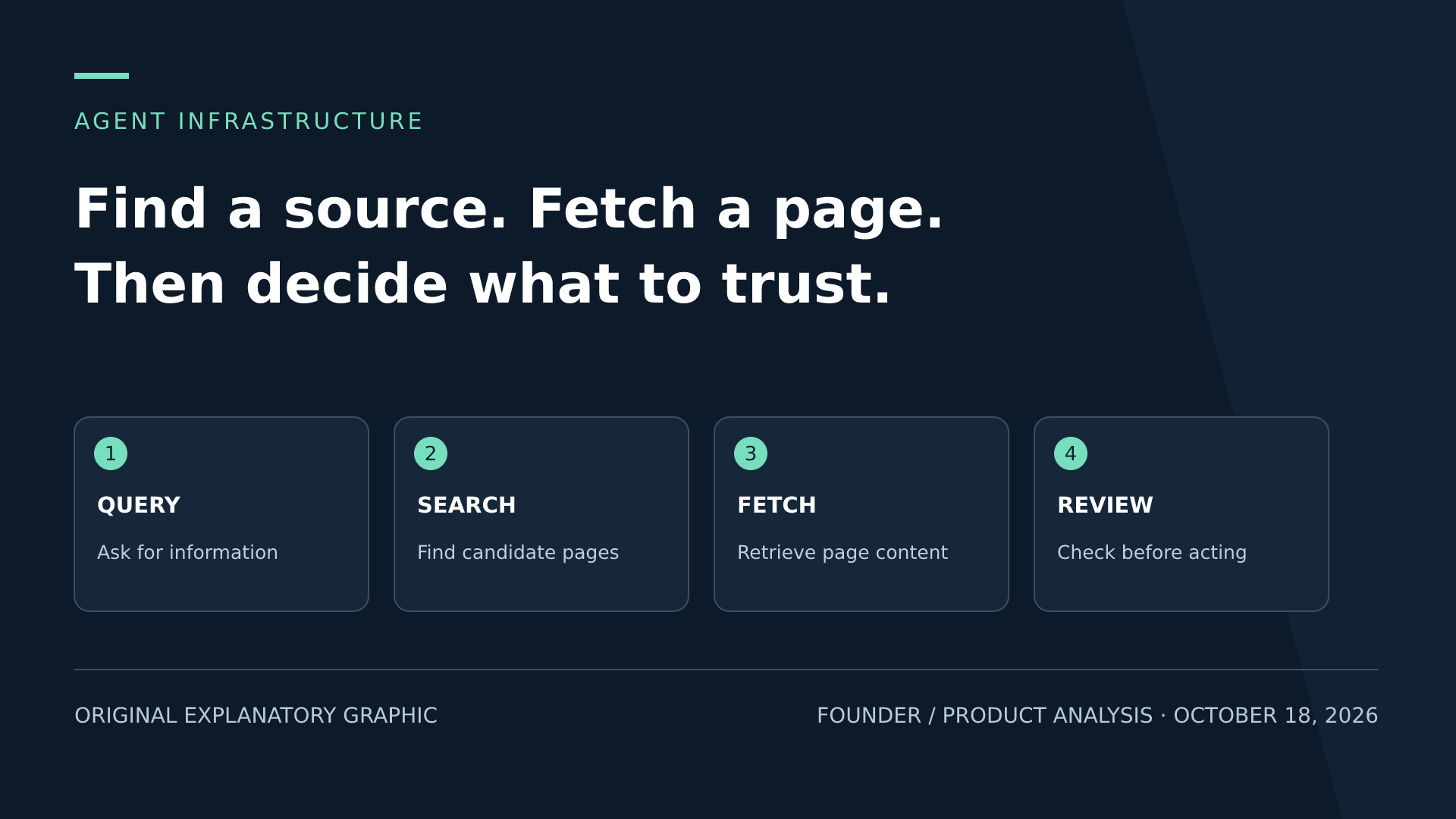
AGENT INFRASTRUCTURE — a practical distinction
QUERY
Ask for information
SEARCH
Find candidate pages
FETCH
Retrieve page content
REVIEW
Check before acting
Retrieval is not authority
The crucial boundary is between treating a page as evidence and treating it as an instruction. A retrieved document may contain outdated commands, promotional assertions or malicious text directed at an agent. Giving the model access to live content expands its information supply; it also expands the set of material that an application must classify and handle defensively.
For an engineering team, that suggests keeping source identity attached to the content throughout the workflow. The original URL, retrieval time and relevant version can matter when an answer later needs to be checked. A polished response without those references may be harder to debug than a less fluent one that clearly shows where its facts came from.
Access is a separate issue. The ability to fetch a page is not a licence to republish it, ignore access restrictions or incorporate its text into an unrelated dataset. Applications still need their own rules for permitted sources, quotation length and retention. A retrieval API cannot resolve those editorial or contractual decisions on the customer’s behalf.
A checkpoint needs a controlled trial
DeepSeek recommends upgrading its Harness to version 0.2.1-rc.1 or later for the refreshed model. That recommendation illustrates a broader point: model behaviour is experienced through a surrounding system of prompts, tools and execution limits. Replacing the model and the harness together may change several variables at once, making an apparent improvement difficult to attribute.
A startup evaluating the release could begin with a bounded set of representative tasks: a documentation-dependent change, an unfamiliar codebase and a task requiring an explicit refusal to act on untrusted page content. Holding the surrounding workflow constant would make the comparison more informative. These are proposed evaluation cases, not tests that Foundra has performed.
The useful opportunity is modularity. A team may find value in the retrieval service without adopting the new checkpoint, or in the checkpoint without expanding web access. Keeping those decisions separate preserves the ability to inspect cost and failure modes. The October release offers another building block for agent applications; the evidence for a dependable finished product still has to come from the application itself.
Sources
- DeepSeek October 17 model and retrieval announcement ↗ DeepSeek October 17 model and retrieval announcement · Primary source
- DeepSeek change log ↗ DeepSeek change log · Primary source
- DeepSeek Search and Fetch documentation ↗ DeepSeek Search and Fetch documentation · Primary source
Have additional information? Request a correction.