Contract wording, crawler preferences and copyright are related but distinct controls. The reported revision is not a blanket clearance to use a publisher’s work.
A narrower clause is not the whole dispute
For a publisher or small media business, a social-platform account can create a relationship that reaches beyond the platform itself. That is why a change to Meta’s commercial terms attracted scrutiny this week: the disputed wording concerned content on websites associated with business accounts, not only material uploaded directly to a social feed.
On October 17, Nieman Lab and The Verge separately reported changes to that wording. Nieman Lab dates the revision to Friday afternoon, October 16, and says it removed an explicit reference to training while narrowing specified uses to advertising and business products. The Verge also reported the removal of the disputed language. The date here follows Nieman Lab’s account of the underlying revision, not a later feed appearance.
There is a meaningful limitation to this reporting. Foundra’s direct retrieval of the commercial-terms preview was blocked by robots restrictions, which were respected. This article therefore relies on the independent reporting and reproduced wording, not a claimed firsthand inspection of the current contract. TechCrunch’s account is additional context, but its reliance on The Verge does not make it a third independent verification.
The distinction matters because the reports do not offer identical interpretations of the result. Removing controversial wording is an observable reported change. Deciding whether the remaining permissions are narrow enough is a separate legal question, and one that cannot be answered simply by identifying a deleted word.
Three controls that should not be collapsed
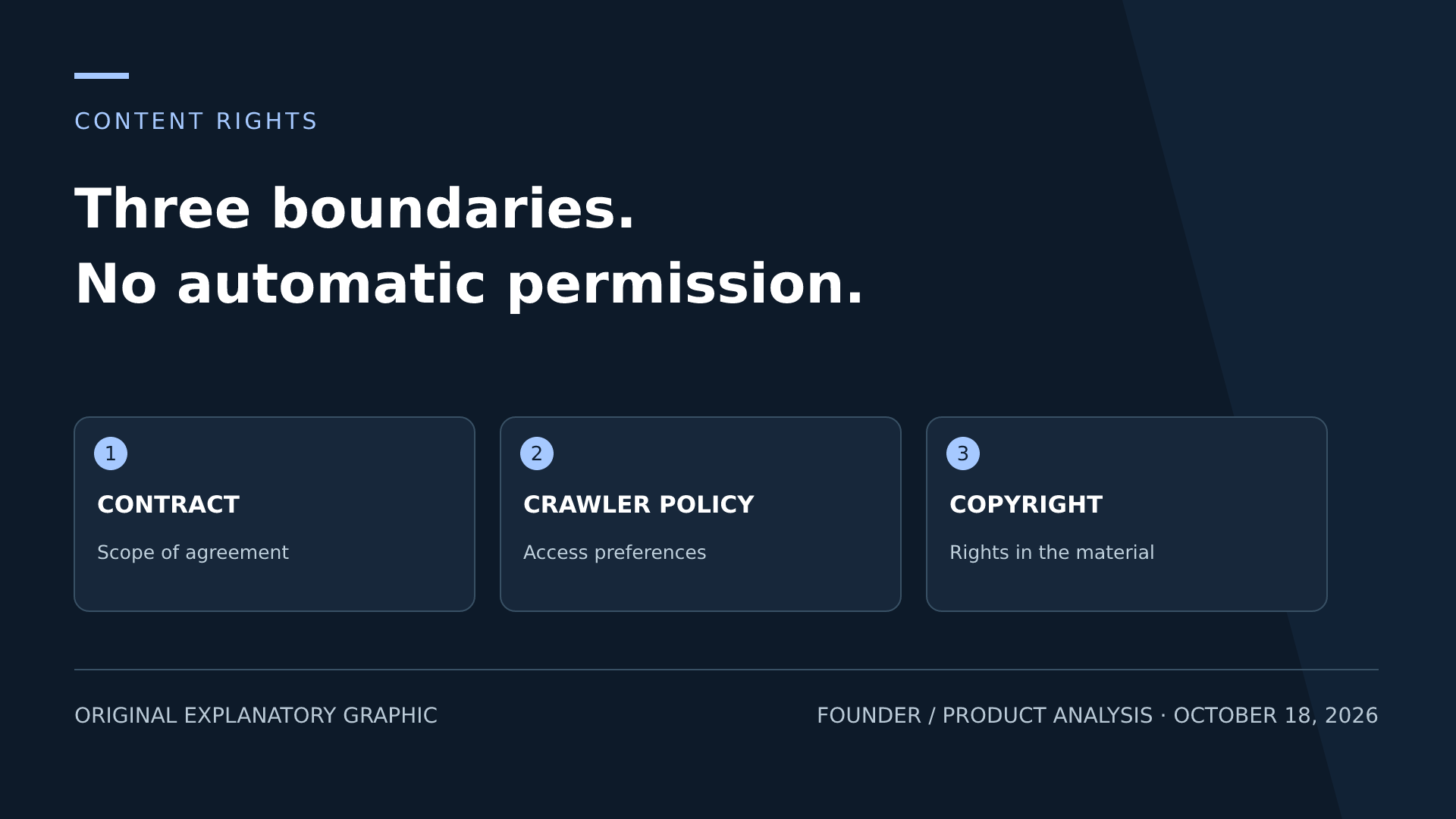
The first control is contractual: what a business account agrees to when it uses a service. The second is technical: which crawlers a site permits or blocks through mechanisms such as robots.txt. The third concerns the legal treatment of the material itself, including copyright. These controls may interact, but none is a convenient substitute for the others.
Nieman Lab reports that Meta said content owners can still disable its crawler through robots.txt flags and that this has not changed. It also reports concerns from legal specialists that the remaining commercial wording is broad. An assurance about crawler behaviour and a disagreement about contract scope can coexist; reporting one does not resolve the other.
A publisher should therefore avoid reading the revision as proof that no content can be used in any AI-related business product. Equally, the reported dispute does not justify declaring that Meta has actually scraped a particular blocked site, overridden a particular instruction or infringed a particular owner’s rights. No such site-specific evidence is supplied here.
The reported effective date for the upcoming terms is October 30. That creates a practical review window for affected businesses, not a licence for Foundra to provide an individual legal conclusion. Decisions about account use or contractual exposure should be made with the actual applicable terms and, where necessary, appropriate legal advice.
CONTENT RIGHTS — a practical distinction
CONTRACT
Scope of agreement
CRAWLER POLICY
Access preferences
COPYRIGHT
Rights in the material
For a startup, the asset may live elsewhere
A company’s website can contain much more than its social-media marketing. Technical documentation, product descriptions and independently produced research may sit on domains connected to a business account. The operational question is whether the team responsible for the platform relationship also knows which external assets could be implicated by the agreement.
One useful internal exercise would map that relationship without presuming infringement. Which domains are associated with the account? Who owns the material on those domains? Which content is licensed from other people? The answers can reveal responsibilities that a simple list of account administrators does not show. This is proposed housekeeping, not evidence of a problem at any named startup.
Crawler policy deserves its own record. A team can document the preferences it intends to express and the date it last checked them. That record does not establish what an external crawler actually did. Observing behaviour would require separate evidence, and a technical observation would still not settle the contract’s legal interpretation.
For businesses supplying original content, the most useful habit is to preserve the distinctions. Permission to access a page is not automatically permission to republish it. Permission for one commercial function is not necessarily permission for every future function. The boundaries have to be established rather than inferred from a broad platform relationship.
Clarity is the product requirement
The business issue extends beyond one revision. A platform asking other companies to trust it with content-related permissions benefits from wording that makes purpose, scope and control understandable. Ambiguity transfers interpretation costs to smaller businesses, which may lack the time or expertise to analyse each change in depth.
That is analysis, not a finding that the revised terms are unlawful. The available evidence supports a more limited conclusion: wording changed after public criticism, Meta renewed an assurance about crawler preferences, and independent specialists still raised questions about the remaining scope. None of those facts should be flattened into either total reassurance or an allegation of proven wrongdoing.
The next useful evidence would be the applicable final text and a clear account of how it relates to crawler controls. Until then, the responsible response is to check the boundary, retain the relevant versions and avoid treating a reported wording change as a settlement of the wider rights debate.
Sources
- Nieman Lab independent commercial-terms revision reporting ↗ Nieman Lab independent commercial-terms revision reporting
- The Verge independent commercial-terms revision report ↗ The Verge independent commercial-terms revision report
- TechCrunch contextual account, relying on The Verge ↗ TechCrunch contextual account, relying on The Verge
Have additional information? Request a correction.