The new event is a public financing disclosure, not an October close. The commercial test is whether industrial knowledge can become dependable operating software.
The announcement is new; the close is not
Aerium’s funding news comes with an important timing distinction. BetaKit reported on October 16 that the Toronto company had announced US$2.5 million in seed financing. Aerium’s own account says the money closed earlier this summer, from Gutter Capital and strategic angel investors. This is a newly public milestone, not evidence that a fresh round closed in October.
That distinction changes how the story should be read. The financing is part of the company’s existing operating resources, while the disclosure accompanies a description of its product and team-building plans. It does not by itself establish a current cash balance, monthly burn rate or runway. Those figures are not supplied in the retained announcement.
Co-founders Adam Trotman and Michael Dawes describe a business built around industrial manufacturers and distributors. Their company account connects the idea to experience building software for industrial clients at McKinsey. The product proposition is that valuable operational knowledge is fragmented across systems, spreadsheets, emails and people. Turning that knowledge into usable software is the opportunity Aerium is pursuing.
The difficult part is the handoff
Consider a hypothetical manufacturer deciding whether it can quote a new order. A sales team may need a price, procurement may need a supplier commitment and production may need an available slot. Even if each department has competent software, the decision can depend on information moving between them. An answer generated from one system alone may be incomplete.
Aerium’s website presents applications across equipment manufacturing, specialty chemicals, metal fabrication and distribution. Its platform descriptions span supply-chain and operational work. Those descriptions establish the intended scope, not proof that every advertised workflow is deployed successfully. The company’s customer statements are marketing evidence and should not be converted into independently verified automation rates.
The analytical challenge is to distinguish a helpful recommendation from an operational commitment. Suggesting an alternative supplier is different from placing an order. Explaining a schedule conflict is different from changing a promised delivery date. A buyer evaluating industrial AI should know where the product stops, who approves an action and how the resulting change appears in the systems people already use.
That makes implementation knowledge commercially important. A general-purpose model can help interpret text, but a customer still has to decide which records are authoritative and how exceptions are handled. The effort to establish those rules belongs in the evaluation alongside the software subscription. Otherwise, a seemingly lightweight deployment can leave the customer carrying an unpriced coordination burden.
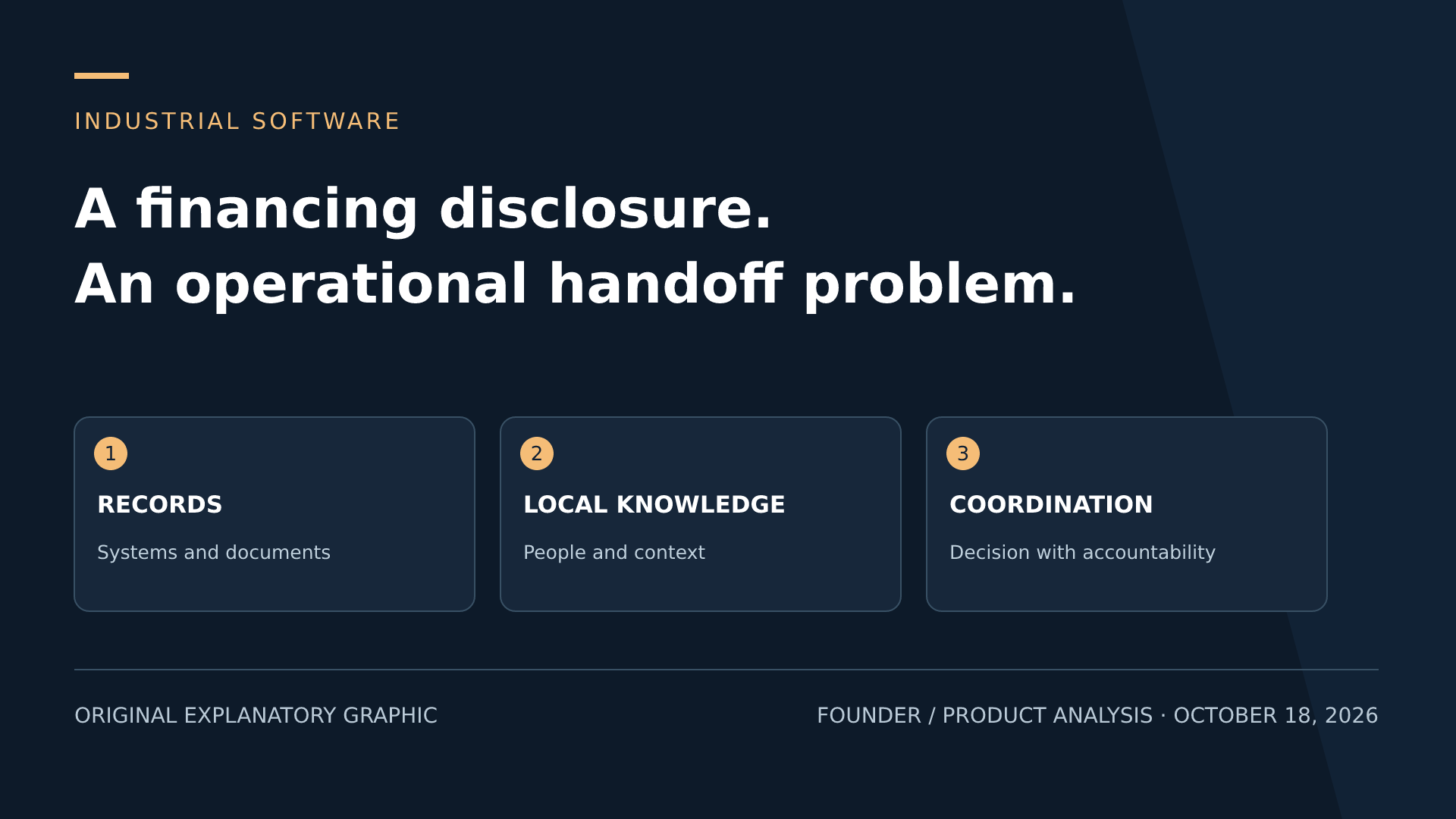
INDUSTRIAL SOFTWARE — a practical distinction
RECORDS
Systems and documents
LOCAL KNOWLEDGE
People and context
COORDINATION
Decision with accountability
Knowledge should remain inspectable
Aerium’s founders emphasise preserving the expertise accumulated inside industrial companies. The idea is attractive because an employee’s understanding of a supplier or production process may not fit neatly into a database field. But preserving that knowledge is not the same as accepting every historical practice as correct. An effective system needs a way to distinguish current policy from a remembered exception.
One proposed procurement test would be to trace a recommendation back to its inputs. A buyer could ask which stock record, specification and commercial assumption produced a suggested action. If the answer cannot be reconstructed, the difficulty is not merely explainability in the abstract. It becomes a practical obstacle when two departments disagree about why an order was prioritised.
Another test is reversibility. Industrial decisions can have consequences beyond the screen, so a pilot should establish what happens when an input changes or an approved recommendation proves wrong. These are evaluation questions, not allegations that Aerium lacks such controls. The public sources do not provide enough detail for Foundra to assess the product’s governance or integration quality.
A seed round buys a chance to prove the workflow
Aerium says it is hiring forward-deployed engineers in Toronto to work closely with customers, from initial ideas through deployment. That hiring description is consistent with a product whose value depends on understanding a customer’s operations. It also suggests that the early commercial challenge involves implementation, not simply making an AI interface available.
The funding disclosure provides no audited revenue, retention or profitability evidence. Its significance is narrower: investors have financed an attempt to make industrial coordination a software business, and the founders are explaining that attempt publicly. The claim should remain at that level until stronger operating evidence is available.
For founders and industrial buyers, the interesting question is where repeatability emerges. If each customer engagement produces reusable methods without erasing necessary local controls, the company may develop a more scalable product. If every deployment remains bespoke, the economics could look different. Neither outcome is established today. The October announcement opens that inquiry rather than answering it.
Sources
- Aerium public seed-financing disclosure ↗ Aerium public seed-financing disclosure · Primary source
- Aerium company news index ↗ Aerium company news index · Primary source
- Aerium product overview ↗ Aerium product overview · Primary source
- BetaKit original Aerium funding-disclosure report ↗ BetaKit original Aerium funding-disclosure report
Have additional information? Request a correction.