Pramana POD is currently for research use only, not diagnostic procedures. A smaller format and conditional throughput do not establish clinical authorization or total deployment cost.
The laboratory is the unit of adoption
Digital pathology begins with a physical specimen and a usable image, not with an AI interpretation. That makes the scanner a consequential part of the workflow: if an image needs repeated attention before someone can use it, the downstream software inherits the delay. A new instrument should therefore be evaluated as part of a laboratory process rather than as a specification sheet in isolation.
Evident announced the Pramana POD whole-slide imaging scanner on October 16 in its original English-language release. The benchtop system is aimed at small and medium-sized laboratories and specialist uses in larger institutions. Later translated releases carry different publication or dateline information; they are not new product events and are not the basis for this article’s original announcement date.
This is a product development from Evident, not an announcement of a newly independent startup or a financing round. The product page explicitly states: “For Research Use Only. Not for use in diagnostic procedures.” It says future clinical availability depends on applicable regulatory authorization, with status and availability potentially varying by country. The current-use restriction is essential to understanding the launch.
Automation before interpretation
According to the release, the scanner includes tissue finding, label detection, automated selection of focal planes and scan profiles, and built-in image-quality assessment. Evident says that assessment can identify scans requiring further review. These functions concern image acquisition and quality control; they should not be described as evidence that the instrument independently diagnoses a disease.
The company also advertises true 40X imaging at up to 25 slides per hour under defined conditions. That qualification belongs next to the number. A conditional throughput claim is not a promise that every lab will achieve the same rate with every specimen type. Foundra has not independently measured scanning performance or examined the conditions of a customer deployment.
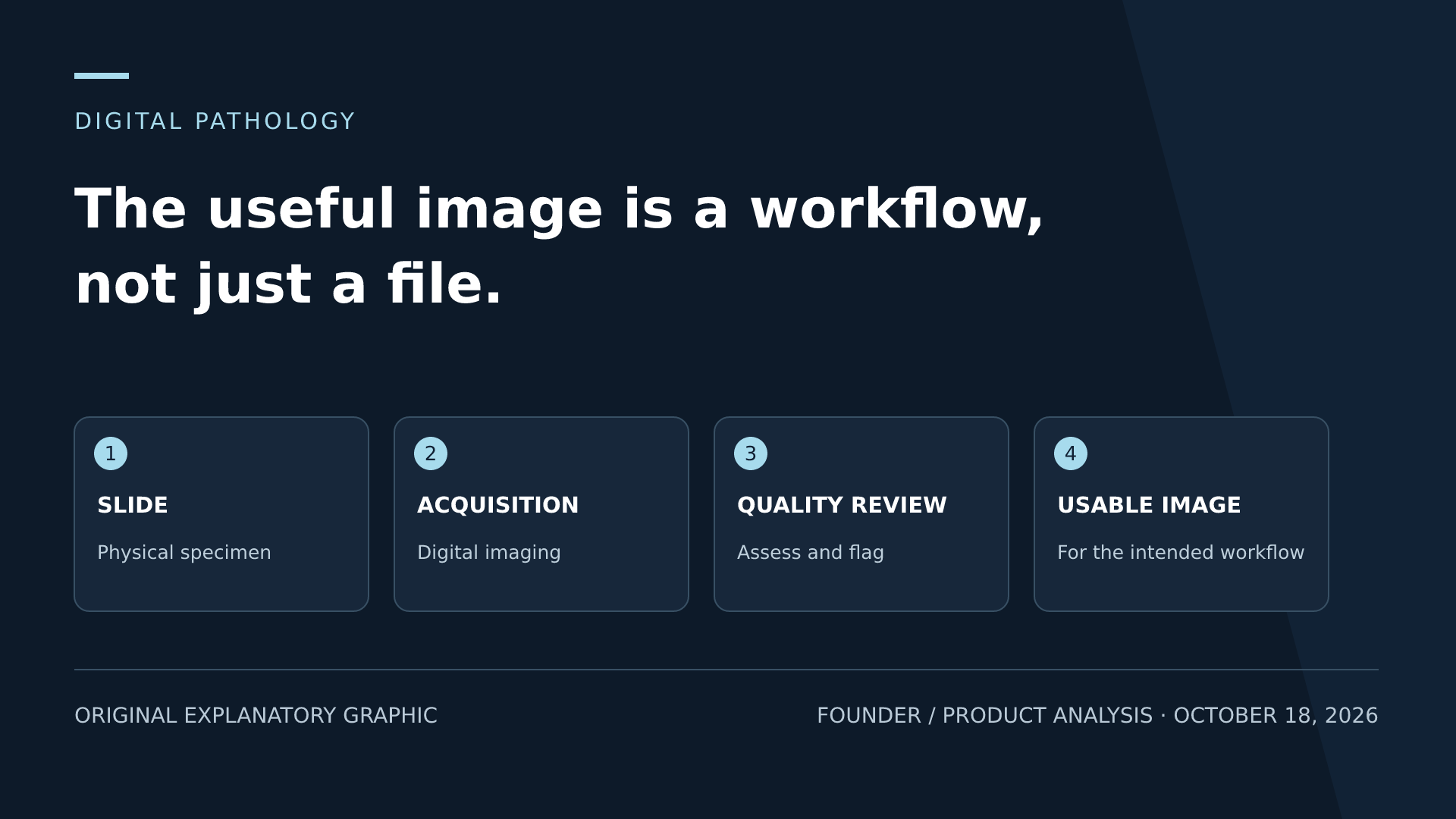
The analytical distinction is between producing a file and producing an image that fits its intended use. A workflow can require human attention even when much of the acquisition process is automated. The relevant question for a buyer is which checks have moved into the instrument, which remain with the laboratory and how an exception is communicated.
DIGITAL PATHOLOGY — a practical distinction
SLIDE
Physical specimen
ACQUISITION
Digital imaging
QUALITY REVIEW
Assess and flag
USABLE IMAGE
For the intended workflow
A compact instrument does not erase integration
A benchtop format may change where an instrument can be placed, but it does not establish the total cost of adopting digital pathology. A laboratory evaluating any scanner would still need to understand its connections to specimen identification, image storage, viewing software and local operating procedures. This is a proposed assessment framework, not a statement that Evident’s product lacks those connections.
The same reasoning applies to staffing. If a laboratory expects automation to reduce a particular task, it should first establish what that task currently involves and what still happens when a scan is flagged. Otherwise, work can shift from one stage to another while a headline automation claim remains unchanged. That shift might be useful, but it needs to be measured rather than assumed.
For startups supplying adjacent software, the instrument illustrates why interoperability matters. A product that analyses images depends on the quality and organisation of its inputs. It may also depend on whether a lab can locate the right image and preserve its connection to the right specimen. Those are practical dependencies, not evidence that any particular integration has been completed.
A pilot should include the inconvenient slides
An informative local evaluation would use representative work rather than only material chosen to show the system at its best. It could record which images require review, what the review entails and whether the process remains understandable to the staff responsible for it. Such a trial would test the laboratory’s workflow, not simply repeat a vendor’s throughput demonstration.
A buyer could also separate the questions it is trying to answer. Acquisition speed, image suitability, exception handling and compatibility are different dimensions. Strong results on one do not automatically establish the others. A research pilot must not be treated as clearance for diagnostic use. Any future clinical deployment would depend on the applicable authorizations, not the phrase digital pathology.
The retained announcement and product page do not support a Foundra claim of improved diagnostic accuracy, reduced patient waiting times or a quantified return on investment. No local trial, clinical comparison or hands-on review was performed for this article. The source material is sufficient to describe the launch and its intended functions, not to certify those broader outcomes.
The useful question is what becomes easier to adopt
Pramana POD’s positioning suggests a commercial effort to serve labs that may not need the same physical setup as a larger institution. The interesting question is whether the complete adoption path becomes more manageable: the instrument, the routine work around it and the handling of cases that do not pass cleanly through the process.
That question is more consequential than treating a smaller form factor as proof of accessibility. Price, operating constraints and local requirements determine what a particular lab can use. The October announcement supplies a new option to examine. Evidence that it changes a lab’s economics or clinical practice will have to come from the deployment, not the launch language.
Sources
- Evident original English Pramana POD release via PR Newswire ↗ Evident original English Pramana POD release via PR Newswire · Primary source
- Evident Pramana POD product information ↗ Evident Pramana POD product information · Primary source
- Later translated Evident release, not the original event ↗ Later translated Evident release, not the original event · Primary source
Have additional information? Request a correction.