An industrial alert needs engineering context and accountable human judgement before it becomes an operational response.
The alert is only the beginning
A security notification is not yet an explanation of what is happening inside an industrial process.
Indurex is pursuing the space between those two things. The Amsterdam company announced on October 22 that it had raised €7 million in a round led by Contrarian Ventures, with Axeleo Capital and Curiosity participating. Its official release says the funding will support research and development and commercial expansion, initially prioritising Europe and the Middle East. Further expansion into the United States and Asia-Pacific is a plan, not a completed rollout.
The company calls its approach Engineering Intelligence. It describes a platform that combines cybersecurity information with engineering configurations, protection settings and safety-system context. That description is important because it locates the product’s ambition beyond listing connected devices. It also needs to be read as a company proposition, not as an independently established measure of industrial safety.
Imagine an operator receiving a warning about an unfamiliar connection while a maintenance task is underway. The connection might require investigation, but the appropriate response would depend on what equipment is involved, who is authorised and what process is currently running. This is an illustrative scenario, not a report of an incident at Indurex or one of its customers.
The company’s proposed value is to help assemble the context in which such a decision can be made. The financing is a current event. Whether the assembled information reliably supports a particular operator’s response remains an evaluation question.
A network record and an engineering record tell different stories
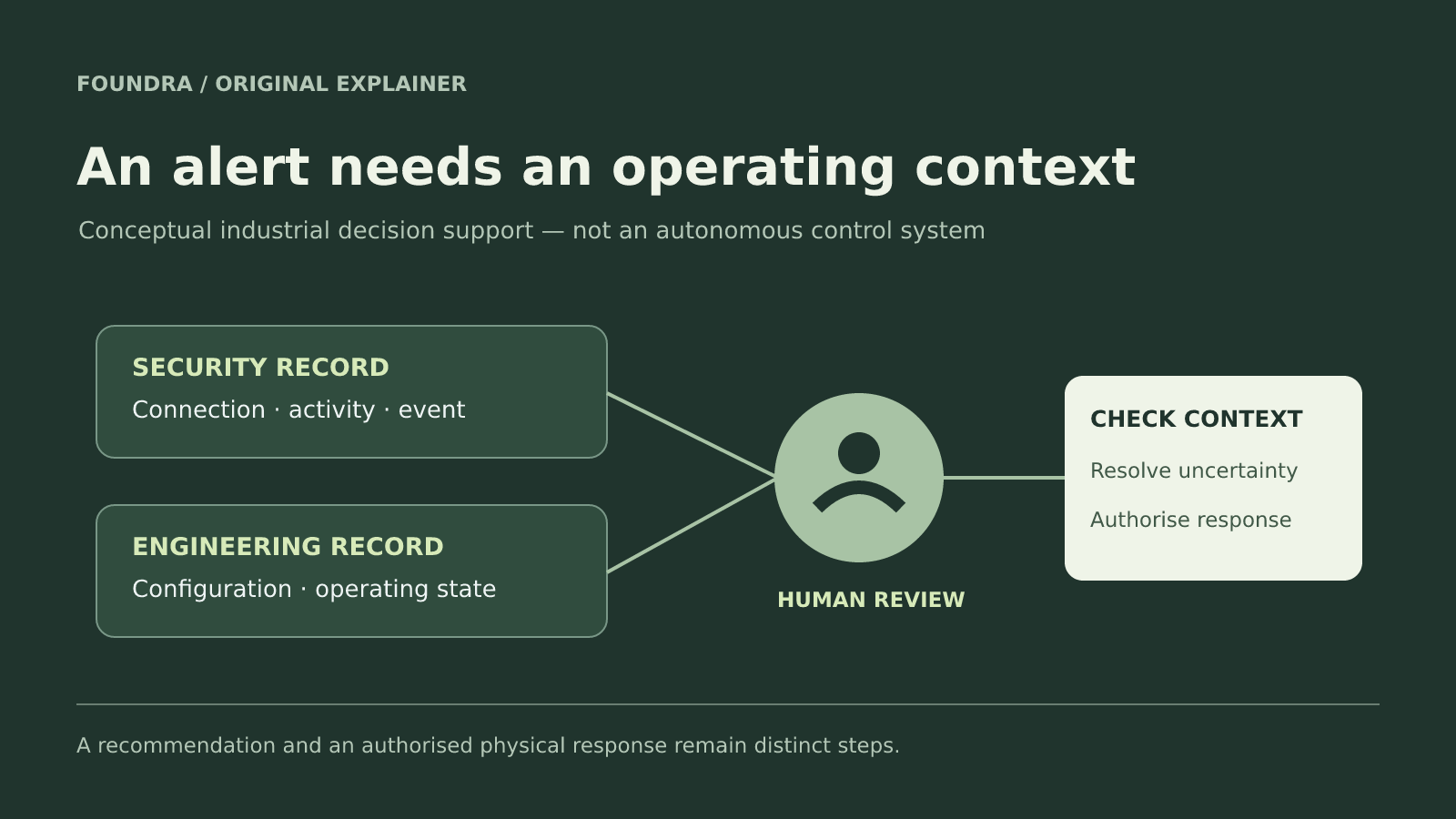
A network view can describe a connection or activity. An engineering view can describe the intended configuration and relationship of equipment within a process. Joining them is potentially useful because the significance of a digital change may depend on its physical role. That is the logic of the category, not a conclusion that every connection automatically creates a safety risk.
Indurex says SafeGuard AI ingests information from distributed control systems, safety instrumented systems, historians, alarm-management systems and IT security tools. Its release describes AI agents surfacing anomalies and engineering deviations that require human attention and decision-making. These are advertised capabilities; Foundra has not tested the integrations or audited the quality of the resulting recommendations.
The distinction between a recommendation and an automatic control action should remain explicit. The source describes context-aware insights and recommended actions. It does not establish that the platform autonomously changes plant controls, nor does this article claim that it does. For an operator evaluating the system, the route from a recommendation to an authorised response would be a central part of the review.
In a hypothetical comparison, two similar digital alerts might concern different pieces of equipment or different operating states. Treating them identically could lose important context. But adding context also creates dependencies: records must be current, equipment identifiers must align and disagreements between data sources need a resolution process. More information is useful only if the user can understand which parts are dependable for the decision at hand.
From digital alert to accountable response
Observe
Identify the security event and its source record.
Add context
Relate it to current engineering and operating information.
Human decision
Review uncertainty and authorise the appropriate response.
What a buyer should be able to reconstruct
A practical assessment could start with a known operational scenario and ask the platform to show the records behind its interpretation. Which security event was observed? Which engineering configuration was used? Was the relevant operating state current? This would be a proposed evaluation, not an experiment conducted by Foundra. It would test the explanatory chain rather than simply the attractiveness of a consolidated dashboard.
The human handoff would also deserve examination. A recommendation should identify what remains uncertain and which role is responsible for acting. An operator may need to compare it with maintenance records or other procedures before deciding. These considerations do not allege a deficiency in Indurex; they follow from the company’s stated position at the intersection of cybersecurity, engineering and safety.
Indurex’s release contains customer-benefit claims and a testimonial whose speaker is identified only by a role and a generic organisation description. This article does not use that material as independent evidence of fewer interruptions, better safety or lower costs. A funding announcement can describe why customers might buy a product without establishing those outcomes through independently accessible measurements.
The investment gives the company resources to pursue both product work and commercial reach. The meaningful next evidence would connect a documented industrial context to a traceable recommendation and an accountable response. That is a more specific ambition than “AI for infrastructure”: helping an operator understand why an alert matters before deciding what to do about it.
Sources
- Indurex: October 22 €7 million funding announcement ↗ Indurex: October 22 €7 million funding announcement · Primary source
- Indurex: official platform description ↗ Indurex: official platform description · Primary source
- EU-Startups: Indurex financing report ↗ EU-Startups: Indurex financing report
Have additional information? Request a correction.