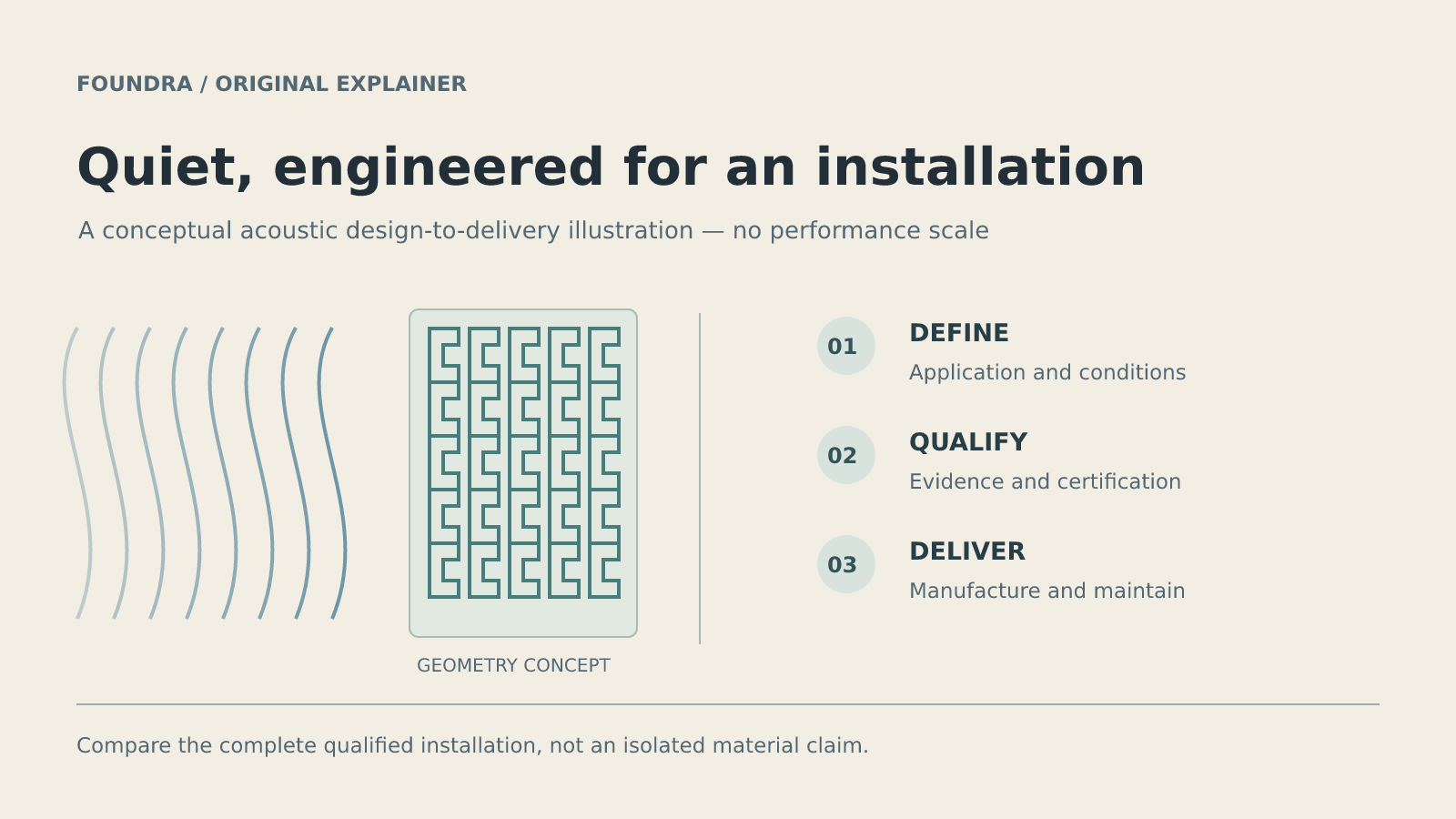
The value of a lighter acoustic product depends on the whole installation: certification, manufacturing, maintenance and the noise it actually controls.
Quiet has to be delivered, not just designed
A quieter railway or industrial enclosure is not bought as a laboratory result. It arrives as a product that must be manufactured, installed and accepted for a specific use. That gap between an acoustic idea and an operational asset is the useful lens for Phononic Vibes’ latest financing: the Italian company is seeking to expand an industrial business, not merely demonstrate an unusual material.
In an October 22 announcement published by lead investor Jolt Capital, Phononic Vibes said it had secured €25 million in financing. Eureka! Venture SGR, CDP Venture Capital SGR and Simest also participated. The announcement describes international growth, new applications and stronger delivery capabilities as uses for the investment. Those are objectives, not evidence that the expansion has already occurred.
The transaction also includes the acquisition of early investor 360 Capital’s stake. That detail makes it important not to treat the entire headline amount as a disclosed quantity of fresh operating cash. The announcement does not provide a primary-versus-secondary allocation. Nor is the stake transaction an announcement that Phononic Vibes itself has been acquired in full.
The shape inside the product
Phononic Vibes describes its approach as acoustic metamaterials: structures designed so their geometry contributes to noise and vibration control. Its investor announcement says products can weigh up to 30% less at the same acoustic performance, or perform better at the same weight. That is a company-and-investor performance claim. Foundra has not tested those products, and the percentage should not be read as a universal result for every application.
A lighter solution could, in principle, change more than a material bill. It might alter handling, supporting structures or installation requirements. But those consequences depend on the actual project. A useful comparison would keep the acoustic requirement constant and examine the complete installed system, rather than comparing isolated panels while ignoring how they are mounted or maintained.
The same caution applies to visual form. A transparent barrier and an opaque enclosure solve different site problems even if both reduce noise. A buyer needs to know which performance requirement a proposed design satisfies, where that requirement is measured and what conditions the certification covers. The attraction of engineered geometry does not remove those application-specific questions.
From acoustic design to an operating asset
Define the job
Specify the noise-control requirement and installation conditions.
Qualify the product
Match design and certification to that particular application.
Deliver and maintain
Assess manufacturing, installation and lifecycle support together.
References are a starting point for scale
Jolt’s announcement says Deutsche Bahn has certified the company’s transparent barrier for the German rail network and that Mercedes-Benz uses its technology in series production. These are attributed reference claims in the financing announcement, not fresh confirmations obtained from those customers. They provide a description of the company’s commercial position, but they do not establish that every future design will receive equivalent approval.
The company was founded in 2018 as a Politecnico di Milano spin-off and says it manufactures in Italy. That background helps explain why the financing is about both design and delivery. Entering another market could require different product documentation, supplier arrangements or installation practices. The engineering platform may be reusable while the finished product still needs a new route to acceptance.
For an industrial customer, continuity also matters after installation. A useful procurement discussion would ask how replacement parts, design changes and maintenance records are handled over the asset’s life. These are analytical considerations, not undisclosed problems at Phononic Vibes. They are what separates a compelling acoustic demonstration from a supplier relationship that an operator can depend on.
A financing for the less glamorous work
Jolt says targeted acquisitions are intended to complement expansion by adding reach and industrial capabilities. That is a strategy, not a list of newly completed acquisitions. The firm’s announcement also places this investment within Jolt Capital V, a fund targeting €1 billion and nearing its final close. The target for that fund is separate from the €25 million company transaction and should not be mistaken for money already raised by Phononic Vibes.
The story’s significance lies in a possible shift from clever acoustic designs to repeatable industrial delivery. If the company can preserve application-level performance while improving weight, installation or manufacturing economics, the gains would be tangible. The financing supplies resources for that effort; the next evidence should come from documented deployments and comparable installed outcomes, not from making the headline percentage do more work than its conditions allow.
Sources
- Jolt Capital: October 22 Phononic Vibes financing announcement ↗ Jolt Capital: October 22 Phononic Vibes financing announcement · Primary source
- Phononic Vibes: official company and product page ↗ Phononic Vibes: official company and product page · Primary source
- EU-Startups: Phononic Vibes financing report ↗ EU-Startups: Phononic Vibes financing report
Have additional information? Request a correction.