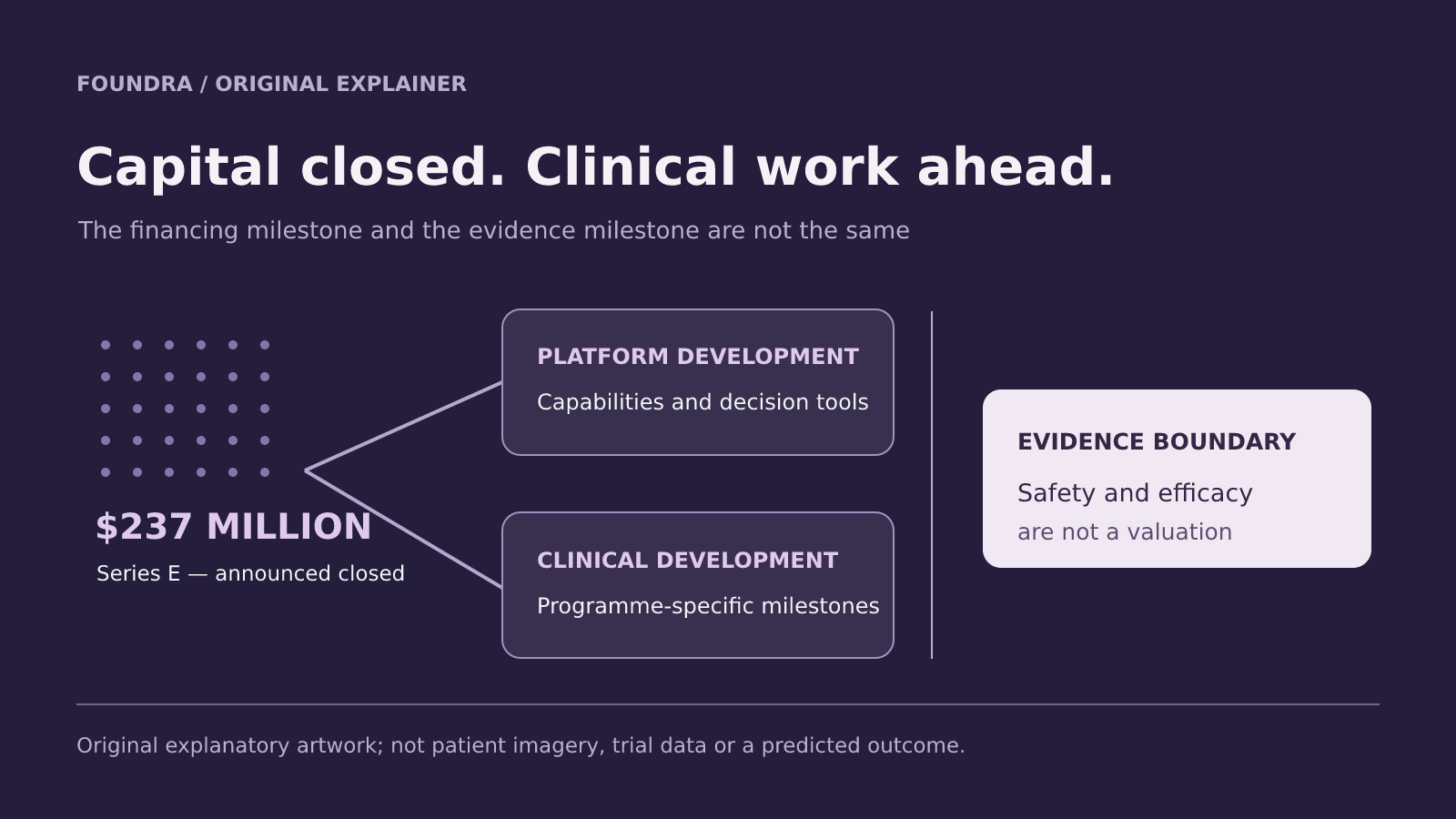
Financing can fund an AI-guided development strategy. It does not establish a therapy’s effectiveness or turn a planned study into a completed one.
A closed round and a development objective
Closed financing is the milestone announced in Pathos AI’s October 23 release. The company reports a $237 million Series E led by Bristol Myers Squibb, alongside existing investors, at an approximately $3 billion post-money valuation. Movement toward registrational studies is described as a funding objective; the release does not announce a new clinical result. That distinction describes what this announcement establishes, not a claim that no clinical milestone or result exists elsewhere.
The New York company describes itself as a clinical-stage AI and technology business developing its own therapeutic pipeline. Proceeds are intended to expand its Foundry platform and advance clinical assets. One stated priority is moving JSKN016 toward registrational studies. The announcement’s language about future studies is not a report that a registrational trial has already started, finished or produced successful results.
That separation is especially useful in AI drug development, where a single announcement can bundle software capabilities, portfolio decisions and ambitions for patients. They belong to different evidentiary categories. The financing is a corporate transaction. The platform description is the company’s account of its technology. The clinical ambitions still require evidence from the development programmes themselves.
A platform attached to a drug portfolio
Pathos says Foundry uses specialised AI agents to combine information relevant to a drug programme, including clinical, genomic and biological data alongside the competitive landscape. Its proposed purpose is to inform asset selection, portfolio choices and subsequent development decisions. Those are company claims about how the platform works; this article has no independent benchmark showing that it raises the probability of clinical success.
The business is therefore not being presented solely as software sold to researchers. Pathos says it is advancing its own clinical assets. The company’s release identifies four active clinical assets and names JSKN016, pocenbrodib, AZD4241 and DO-2 among the programmes the capital will support. The list describes a development pipeline, not a group of medicines newly approved for routine patient use.
JSKN016 is described in the release as a TROP2/HER3 bispecific antibody-drug conjugate. For this story, the important fact is its place in the stated funding plan: Pathos wants to move it toward registrational studies. The announcement does not supply a new trial-results dataset with which to assess its safety, efficacy or comparative benefit. Those conclusions cannot be inferred from the size of the round.
A financing is not a clinical result
Closed financing
Pathos announces $237 million in Series E capital.
Development plan
Platform expansion and movement toward study milestones remain plans.
Clinical evidence
Safety and efficacy require programme-specific results, not a valuation.
The questions that software cannot retire
In principle, a continuously updated research system could help a development team notice a relevant change earlier or compare competing explanations more systematically. That is a possible workflow benefit, not evidence that a particular therapy works. A better organised decision process and a better clinical outcome are related ambitions, but they are not the same observation.
A useful evaluation would ask which decisions the system influenced and what information was available at the time. Did it generate a new hypothesis, rank existing options or surface evidence a team had overlooked? How were conflicting data handled? These are proposed questions for evaluating an AI-guided programme, not undisclosed findings about Pathos or a claim that Foundra has examined its internal records.
The treatment question remains separate. A model’s recommendation would have to be tested against the appropriate clinical evidence for the programme. If a trial result disappoints, an attractive retrospective explanation would not itself validate the earlier recommendation. Conversely, a successful programme would not automatically reveal how much of the outcome came from the AI platform rather than other scientific and operational work.
Read the valuation as a financing term
Bristol Myers Squibb’s role as lead investor is a fact reported by Pathos in the financing announcement. It shows participation in this transaction, not regulatory endorsement or a clinical guarantee. The approximately $3 billion post-money valuation is likewise a financing figure. It should not be treated as a measured value of future patient benefit or as a forecast that all named assets will reach the market.
The scale of the round makes the execution path worth watching. Pathos plans to invest in both platform capabilities and clinical development, so future updates should distinguish software progress from programme milestones. A new analytical capability, a study initiation and a clinical result would each be news, but they would answer different questions.
For now, the defensible conclusion is narrower and still substantial: Pathos has announced a closed, large late-stage financing to pursue an AI-guided drug-development strategy and its own pipeline. The funding gives that strategy more resources. The next chapter should be written from dated programme evidence, with the difference between an intended study and an observed result kept intact.
Sources
- Pathos AI: October 23 Series E closing announcement ↗ Pathos AI: October 23 Series E closing announcement · Primary source
- Pathos AI: official company and pipeline description ↗ Pathos AI: official company and pipeline description · Primary source
Have additional information? Request a correction.