An auditable credit analysis needs traceable inputs and controlled access. Fluent output cannot substitute for either.
Before the answer, which document?
An analyst comparing two borrowers may have a neat spreadsheet for one and a collection of private disclosures for the other. Both can become inputs to an AI-assisted workflow, but they are not interchangeable. The first question is not how persuasively a model can explain a balance sheet. It is which statement, period and set of permissions sit behind the numbers it is using.
Cognitive Credit’s October 22 announcement puts that source layer at the centre of a completed $40 million strategic growth investment led by Summit Partners, with continued participation from ETFS Capital. The company and the investor each published an announcement. They are transaction participants, not independent assessments of the product, but their statements expressly describe completion rather than a planned fundraising target.
The company provides corporate-credit data, analytics and AI tools. It says the investment will support global growth, commercial expansion in the United States and product development. The distinction between its current offerings and its roadmap matters: the announcement describes DealConnect for private issuers as an imminent launch, and agentic credit analysis as a pending deployment. Neither should be reported as already generally available on the strength of this financing release.
Public coverage and private access are different jobs
For its existing platform, Cognitive Credit describes credit models and primary-reporting libraries covering more than 3,500 corporate bond and loan issuers across the United States, Europe and emerging markets. This is the company’s coverage claim, not a count independently audited by Foundra. Its website and announcement describe a web application, Excel add-in, REST API and Claude connector as routes into the data.
In an illustrative public-issuer workflow, an analyst might compare a revenue figure across reporting periods and then return to the underlying disclosure. The benefit would be the path back to the source, not merely the speed of producing a table. A system that preserves that path makes it possible to examine definitions, restatements and context before the result is used in a decision.
A private-issuer workflow adds another layer. DealConnect is described as providing access to credit models for issuers that report through secure data rooms. The design question is therefore not only whether information can be extracted, but whether a particular user or automated process is entitled to retrieve it. A private disclosure does not become public information because a model can summarise it.
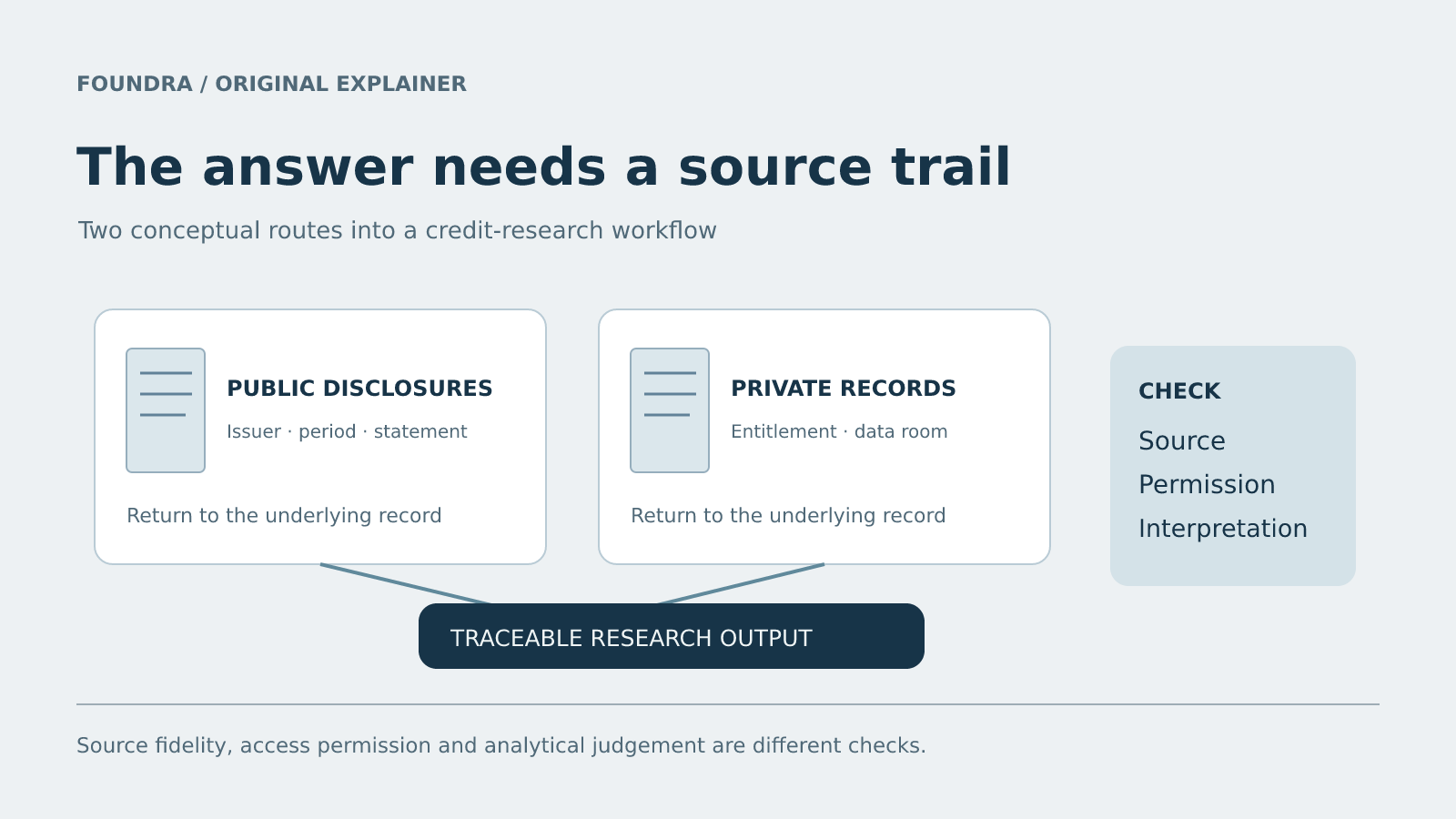
Two routes into credit research
Public disclosures
Preserve the issuer, reporting period and original statement.
Private data rooms
Check entitlement before retrieval or model access.
Shared discipline
Keep transformations and conclusions traceable to authorised inputs.
Auditability is a relationship, not an adjective
Cognitive Credit says its outputs are auditable and traceable to source. That promise can be evaluated more concretely than a general claim of AI accuracy. A buyer could ask for the exact document and period behind an output, an explanation of any transformations, and a way to reproduce the result. This is a proposed assessment framework, not a report of testing performed on the company’s software.
Traceability would still leave work for the analyst. Two disclosures can use different definitions for superficially similar measures. A number can be correctly extracted but unsuitable for the comparison being attempted. Access can be authorised while the analytical inference remains weak. Source fidelity, accounting interpretation and an investment conclusion are separate stages; a good workflow would not collapse them into a single confidence score.
The same separation is important when an agent performs several research steps. Retrieving a file, building a model and drafting a conclusion may each need a record of what happened. If an input changes, the user should be able to identify which downstream outputs depended on it. That is an analytical expectation for the category, not a claim that the planned agentic product already implements every such feature.
What the growth capital is buying time to build
The company also makes adoption and user-growth claims in its release. Those figures are not necessary to establish the transaction, and this article does not present them as independent evidence that the tools improve investment results. A data platform can be widely used without settling how much of a particular institution’s outcome is attributable to that platform.
The investment is consequential because it connects a specialised data business with an expanding set of AI interfaces. A connector may make an existing dataset easier to reach, while a private-issuer product may expand the kinds of records a workflow can handle. These are different forms of growth, with different access and verification requirements.
For credit teams, the useful standard remains prosaic: can the user move from an answer back to an authorised, identifiable source and understand what changed along the way? Cognitive Credit now has additional capital to pursue its roadmap. Whether that roadmap earns trust will depend on the quality of those links between documents, models and decisions—not on the fluency of the final paragraph.
Sources
- Cognitive Credit: completed $40 million investment announcement ↗ Cognitive Credit: completed $40 million investment announcement · Primary source
- Summit Partners: Cognitive Credit growth investment announcement ↗ Summit Partners: Cognitive Credit growth investment announcement · Primary source
- Cognitive Credit: official product page ↗ Cognitive Credit: official product page · Primary source
Have additional information? Request a correction.