For design work, making an image and making it editable are related but distinct problems. Canva Craft is a new approach to the first, with a route toward the second.
Design is more than a collection of pixels
A poster can look impressive and still fail at its job. The important text might be hard to read, the product might be too small, or the visual hierarchy might send attention to the wrong place. Those are composition problems as much as image-generation problems. Canva’s new model, Craft, makes that distinction part of its reported architecture.
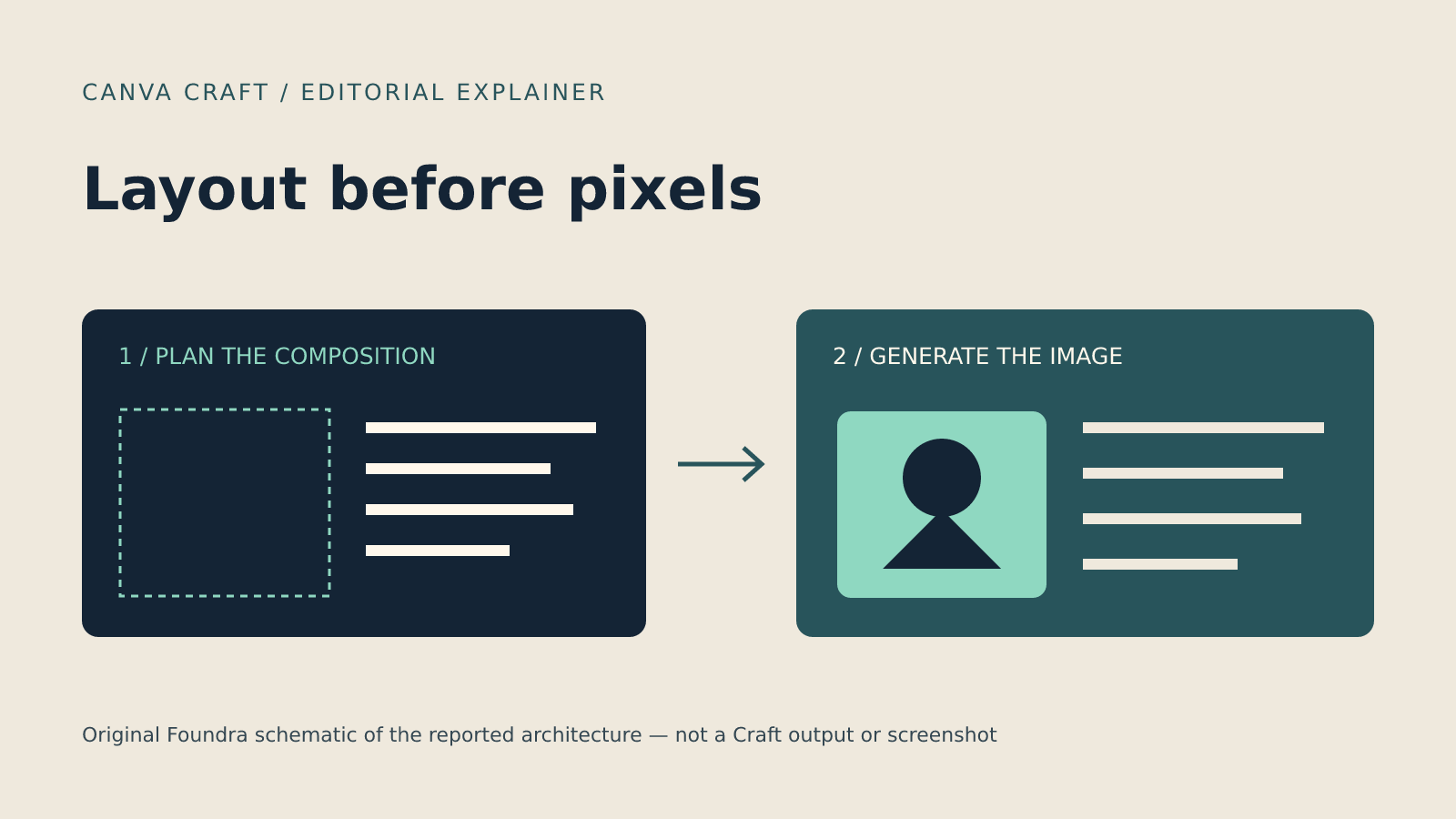
Canva released its first image-generation model on October 22, according to TechCrunch’s launch report and The Verge’s separate report, which refers to the company’s Thursday announcement. The model uses a planning stage before image generation. The reports attribute to Canva a process that considers placement, relative size, hierarchy and text before producing the final image. Foundra could not retrieve the company’s announcement because it returned HTTP 403; this article relies on the two independently bylined reports, not an invented primary readback.
That sequence is the product news. Canva’s claims about greater control, legible text and precise editing are claims about the intended or reported capabilities. They are not independently verified performance findings from Foundra. No paid product test or comparison benchmark was conducted for this article.
The plan is a useful place to put constraints
Foundra’s interpretation is that the planning stage gives the model a place to organise constraints before rendering them together. A design brief can contain competing requirements: make one element prominent, preserve room for a headline and fit an unusual format. Treating those requirements as a composition problem may be more useful than regarding them as an undifferentiated request for a beautiful picture.
As an illustrative example, a creator might need an event announcement in which the date remains legible and a sponsor mark does not dominate the page. A plan could describe how those elements relate. Whether the resulting image follows that plan is a separate question. This example is not a Craft output, a tested prompt or a claim that the model correctly handles that particular task.
Separating stages can also make a failure easier to describe conceptually. The composition could be reasonable while the final rendering is inaccurate, or the rendering could faithfully follow a poor plan. The launch reports do not establish whether users can inspect or control every intermediate decision. The distinction is analytical: a two-stage description should not be expanded into an unsupported claim about an exposed planning interface.
Two model stages, followed by editorial responsibility
Plan
The reported first stage organises the composition.
Generate
The second stage produces the image; accuracy remains a claim to assess.
Review and revise
The creator checks the message, details and usefulness of the resulting material.
Training on designs changes the emphasis
TechCrunch reports that Canva trained the model on human-designed templates from its library, including typography-rich layouts. The Verge likewise reports the company describing training material from the platform’s template collection. This is an attributed description of the training input, not a dataset audit. It does not establish the complete composition of the training set or resolve every rights question associated with it.
The emphasis helps explain why Craft is being presented as a design-oriented model rather than simply another way to generate scenes. A layout carries relationships between elements: a heading and its supporting text, an image and its caption, a foreground subject and surrounding space. Foundra’s analysis is that a product built around those relationships can be judged on usefulness in a design task rather than realism alone.
That does not mean realistic imagery is irrelevant or that Canva has abandoned other tools. It means the new model’s reported design choices should be examined on their own terms. A good-looking example from one task would not establish reliable handling of all layouts, languages or revision requests.
A generated image still has to become working material
TechCrunch reports that Craft is available through Canva’s Dream Lab and that generated images can be converted into layered designs using Canva Magic. The existence of a route from an image to a layered design matters because designers often need to revise a piece rather than merely accept it. The report describes a capability and integration; it does not establish the accuracy of every conversion.
Here the difference between appearance and structure becomes practical. A picture of a headline is not necessarily editable text. A picture with several objects is not necessarily a document with independently controllable elements. A creator who needs repeated revisions should assess what can actually be changed in the resulting material, rather than assume that visual separation implies editing control.
The same caution applies to a model’s ability to make a precise edit without changing other details. That can be an important aspiration, but a useful assessment would examine the details that remain as well as the detail that changes. A successful isolated edit does not establish that all future edits will preserve the rest of a design. Foundra is not assigning an error rate or ranking Craft against another model.
A design tool, not a verdict on the designer
Craft’s launch is a move toward treating image generation as part of a design workflow. The reported planning stage, template-oriented training and route into layered material all point to that product direction. They do not remove the need to decide what the work is meant to communicate or to examine the finished result.
For a creator, the interesting possibility is a tool that produces material closer to the structure of the intended job. The lasting distinction is between an image that looks finished and a design that is ready to use. Canva has introduced a new approach to that distinction; the launch itself does not settle it.
Sources
- TechCrunch: Canva Craft launch ↗ TechCrunch: Canva Craft launch
- The Verge: Canva Craft launch ↗ The Verge: Canva Craft launch
Have additional information? Request a correction.