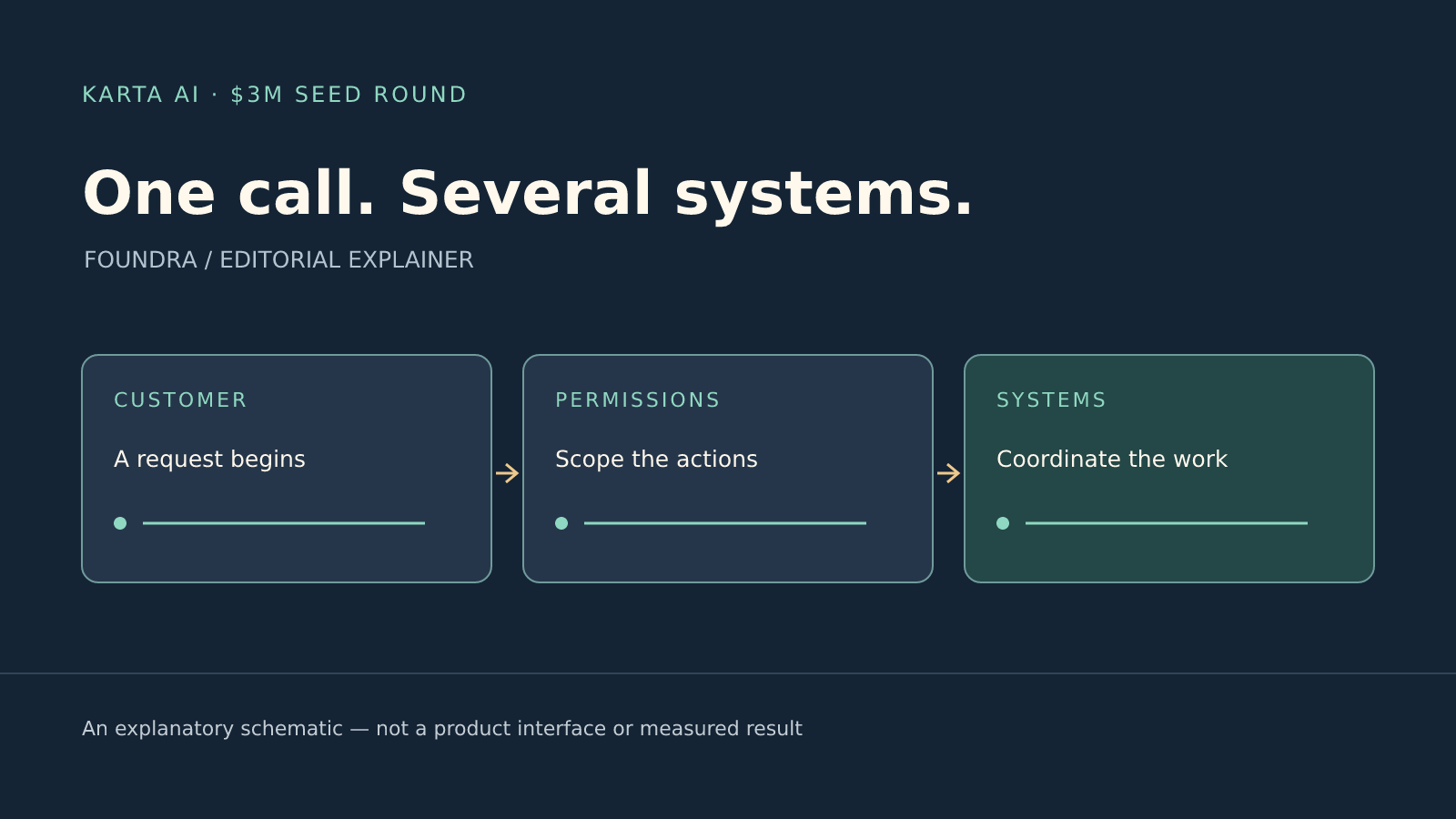
For financial-service voice agents, a plausible answer and a completed, authorised customer request are different products.
A caller brings more than one problem
Consider a hypothetical borrower who calls a lender to ask for a loan statement and also wants to change a correspondence address. The first request concerns a document. The second concerns a customer record. A fluent voice agent could acknowledge both in a single conversation and still leave one unfinished. This imagined call illustrates the distinction behind Karta AI’s funding news: conversation is the entry point, not the whole job.
Karta AI disclosed a $3 million seed round in an October 22 press release reported by Indian Startup News. Inc42’s separately bylined report identifies PeerCapital and Cedar Hill Capital as the lead investors and Wyser VC, CDM Capital and Seedstars as participants. Both reports describe a completed raise, rather than an intention to seek funding. Foundra has not independently examined the financing documents.
Founded in 2024 by former Razorpay executives Vijaypal Singh and Abhishek Kushwaha, the startup provides customer communication software across voice, chat, email and WhatsApp. Voice is its main focus. Inc42’s account of the round describes plans to strengthen product development and distribution; Indian Startup News also reports investment in multilingual capability and deployments with financial institutions. These are intended uses of the capital, not completed expansion milestones.
The conversation has to reach the record
The financial-service setting makes this a different proposition from a general-purpose chatbot. Karta is targeting inbound requests that need information or actions from more than one enterprise system, according to the two reports. Foundra’s analysis is that the difficult boundary lies between understanding the caller and changing an operational record. A statement may be easy to describe; locating the correct account, checking permission and delivering the correct document are separate responsibilities.
Return to the hypothetical call. If the document request succeeds but the address change fails, the agent should not announce that everything is complete. A useful service design would preserve the difference between a retrieved record, a submitted change and an accepted change. It would also make that difference available to a human colleague if the conversation is transferred. These are illustrative requirements, not claims that Karta already implements each safeguard.
An agent can also create work while appearing to save it. A polite response that leaves the customer uncertain may generate another call. A fast interaction that changes the wrong record can create a more serious problem. Evaluating this type of product therefore requires looking beyond the sound of the conversation to the state of the request after the customer hangs up.
An illustrative service request has three states
Understand
Identify each request in the conversation; this is not yet completion.
Execute
Check permissions and track the result of each authorised action.
Explain or hand off
Tell the customer what succeeded, what remains and where help continues.
What the customer numbers do—and do not—establish
Inc42 reports Singh saying Karta has 10–12 paying customers, naming PhonePe, Pine Labs, Bajaj and Aavas. Indian Startup News reports the same customer range and names. That is an attributed account of commercial adoption. It is not a public audit of contract scope, revenue, renewal rates or the share of each customer’s service traffic handled by the platform.
The distinction matters because a company can buy an agent for a narrow workflow before deciding whether to extend it. A successful deployment for document requests would not, by itself, establish suitability for disputed transactions or more sensitive account changes. A sensible procurement process would define which requests the agent may answer, which it may execute and which it must escalate. Those boundaries can be more informative than an undifferentiated claim about how much customer service is automated.
The reports also carry company claims about servicing performance. Foundra does not adopt those claims as independently established outcomes. Without the underlying sample, workflow mix and definition of a resolved query, a headline percentage cannot tell a buyer whether the software will improve its particular service operation.
The handoff is part of the service
The seed round gives Karta resources to pursue a product whose value depends on coordination. More natural speech may make the interaction easier, but it does not remove the need to know whether the underlying work happened. The software has to serve two audiences: the customer who needs a clear answer and the institution that remains responsible for the resulting action.
In the imagined borrower’s call, a good ending is not simply silence after a confident voice says goodbye. It is a delivered statement, an accurately described address-change status and a route to help if either remains unresolved. That is why the most revealing part of a financial-service agent may come after its last spoken sentence.
Sources
- Indian Startup News: Karta AI seed funding ↗ Indian Startup News: Karta AI seed funding
- Inc42: Karta AI seed funding ↗ Inc42: Karta AI seed funding
Have additional information? Request a correction.