A self-service creative platform changes the division of labour; it does not make the brief, permissions and final review disappear.
One business, two ways to make the work
ShopOS has launched Sloosh, a self-service AI platform for image and video creation, according to Inc42’s October 22 report. The report explicitly describes the platform as launching that day and attributes the product’s purpose to ShopOS cofounder Ajay PV. ShopOS’s own website links to Sloosh, and the live Sloosh site presents image and video tools. This is a product launch, not a funding announcement.
The launch extends technology used in ShopOS’s creative service to individual creators and smaller businesses, Inc42 reports. But Sloosh’s terms explicitly describe the service as early-access and invitation-only, and its homepage labels it beta. A public homepage and pricing page do not prove unrestricted account access. Foundra reviewed those public pages, not a paid account or a generation.
The proposition creates a comparison within the same business: a customer can seek a service that takes responsibility for producing creative work, or operate a tool and organise more of the process themselves. Sloosh’s public pricing page describes credit allowances, multiple image and video models, and paid plans. A buyer needs to understand the unit being purchased, the access conditions and the work it leaves with the creator.
A subscription is not the same bundle as a service
The direct comparison between an agency charge and a software subscription can conceal the largest difference. A service may include discussion of the brief, selection of outputs, revisions and delivery in the needed format. A self-service tool gives the creator more direct control, but the creator may have to supply those surrounding decisions. This is an analysis of the two models, not a statement that every ShopOS engagement contains a particular deliverable.
For a hypothetical small retailer, that trade-off could be attractive. Someone who already knows the product, desired format and intended message might prefer to iterate directly. Someone who needs help deciding what the campaign should say may be buying a different kind of assistance. Neither customer is necessarily making the cheaper choice simply because one invoice is smaller.
Credits add another consideration. A generated attempt and a finished asset are not the same unit. If a creator needs several attempts to reach an acceptable result, the relevant cost is the work that becomes usable, together with the time spent getting there. Sloosh’s pricing page shows that allowances and available generation types form part of the subscription. Foundra is not estimating an average success rate or a cost per usable image from that page.
This also changes what a useful trial would examine. Rather than choosing only an easy example, a creator could compare several real tasks: a product close-up, a layout with text and a short video with consistent details. The suggestion is a way to investigate fit, not a report of tests performed by Foundra or a conclusion that Sloosh passes them.
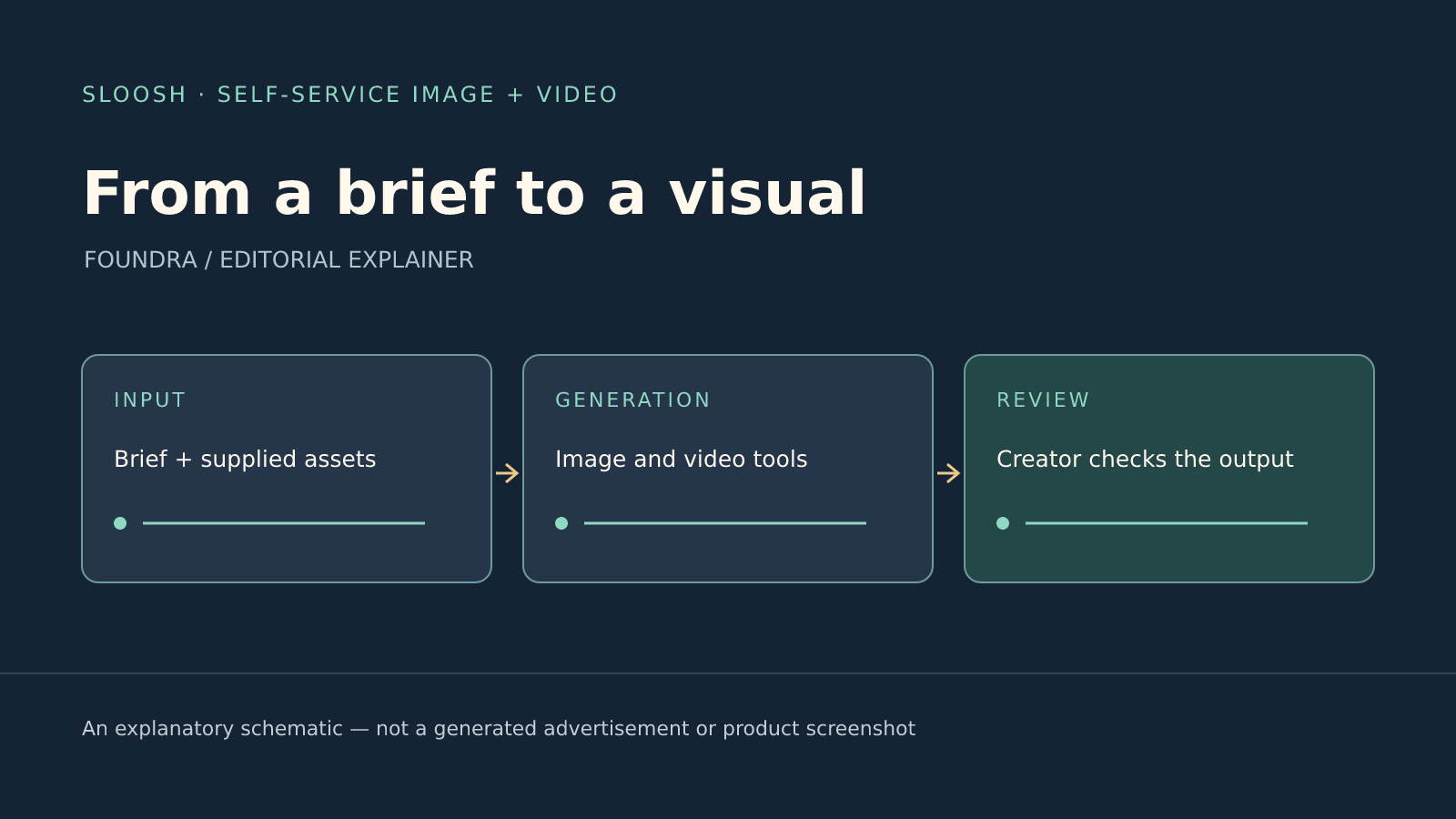
Compare the production responsibilities, not just the price
Brief and assets
Decide the message and confirm permission for supplied material.
Generate and select
Use the tool, assess attempts and choose a workable version.
Approve and deliver
Check product accuracy, rights context and the intended publishing format.
The output has a rights context
Sloosh’s terms say users retain ownership of their inputs and that the operator does not claim ownership of outputs. The described output licence applies after the applicable credits are deducted, but it has important qualifications: models marked non-commercial are limited to non-commercial use, and some models require attribution that must be preserved. This is the platform’s contractual description, not a legal opinion that every possible output is free of third-party claims.
For team use, the terms assign the described output rights to the owner of the workspace in which the output is generated. Members may use that output for the workspace’s purposes unless its owner agrees otherwise. That is a different position from assuming every individual who presses Generate owns unrestricted commercial rights. The terms also describe processing supplied content, including transmission to model providers.
A creator therefore needs to consider what is being supplied as well as what is being generated. A product photograph, a person’s likeness and another company’s artwork pose different questions. Having access to a generation tool does not establish permission to use each of those inputs. For a business, documenting the source of supplied assets can be part of the production workflow rather than an administrative task left until publication.
Final review is equally important when an image is meant to represent a real product. An attractive picture that changes a relevant product detail can be unsuitable even if its visual quality is high. The ability to generate another version is helpful; it is not a substitute for checking that the approved version says and shows what the business intends.
Choose the missing work, not just the tool
Sloosh is a proposed route into ShopOS’s image and video technology for creators who want to operate the tools directly. Its significance is the changed division of labour, while the service business remains a different way to organise creative production. The launch report establishes the reported introduction; the public pages and terms show a beta offering, commercial structure and invitation-only access language.
For a prospective user, the practical question is where help is actually needed. If the brief, source assets and review process are already in place, direct generation may fit the gap. If those are the unresolved parts, a subscription alone will not settle them. Moving the controls closer to the creator can be valuable—but it also moves responsibility for the finished work.
Sources
- Inc42: Sloosh launch ↗ Inc42: Sloosh launch
- ShopOS: official service and Sloosh link ↗ ShopOS: official service and Sloosh link · Primary source
- Sloosh: official product page ↗ Sloosh: official product page · Primary source
- Sloosh: public pricing ↗ Sloosh: public pricing · Primary source
- Sloosh: terms of use ↗ Sloosh: terms of use · Primary source
Have additional information? Request a correction.