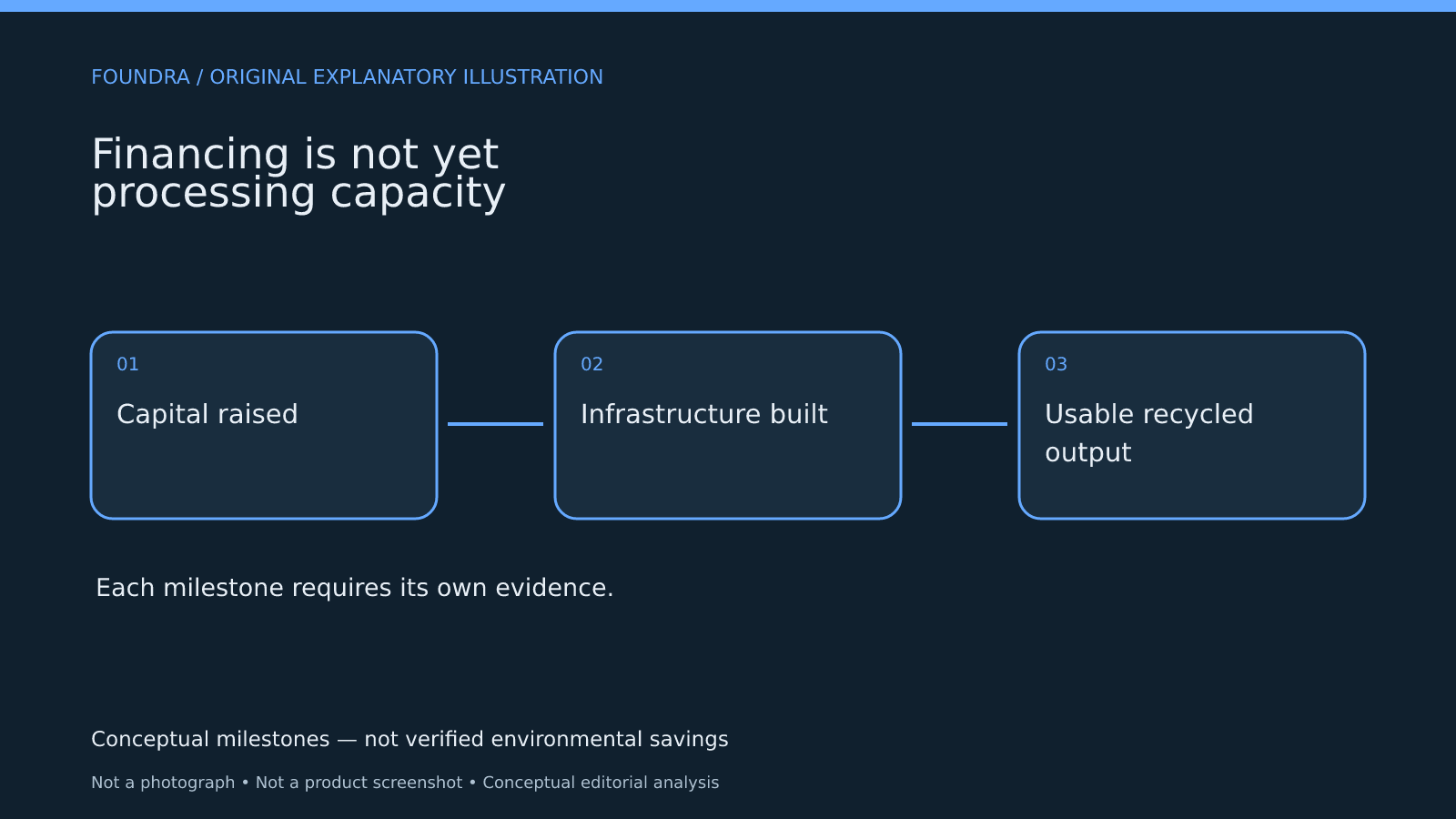
Track capital raised, facilities built and material actually processed as separate evidence in recycling infrastructure.
Two numbers that should not be added together
Recove Ventures has raised a financing package reported at approximately ₹56 crore for recycling infrastructure. That present financing should not be conflated with its much larger long-term investment ambitions.
Indian Startup News reported on November 18 that the package totals ₹56.25 crore, comprising ₹36.25 crore of equity and ₹20 crore of debt. Inc42 reports the same financing at rounded figures of ₹56.3 crore and ₹36.3 crore of equity. Both accounts describe infrastructure in Maharashtra and expansion in Karnataka. The difference is disclosed rounding, not evidence of two separate rounds.
Inc42 also reports proposed investment exceeding ₹2,000 crore across several states over the next decade. That is a future ambition, not the amount now raised, spent or committed to completed facilities. This article does not count memoranda or stated plans as operational recycling capacity.
A recycling plant has to close more than one loop
The circular-economy story often begins with waste and ends with a useful material. Between those endpoints sit collection, sorting, processing, quality and a customer willing to use the output. Financing one part of that chain does not establish that all the others will operate as intended.
A hypothetical plant could have sufficient processing equipment but inconsistent input material. It could produce an output that is saleable for one application but unsuitable for another. Those scenarios are not reported Recove conditions; they explain why an investment announcement cannot be read as a verified environmental result.
For readers assessing the business, capacity should have a defined unit and a defined operating basis. Designed throughput, actual input processed and usable output are different quantities. If a facility processes mixed material, losses and rejected fractions matter to understanding what ultimately reaches a customer.
The same applies to a claim about avoided waste or emissions. A credible environmental comparison needs a baseline, boundaries and a method. This article does not infer a carbon saving from the round amount, a future facility plan or the general fact that the company works in recycling.
Four records for a recycling expansion
Financing
Identify equity, debt and their disclosed purpose.
Facility
Verify what is built and actually operational.
Material flow
Measure inputs, losses and usable output on a defined basis.
Customer use
Establish who buys the output and what specification it meets.
Infrastructure economics do not fit neatly into a software-round headline
Equity and debt can finance different parts of an industrial expansion, but the public accounts do not disclose enough terms to assign each rupee to a particular asset or working-capital requirement. Readers should not infer repayment dates, interest rates or secured assets.
The broader economic issue is timing. Facilities require spending before they can produce sustained output. Material collection and customer demand may not develop on the same schedule. A capital package can support that gap without eliminating the execution risk around it.
An illustrative diligence process would ask when a planned facility becomes operational, what permits or contractual steps remain and how its output will be sold. It would also ask what happens if commissioning slips. These are questions for future verified evidence, not assertions about an undisclosed Recove timetable.
Long-horizon investment plans belong in that same framework. A state-level announcement may express intent or establish a relationship. It is not interchangeable with financing documents, construction progress or production records. Keeping those records separate helps prevent a large plan from overshadowing the smaller but concrete financing now reported.
Follow the material as well as the money
The next meaningful milestones would show where capital is deployed and what operational capability results. A facility opening would still need follow-up evidence on actual processing and output quality. Customer demand would need to be assessed against the material the plant can consistently supply.
For climate and industrial founders, the communications lesson is straightforward: state the current financing precisely, keep future investment ambitions in the future tense and disclose the units behind capacity claims. That makes a complex infrastructure story more credible than placing every milestone under one growth number.
Recove’s reported round is a financing development with a defined equity-and-debt split. Its larger significance will depend on the physical chain it helps build—from incoming waste to usable, purchased material. The environmental and commercial outcomes remain to be demonstrated.
Sources
- Indian Startup News ↗ Indian Startup News
- Inc42 ↗ Inc42
Have additional information? Request a correction.