Treat the October 23 study as descriptive evidence from a proprietary sample. For an actual tender, examine eligibility, allocation and the source of cash; neither a run-rate nor a participation figure establishes a successful transaction.
The liquidity event that is not a fundraising round
A startup can arrange a share sale without raising a dollar for its own balance sheet. That distinction is the useful starting point for reading NewView Capital and Carta’s October 23 tender-offer study. The report concerns company-managed opportunities for existing holders to sell shares, not a newly announced financing round. For founders, the central question is therefore not simply how much a transaction is worth, but whose needs it serves and whose ownership changes.
In Inside the Tender Offer 2026, the two firms describe an analysis of anonymized proprietary data from more than 550 tender offers between the first half of 2021 and the first half of 2026. That gives the report a window into programs in its dataset, rather than a census of private-company liquidity. A platform and an investment firm can have useful transaction visibility while also having commercial interests in the market they describe. Readers should keep both points in view.
The timing also needs separating from an older corporate announcement. NewView’s own site dates its collaboration announcement with Carta to September 22. The fresh development here is the October 23 research publication. It would be misleading to package this as a partnership launched today, or to treat the study as evidence that a particular startup has just completed a tender.
A recovery in the sample, not an industry forecast
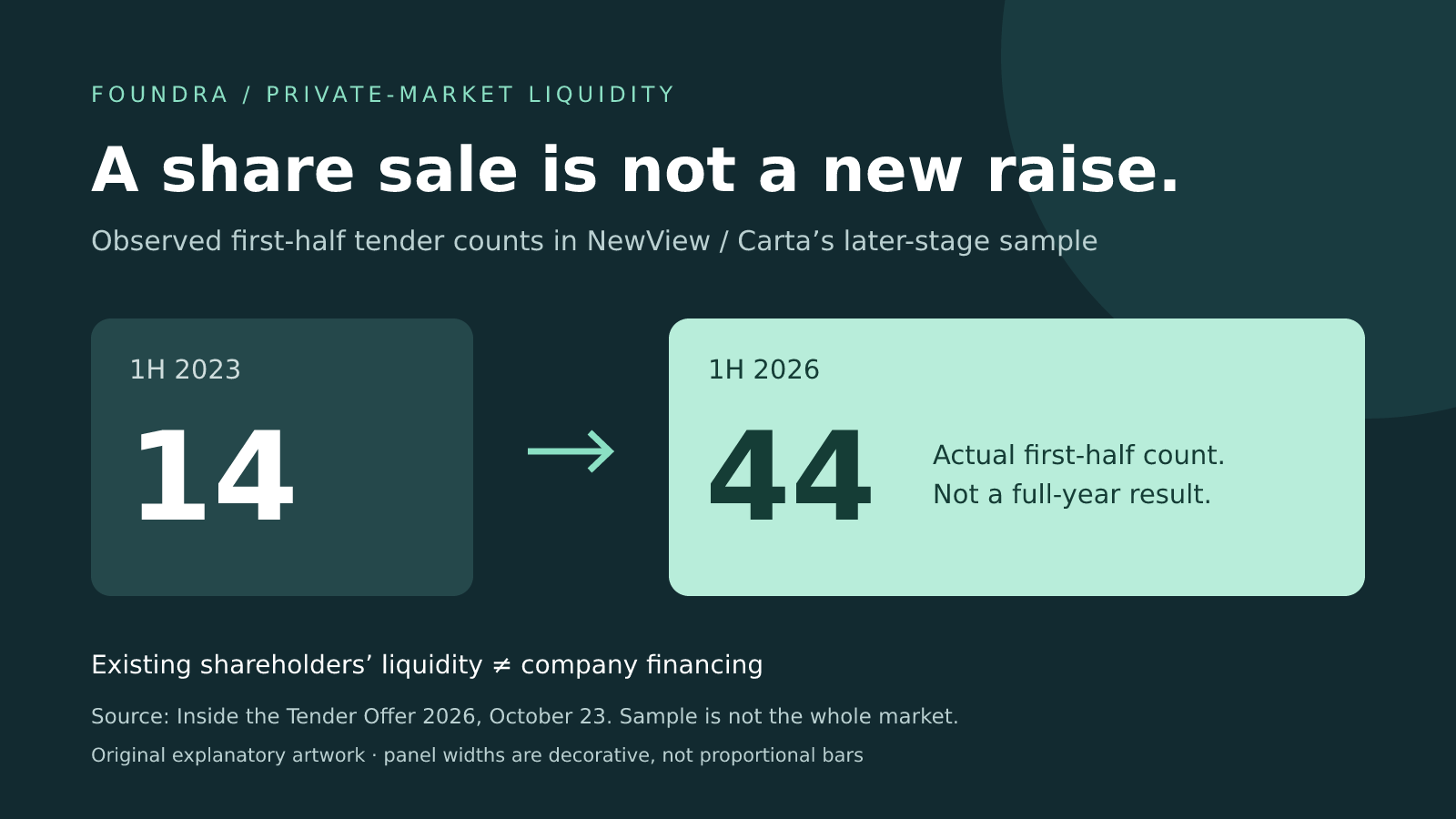
The report says Series C and later-stage tender count in its dataset rose from 14 in the first half of 2023 to 44 in the first half of 2026. Its activity chart identifies a sample of 404 transactions across the periods analyzed and annualizes first-half 2026 activity to produce a full-year run-rate. The 44 observed first-half transactions and an annualized projection are different quantities. Neither establishes the eventual full-year total.
That difference matters because a run-rate can make a recovery look settled before the remaining period occurs. A founder considering a program does not need to assume the second half will reproduce the first. A more useful reading is that this particular sample shows greater activity than its earlier low point. It does not reveal how many eligible companies declined to hold a tender, or prove that every company now has access to willing buyers.
There is a separate selection issue. A dataset of completed or recorded programs describes choices among participating companies. It cannot, by itself, explain the circumstances of firms that never reach that stage. Nor can an aggregate count answer whether a proposed sale price is fair for a specific business. Those are questions about the transaction’s own terms, available information and alternatives, not conclusions supplied by a rising bar.
Four questions that keep a tender distinct from a raise
Define the objective
Is the proposed program intended to give existing holders liquidity? This is an editorial framework, not a reported transaction.
Identify the cash source
Separate an outside investor’s secondary purchase from a hypothetical company-funded repurchase.
Read eligibility and allocation
Permission to offer shares does not guarantee acceptance or an unrestricted sale.
Keep the remaining stake visible
Review ownership after the proposed sale; the study does not establish individual outcomes.
What employees can sell is as important as who can participate
According to the study’s employee-participation analysis, employees were included in 91% of tender offers, while the median cap permitted them to sell up to 20% of their equity. That analysis identifies a sample of 380 tenders. Inclusion and permission to sell an entire holding are plainly not equivalent. The reported cap is a limit, not a measurement of how much employees actually sold or a guarantee that every eligible offer was filled.
Consider a hypothetical employee permitted to offer one fifth of an eligible holding. Even before considering the price, the employee needs to understand which shares count toward that holding, whether there are additional eligibility conditions, and whether buyer demand constrains the amount accepted. This illustration is not an account of a company in the report. It shows why a headline participation percentage cannot substitute for the documents governing an individual program.
For the company, the analytical trade-off is also more specific than the slogan of providing liquidity. A tightly limited sale might leave a holder with substantial exposure to future outcomes. A broader permission could meet more immediate personal needs but redistribute more ownership. Neither choice proves a retention benefit. The report’s authors discuss retention as a rationale; the supplied data do not establish that a sale cap caused people to stay, or that participants became more productive.
Communication is consequently part of the design problem. A clear explanation should distinguish eligibility, permitted volume and completed sales. It should also make clear whether the buyer is an outside investor or the company itself. In a hypothetical externally funded secondary transaction, proceeds go to selling holders; in a hypothetical company-funded repurchase, corporate cash is involved. The report is not evidence that either structure applies to a newly completed deal at a named startup.
The document to read after the headline
NewView’s methodology and chart notes are the route to checking the scope of each figure. The different sample sizes should not be flattened into a single universal denominator. A reader can accept that the publication offers useful descriptive evidence while withholding broader claims about all startups, all employees or the financial effect of tender programs.
The practical next step for a founder is a transaction-specific review: identify the objective, the funding source, the eligible holders and the rules that determine allocation. Employees need their own understanding of price, restrictions and applicable tax treatment; this article supplies neither a valuation opinion nor individualized legal or tax advice. Those questions remain unresolved by the aggregate study.
An orderly share sale can be a distinct decision from financing the business or preparing an IPO. The October 23 report is most useful when those decisions stay separate. Its figures illuminate how sampled companies have structured liquidity, not a promise that any particular program will succeed. The relevant test is whether the proposed terms solve a clearly stated problem without disguising who receives the cash and what stake remains.
Sources
- NewView Capital and Carta: Inside the Tender Offer 2026, October 23 ↗ NewView Capital and Carta: Inside the Tender Offer 2026, October 23 · Primary source
- NewView Capital: September 22 collaboration announcement (historical context) ↗ NewView Capital: September 22 collaboration announcement (historical context) · Primary source
Have additional information? Request a correction.