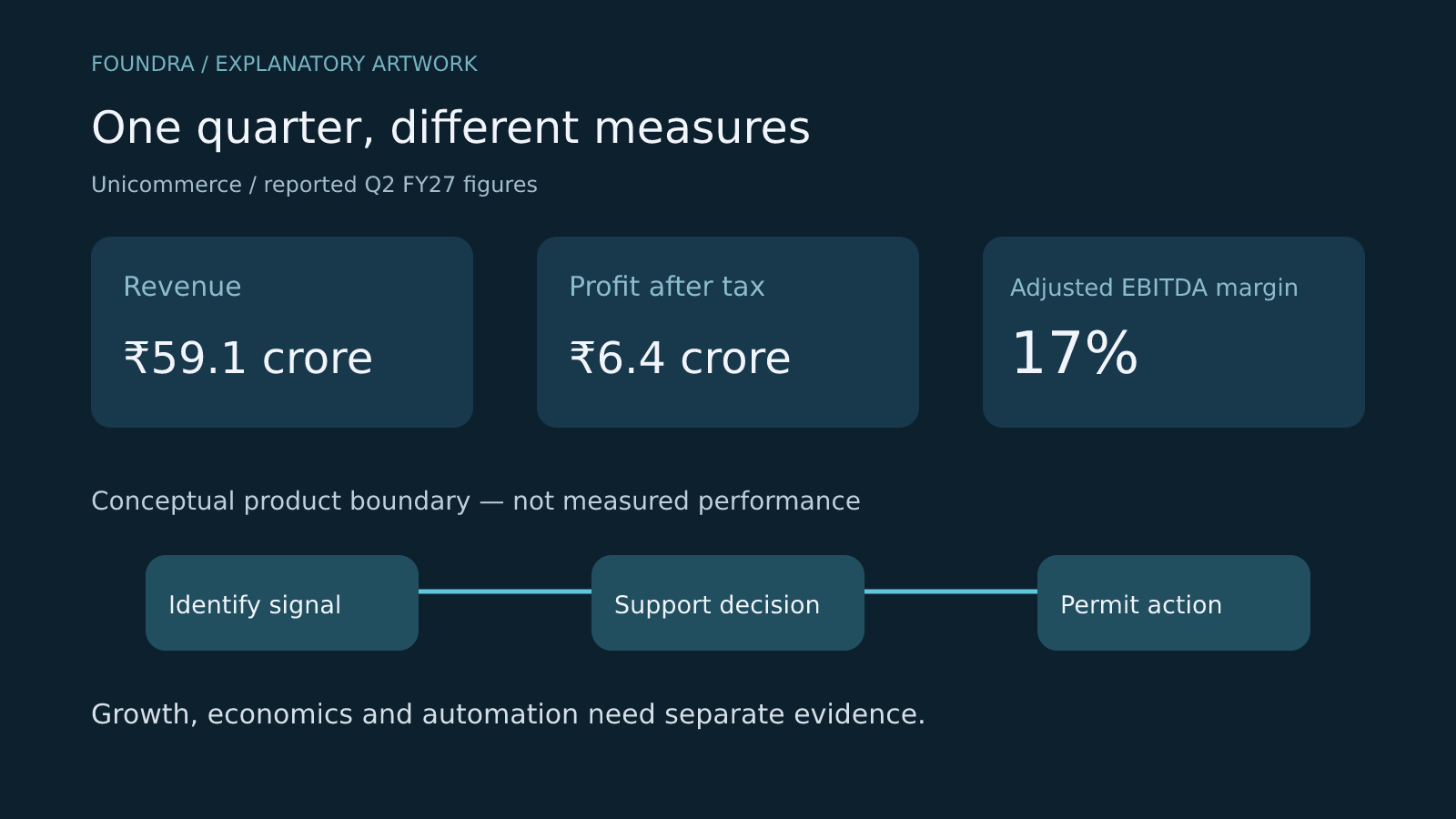
Read revenue, profit, adjusted margins and product claims separately. A growing software business still has to demonstrate the economics and reliability of its next layer of automation.
Growth is not a single number
A software company can increase revenue and net profit while the operating story becomes harder to read. Unicommerce’s October 23 results offer that combination: consolidated quarterly revenue of ₹59.1 crore, up 15% year on year, and profit after tax of ₹6.4 crore, up 10.6%. Those figures are positive. They do not, by themselves, settle whether the next phase of growth is becoming more profitable.
The October 23 results release, filed with the National Stock Exchange, also puts adjusted EBITDA at ₹10 crore and its margin at 17%. The company attributes the investment burden to product development, talent, sales and marketing. It expects the pace of incremental investment to moderate in the second half of FY27. That is management’s expectation, not an outcome already demonstrated by these results.
The same announcement introduces DNA, Uniware’s second-generation AI companion. Unicommerce describes a product that identifies operational signals and anomalies, supports decisions and enables automated corrective actions. For founders building commerce software, the interesting conjunction is not simply “AI plus growth.” It is the arrival of a more action-oriented product while the business is paying for its expansion.
Three accounts of the same quarter
Revenue measures the scale of the business sold during the period. Net profit includes expenses, financing and tax effects. Adjusted EBITDA is a separate management-reported measure whose definition and reconciliation matter. Treating all three as interchangeable makes it easier to tell a celebratory story, but harder to understand a software company.
Indian Startup News’s financial breakdown reports that adjusted EBITDA declined from ₹11.4 crore a year earlier and that the comparative adjusted margin was 22.2%. It also reports a lower tax expense and a deferred tax credit, helping explain why net profit rose even as adjusted operating profitability weakened. This is a distinction between measures, not an allegation that the company’s profit is unreal.
The reporting also identifies a revenue-mix issue between Uniware and Shipway. Different offerings can contribute different margins; a consolidated percentage may therefore move even when an individual business is improving. For an operator, separating mix from underlying unit economics is more useful than asking one consolidated ratio to explain the entire company.
The company’s release reports ₹23.9 crore of operating cash flow for the first half and a ₹104.4 crore cash balance at September 30. These are different from quarterly earnings. They provide financial context, but neither is a guarantee that product investment will create a particular return. The next reporting periods will be needed to test management’s expectation about investment moderation.
Two tracks to evaluate after the results
Read the figures
Revenue, net profit and adjusted EBITDA answer different financial questions.
Separate the launch
The company describes DNA capabilities; no causal revenue contribution is established here.
Define permission
For any action-oriented tool, evaluate who approves and reverses a change. This is an editorial framework.
Observe the next period
Test management’s spending expectations against later disclosures rather than treating them as completed results.
Acquisition, expansion and a new product
The release reports 121 enterprise clients added to Uniware during Q2 FY27. It also describes cross-selling between offerings as part of its strategy. The count establishes reported additions during the quarter; it is not a measure of customer retention, the value of every contract or the lifetime profitability of the newly added accounts.
A founder can learn more by keeping acquisition and expansion separate. Selling to a new customer tests the proposition and the distribution process. Selling a further module to an existing customer tests whether the first product has created a credible route to another need. Neither automatically establishes that a bundle is simpler to use or more economical to serve. These are business-model distinctions rather than unreported findings about Unicommerce’s customers.
There is also a measurement trap when a company adds a new AI capability during a period of growth. The existing product, the sales organisation and changes in customer mix can all be relevant to the reported result. Without an appropriate method, assigning the increase to the newest feature would be a causal claim the results do not support. The filing describes AI-led innovation as a strategic lever; this article does not convert that description into an attribution of revenue.
A useful assessment would follow the new capability on its own terms: which customers use it, which tasks it supports and whether its use changes a clearly defined outcome. Those questions can coexist with the ordinary software metrics rather than displacing them. The company has announced DNA, but the launch and the quarter’s results should remain distinct pieces of evidence.
When an anomaly becomes an action
DNA’s stated progression raises a product-design question. Detecting something unusual, recommending a response and making a change are three different levels of responsibility. A system can be useful at the first level without being safe to delegate the third. Unicommerce’s announcement describes capabilities; it does not supply an independently validated error rate or a quantified customer return for the new companion.
Consider a hypothetical fulfilment exception. An assistant might flag an unexpected pattern, then suggest an operational response. If it is allowed to act, the buyer needs to know which records or workflows it can change, who approves the change and how an incorrect intervention is reversed. This is an illustrative evaluation framework, not a description of a tested DNA workflow.
For a founder selling a similar product, the measurement problem is practical. Count whether an alert leads to a useful decision, whether the proposed action is accepted and whether the resulting task is completed without avoidable rework. Those are proposed evaluation questions. They are not metrics Unicommerce has disclosed in the evidence reviewed for this article.
The company’s announcement ties organic growth to new customers, deeper engagement and AI-led innovation. The defensible interpretation is that DNA is part of that strategy. It is not yet evidence that AI caused the reported revenue increase or will restore the earlier adjusted margin.
What the next quarter can clarify
An investor can now watch two tracks without collapsing them into one. The financial track concerns revenue growth, cash generation, revenue mix and the pace of spending. The product track concerns adoption, reliability and the usefulness of permitted actions. Progress on either track may matter, but one cannot substitute for evidence on the other.
For startup operators, this is a more useful benchmark than an AI launch headline. The difficult work is selling more software while accounting for the cost of making it dependable. Unicommerce has reported growth and described a new product direction. Whether those developments reinforce one another is the question still open.
Sources
- Unicommerce: October 23 audited-results press release filed with NSE ↗ Unicommerce: October 23 audited-results press release filed with NSE · Primary source
- Indian Startup News: results and revenue-mix reporting ↗ Indian Startup News: results and revenue-mix reporting
- Inc42: October 23 results reporting ↗ Inc42: October 23 results reporting
Have additional information? Request a correction.