Treat conversational timing, local operation and dependable task performance as separate tests. A convincing voice is not evidence that a system understands or safely acts.
A pause can be part of the interface
A voice interface carries more than a transcript. A pause can change the rhythm of a conversation; an interruption can be useful or irritating; a laugh can be welcome or badly timed. These are design considerations, not proof that an AI system experiences the feelings its voice conveys. They are also the territory Block is trying to claim with Dessa.
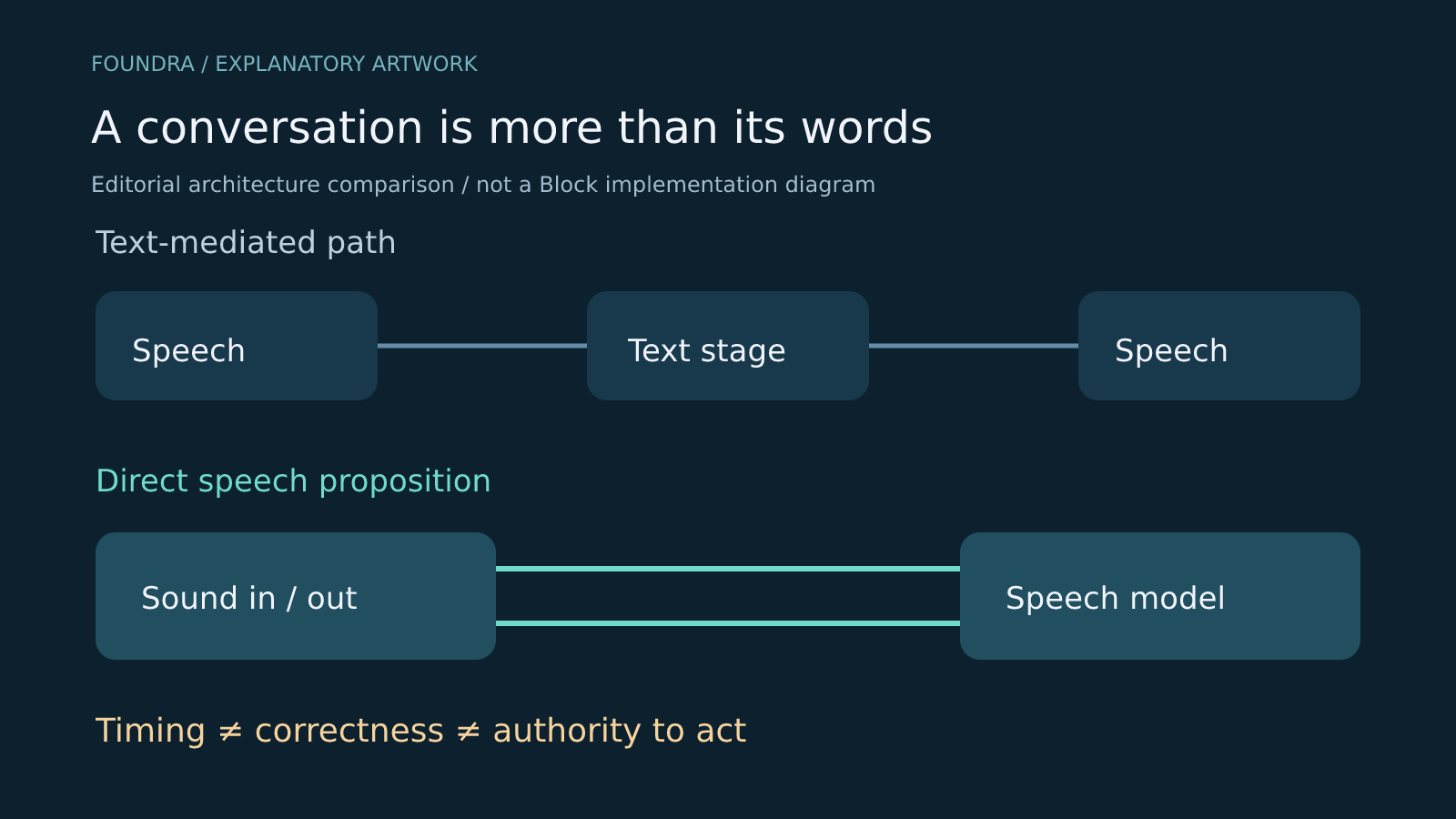
Block’s Dessa introduction describes a model trained from scratch on human conversation rather than text or a pretrained model. It calls the system full-duplex: able to listen and speak at the same time. The Verge’s October 23 report identifies the announcement and links to the official introduction.
The proposition is that directly modelling speech retains information that a speech-to-text step may leave out. Block describes examples involving timing, intonation, laughter and conversational backchannels. Those are company claims illustrated by company-selected recordings. Foundra has not run the model, listened to and independently evaluated its demos, or reproduced its training or performance claims.
That limitation does not make the proposition uninteresting. It tells a buyer what kind of evidence is currently available: an official product explanation, demonstrations selected by its developer and independent reporting of the announcement—not a complete assessment of how it behaves across ordinary users and difficult situations.
Three questions behind a natural-sounding answer
The first question is whether the interaction feels responsive. The second is whether the answer is correct and useful. The third is whether the system is allowed to take consequential action. A demonstration can look persuasive on the first question while leaving the other two open. A founder evaluating a voice product should resist using conversational fluency as a proxy for all three.
A text-mediated architecture and a direct speech model also create different evaluation surfaces. With a transcript-centred system, developers may inspect the words at an intermediate stage. With a speech-first interaction, they need to think about timing and acoustic behaviour as well as meaning. This is an analytical comparison, not a claim that one design is inherently more reliable or that Dessa lacks any particular inspection tool.
Consider a hypothetical customer-support conversation. Talking over a caller could make a technically accurate answer unusable. Conversely, a well-timed acknowledgement could make a wrong answer seem more credible. These are scenarios for testing an interface, not incidents observed with Dessa. They show why assessment should include both conversational behaviour and task-level verification.
Block’s language about emotion and natural conversation belongs in that distinction. A voice can convey a style listeners interpret as sympathetic without establishing understanding, judgement or a human relationship. No therapeutic benefit, dependable advice or superior safety follows just from the qualities of a recording.
Evaluate the voice, the answer and the boundary
Conversation
Timing and interruption handling require representative tests, not just developer-selected recordings.
Task
A natural-sounding response must still be assessed for correctness and usefulness.
Deployment
Block states local Mac requirements; privacy and application-level data handling need separate checks.
Authority
If a product takes action, evaluate its permitted scope. No task delegation was tested by Foundra.
Local inference is a deployment condition
The official page says Dessa runs locally on a MacBook Pro with an M4 Max or better and describes inference as faster than real time. Those are stated requirements and performance claims, not a tested recommendation for every workload. Local execution may be relevant to architecture choices, but it does not automatically establish privacy, data handling or security across an entire application.
A product team would still need to examine what is stored, which other components connect to external services and how user consent and retention work. These are proposed diligence questions. The announcement reviewed here does not justify assuming that every application built around the model is offline, private or compliant with a particular rule.
Availability also needs a narrower reading than “a new AI assistant for everyone.” Block’s page displays download and waitlist options. It does not support describing universal availability on arbitrary devices. Hardware requirements, the exact distribution terms and the intended integration path belong in the evaluation before a buyer makes a deployment decision.
The Verge’s October 23 report is useful corroboration that the model was publicly announced. It is not a substitute for a buyer’s own assessment or evidence that the official demonstrations generalise. Equally, the word “model” should not be stretched into a claim that an entire dependable business workflow is ready around it.
The test is bigger than the demo
For startup builders, Dessa offers a concrete question about interface design: what should be learned and evaluated in sound rather than reduced to words? Answering it requires representative conversations, transparent task criteria and a clear separation between sounding engaged and being dependable. That is an evaluation agenda, not a finding about this release.
Block has put forward a speech-first design and a set of recordings intended to make its case. The next useful evidence would show how the model handles interruptions, uncertainty and varied users in defined tasks. Until that evidence is available, the defensible story is a new approach to conversation—not an established replacement for reliable judgement.
Sources
- Block: Dessa model introduction and availability description ↗ Block: Dessa model introduction and availability description · Primary source
- The Verge: dated October 23 announcement reporting ↗ The Verge: dated October 23 announcement reporting
Have additional information? Request a correction.