LogSync’s contribution is an engineering and research result. Distinguish decoding recorded states, triggering stimulation and improving a patient’s health.
The connection is the signal
The engineering choice behind LogSync starts with where to look. Rather than treating one brain region as the whole source of a useful signal, the chip extracts information about activity across regions. EPFL’s October 23 announcement describes a low-power implantable system-on-chip designed to measure oscillations and the synchrony between recorded signals, then use those features to distinguish cognitive and emotional states.
That is a research announcement, not a product launch for patients. The work described by EPFL appears in the IEEE Journal of Solid-State Circuits; the university’s reference dates that paper to September 2026 and also lists earlier related conference work. The fresh event is the university’s October 23 explanation of LogSync, not a claim that the underlying research first existed this weekend.
EPFL’s October 23 announcement places the work in its Integrated Neurotechnologies Lab, led by Mahsa Shoaran. The lab’s stated rationale is that information relevant to psychiatric conditions may be distributed across interacting brain regions. That rationale motivates the design. It does not mean a chip measuring synchrony can, on its own, diagnose a disorder or establish the right therapy for a particular person.
A compact loop, with an important boundary
As EPFL describes it, LogSync combines recording, network-level biomarker extraction, machine-learning classification and stimulation triggers. The distinction between a trigger and a successful therapeutic intervention matters. A circuit can generate a signal at the requested time while the larger clinical question remains unanswered.
The university reports evaluation using human brain recordings from previous psychiatric experiments. One dataset concerned cognitive engagement during a mental task; another concerned emotional arousal while participants watched video clips. EPFL says the algorithm distinguished the corresponding states from the recordings. These are analyses of recorded data, not evidence in this announcement of a human treatment trial using the implant.
EPFL also describes experiments in rats at the University of Minnesota, where the implant tracked oscillations and generated stimulation triggers at predefined phases of activity. The human-recording work and the animal experiments answer different questions. Combining them into a phrase such as “the chip treats psychiatric illness” would erase precisely the boundary that makes the result understandable.
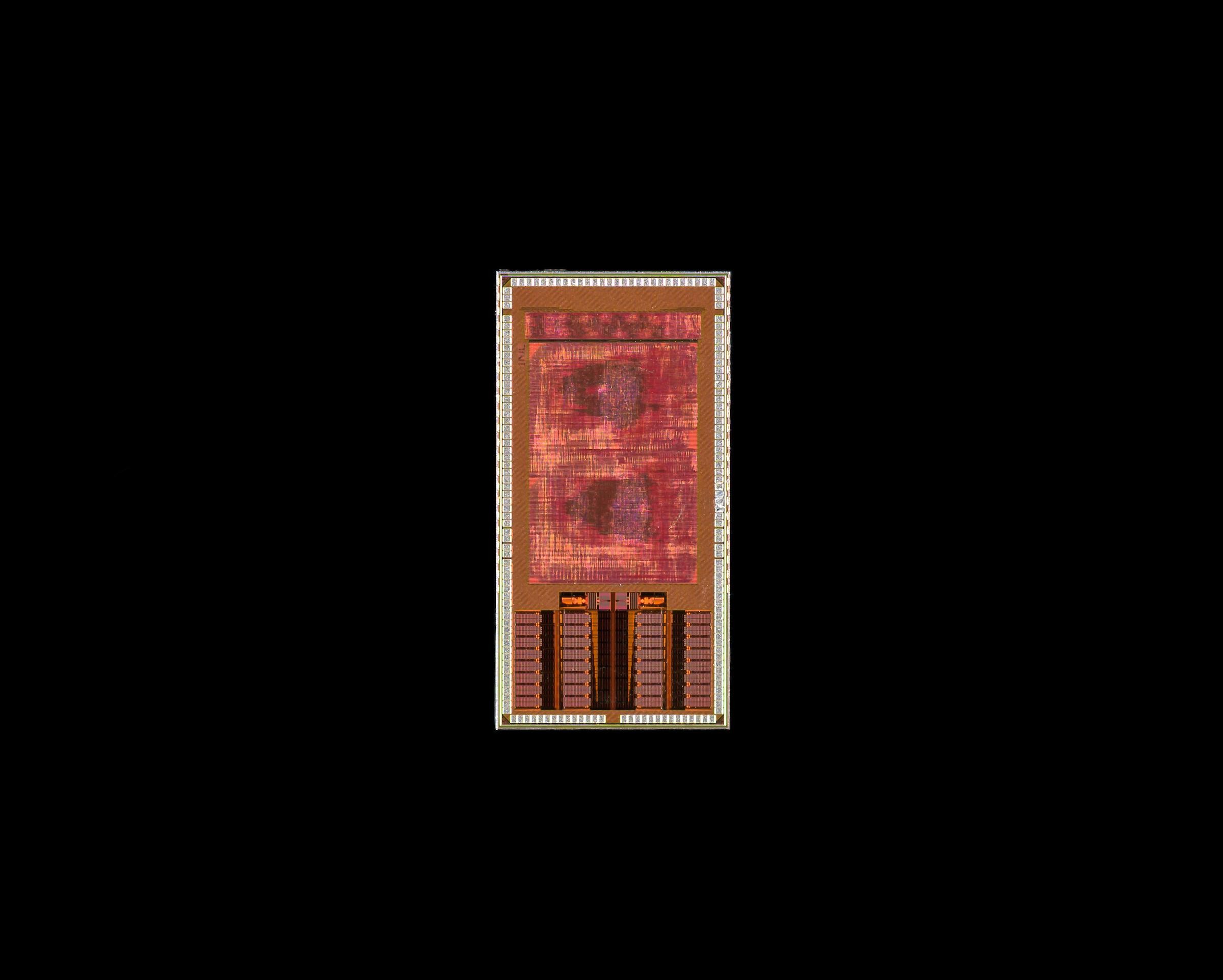
The official photograph shows the LogSync chip itself. Its accompanying credit identifies EPFL and Lundi13 and provides a CC BY-SA 4.0 licence. The device is pictured as research hardware, not as an approved commercial implant or an illustration of patient benefit.
Three different evidentiary steps
Decode recorded states
EPFL reports classification using human recordings from prior experiments.
Trigger in hardware
EPFL separately describes phase-related stimulation triggers in rat experiments.
Demonstrate clinical benefit
The announcement does not establish a human treatment outcome or regulatory clearance.
Why the power budget changes the design
Shoaran’s explanation in the announcement puts the system’s power consumption below 200 microwatts. This is a reported research figure, not a benchmark independently reproduced by Foundra. The university describes logarithmic computations as a way to simplify operations used in network analysis and decoding, with algorithms and hardware designed together around implant constraints.
For a deeptech founder, the broader design lesson is about interdependence. A software technique cannot be assessed entirely apart from the device that has to run it. A feature that is attractive in a laboratory analysis may need a different implementation when it must operate within a constrained system. Conversely, an efficient circuit is not useful merely because it consumes little power; it must preserve the information needed for its task.
A hypothetical competing design illustrates the trade-off. Recording more channels might offer a richer picture, but it would need to be evaluated against the cost of processing and the reliability of the resulting decision. This is a general engineering question, not a claim about LogSync’s unreported performance or a recommendation for a particular medical device.
That is why the useful comparison is not simply chip size or a single power number. It is the combination of what is measured, what is computed, how the result is evaluated and what action the system is permitted to initiate. For reference, the research and image credits listed by EPFL provide the route back to the underlying work rather than asking readers to rely on an announcement alone.
The route from a state to an outcome
There are at least three separate evidentiary steps: identifying a state in data, producing a reliable response in hardware and demonstrating that the response helps people in a relevant setting. LogSync’s announcement supplies evidence about the first two through different experiments. It does not complete the third.
EPFL mentions Infera Neuro, a spin-off co-founded by Shoaran, in the context of broader work toward clinical neural interfaces. That connection gives the research a startup dimension, but it is not a funding announcement, a commercial availability claim or regulatory clearance for LogSync.
The significance of the result lies in making network-level measurement and decoding part of a constrained chip design. The significance of the remaining uncertainty is equally concrete: a useful signal is not yet a useful treatment. Keeping both statements in view allows the engineering advance to stand without promising a clinical outcome the announcement has not established.
Sources
- EPFL: October 23 LogSync research announcement ↗ EPFL: October 23 LogSync research announcement · Primary source
Have additional information? Request a correction.
Updates & corrections
October 25, 2026: 25 October 2026: Restored the contextual link to EPFL’s research and image credits by adjusting its introductory wording. The research findings and original publication date are unchanged.