Evaluate visual agents on their evidence trail and end-to-end task cost, not just a benchmark score.
The useful question is where to look next
Consider a hypothetical inspection task: a model must decide whether the same object appears before and after a camera changes position. A fluent description of each frame is not enough. The system has to preserve identity, notice what is obscured and decide which detail deserves another look. That is a different product requirement from producing a plausible caption.
Elorian’s October 16 research preview puts that requirement at the centre of Glimpse. The company says the model can revisit visual evidence while reasoning and use tools to transform images, inspect video and coordinate subagents. It is available through an API and a chat interface. These are the company’s description and launch status, not results from a Foundra product test.
The distinction matters for startups building products on top of visual models. If a system can request a better view rather than confidently finish from an inadequate one, the application can potentially treat uncertainty as an actionable state. But the surrounding software must still decide when another inspection is worth its time and cost.
A score is not an operating specification
Elorian publishes a comparison across visual, video and embodied-reasoning evaluations. Its own table shows a mixed pattern rather than an across-the-board win. That makes the release more interesting as a specialised proposition than as a reason to declare every incumbent model obsolete. The evaluations are company-reported; this article does not independently reproduce them.
For a buyer, the first useful comparison would be with the existing workflow on representative inputs. An application for counting items, for example, could test crowded scenes, partial occlusion and repeated objects separately. A system that performs well on clean images might still require review on the cases that create the greatest commercial loss. That is a proposed evaluation design, not a claim about Glimpse’s actual behaviour.
The same caution applies to price. A token rate is only one component of a completed task. Repeated inspection, tool execution, retries and human review can change the total. A low-cost answer that needs substantial checking may be less useful than a more expensive answer that comes with an intelligible, accurate account of its evidence. Conversely, extra reasoning is wasteful when a simple classifier would suffice.
At launch, Elorian lists input tokens at $0.60 per million and output tokens at $3 per million. Those are the company’s published rates, not a verified cost for any particular application. The company also identifies token efficiency as a priority. Together, the price and that stated priority make task-level measurement especially important: the rate tells a buyer what a unit costs, while the workflow determines how many units it consumes.
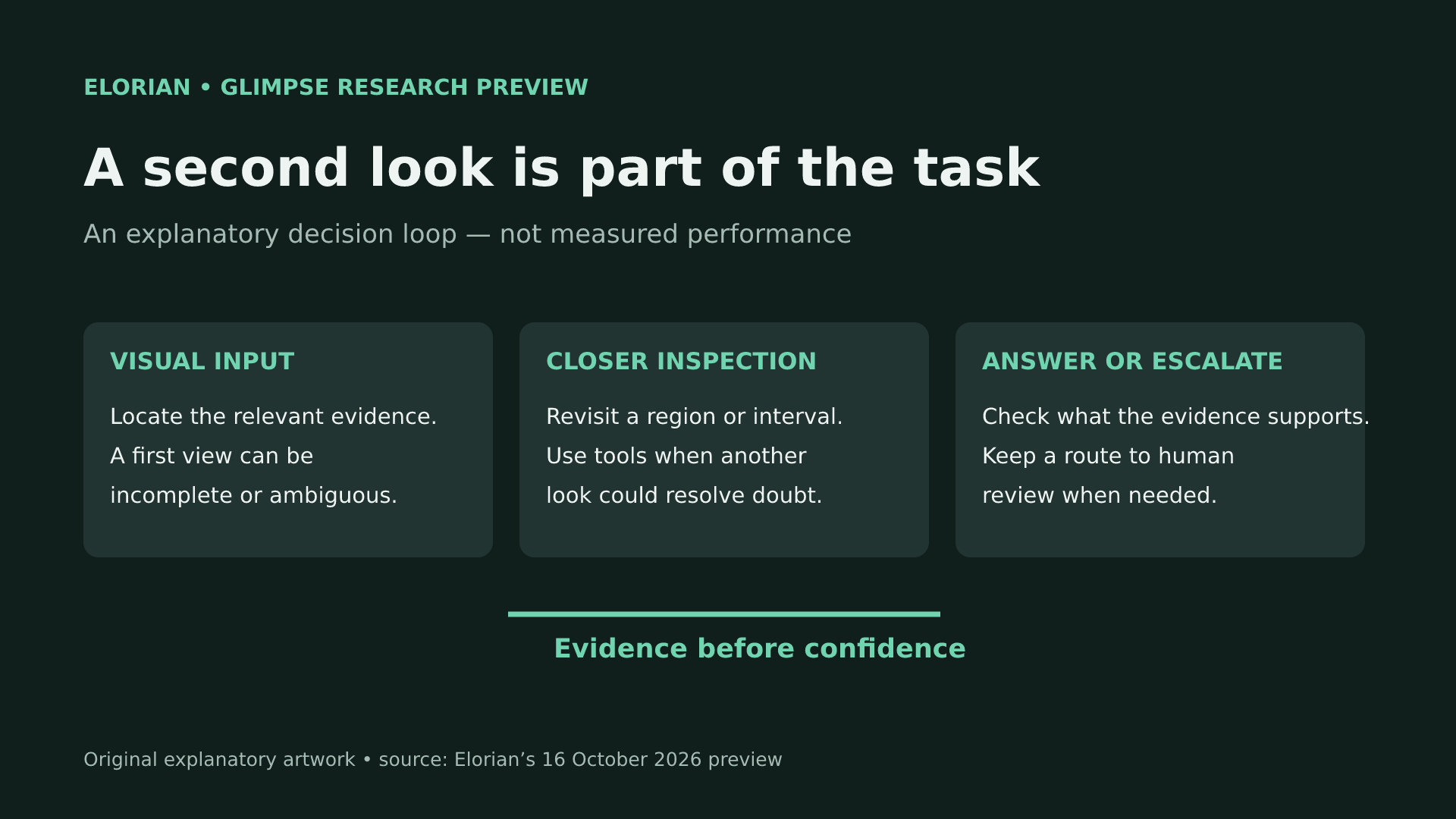
A visual agent’s decision loop
Inspect
Identify which visual evidence is relevant to the question.
Revisit
Use a closer view or another interval when the first view is insufficient.
Check or escalate
Assess the conclusion and retain a route to human review.
The scratch space belongs in the workflow
Elorian describes a visual scratch space that exposes operations such as zooming into a region or examining a short video interval more closely. For an application designer, that creates a possible interface between an automated decision and a human reviewer: not just the answer, but the portion of the evidence that informed it.
An inspection history should not be mistaken for proof of correctness. A model can examine the wrong region carefully. The application still needs a way to compare the selected evidence with the question, preserve the relevant input and let a reviewer override an unsupported conclusion. More visible reasoning is useful only if it helps identify and correct mistakes.
A practical pilot could therefore separate three outcomes: correctly solved tasks, appropriately escalated tasks and confident errors. Counting only completed answers would hide the difference between a capable system and one that refuses too little. Measuring reviewer effort alongside those outcomes would show whether the new interface actually reduces work.
A preview, with a concrete buying test
The launch is a research preview, not evidence of validated performance in a factory, laboratory or deployed robot. Elorian’s suggested applications should be read as areas to investigate. A purchaser would need to establish its own operating constraints, data-handling requirements and acceptable failure rate before placing the model in a consequential process.
What makes Glimpse worth examining is the product hypothesis: better visual reasoning may require an agent to control its attention, not merely accept a fixed description of an image. The next useful milestone is less theatrical than a demonstration. It is a measured reduction in costly mistakes on a defined task, with the additional inspection effort included in the bill.
Sources
- Elorian Glimpse research preview ↗ Elorian Glimpse research preview · Primary source
- Independent report: techcrunch.com ↗ Independent report: techcrunch.com
Have additional information? Request a correction.