Financing supports the next experiments; it is not evidence that a gene therapy works in patients.
The launch and the experiment are different milestones
Estuary Biotherapeutics entered public view on October 16 with a financing package and a specific development ambition: genetic medicines for serious kidney disease. The company’s launch is a verified announcement. Success in treating patients is still a question for the development programme, not a consequence of the size of its backing.
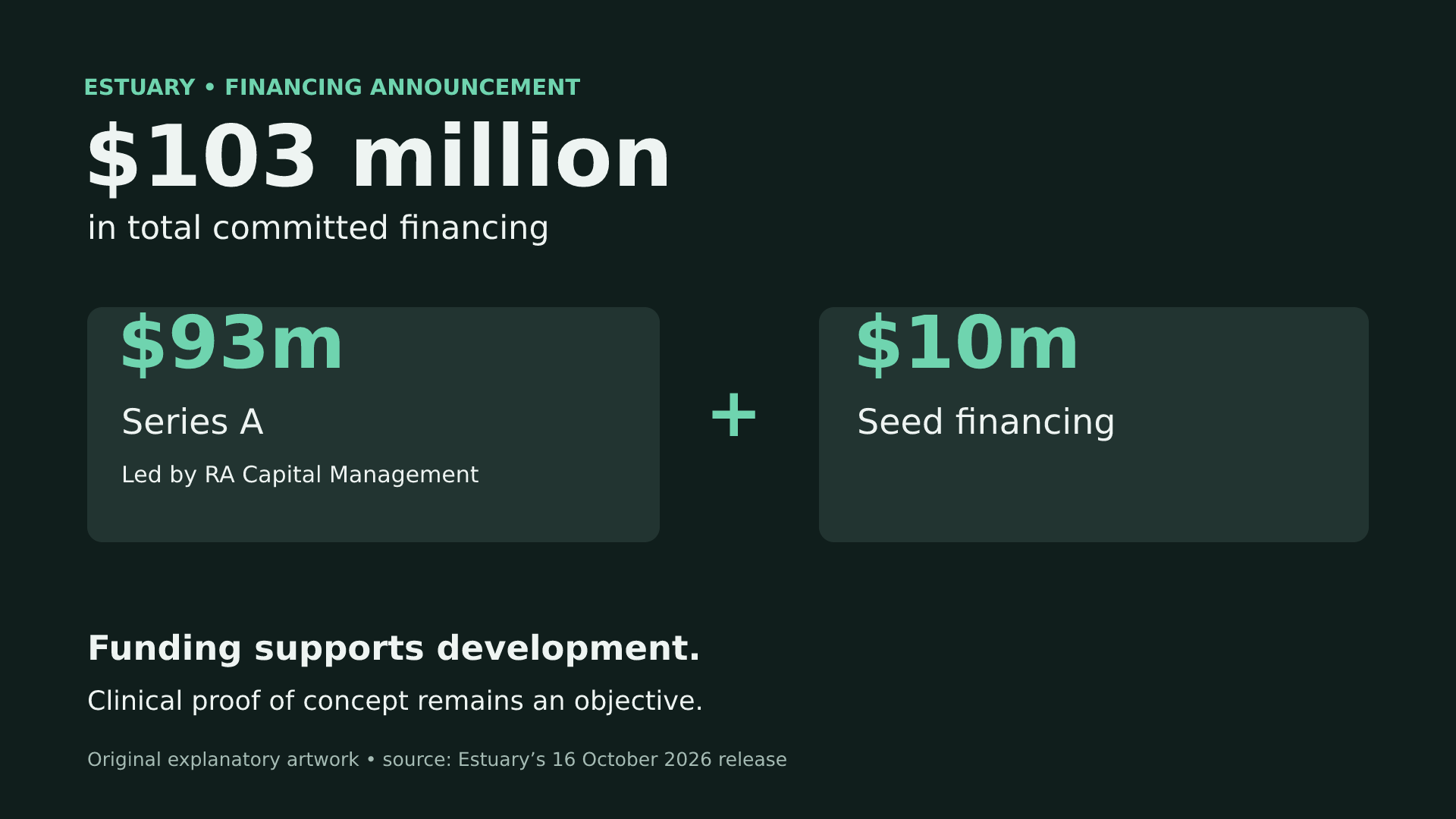
The release describes $103 million in total committed financing, comprising a $93 million Series A led by RA Capital Management and $10 million in seed financing. The distinction matters. It is not a newly announced $103 million Series A, and “committed” should not be rewritten as proof that every dollar has already been received in cash.
Estuary plans to use the financing to advance its lead programmes through clinical proof of concept and develop its kidney-targeting platform. The stated focus is autosomal dominant polycystic kidney disease, or ADPKD. The company describes a kidney-directed delivery approach; its therapeutic ambitions are not established clinical outcomes.
Delivery is part of the medicine
The commercial question in a targeted therapy is not limited to identifying a biological mechanism. A programme also needs to deliver its intervention in a way that can be tested, produced and administered. Estuary’s release places delivery at the centre of its approach. That emphasis is useful for understanding what the company intends to build, without endorsing the claims attached to it.
A scientific idea and an operational treatment are different kinds of achievement. The latter requires evidence from the relevant setting, not just confidence that the former is promising. This article does not infer patient efficacy, a regulatory approval or a trial result from the financing announcement. It also does not establish that a trial has already begun.
For investors and prospective partners, that creates several distinct questions. What must the next study establish? What would count as a failure of the proposed approach? Which parts of the delivery process need to be demonstrated before a larger development commitment? Asking those questions is more informative than treating the entire platform as one undifferentiated bet.
The company’s language about potential disease modification should therefore remain conditional. A goal of halting or reversing disease is a development objective. Repeating that goal as something a treatment already does would erase the most important uncertainty in the story.
Financing is not clinical proof
Committed backing
The announced total includes Series A and seed financing.
Delivery development
The company plans to develop kidney-directed programmes.
Clinical evidence
Proof of concept remains a development objective, not an established result.
Read the financing as a programme budget
The funding mix shows why launch totals deserve careful reading. Seed financing may have supported work before the company’s public introduction; a Series A can finance the next stage. Combining the two makes sense as a description of committed backing, but it does not make the earlier money a second new event.
The practical analytical lens is the work the capital is meant to enable. Estuary names clinical proof of concept and further platform development. Those are specific objectives, even though the release does not give this article an independently verified timetable for achieving them.
A founder in another deeptech field can recognise the same pattern. Capital has value because it allows a team to resolve a defined uncertainty before it scales an operation. Spending rapidly is not the same as learning rapidly. A useful milestone is one that changes what the company, its partners or its investors know about the programme.
That does not mean development can be reduced to one clean financial metric. A result may narrow the programme, alter the delivery approach or show that an assumption needs to be abandoned. The important distinction is between evidence that reduces uncertainty and activity that merely consumes the budget.
What the announcement does—and does not—settle
Estuary’s launch establishes a company, announced committed financing and a stated therapeutic direction. It provides a basis for following the programmes as further evidence appears. It does not settle their safety, durability or effectiveness in patients.
The next substantive story should be about evidence from the development work rather than a stronger adjective attached to the platform. For now, the financing is best understood as support for that work. The scientific promise is a reason to investigate; the clinical proof is still to be established.
Sources
- Estuary launch release ↗ Estuary launch release · Primary source
Have additional information? Request a correction.