For a distributed hardware company, adding a location only helps if engineering decisions and programme ownership remain clear.
A new address for a specific kind of work
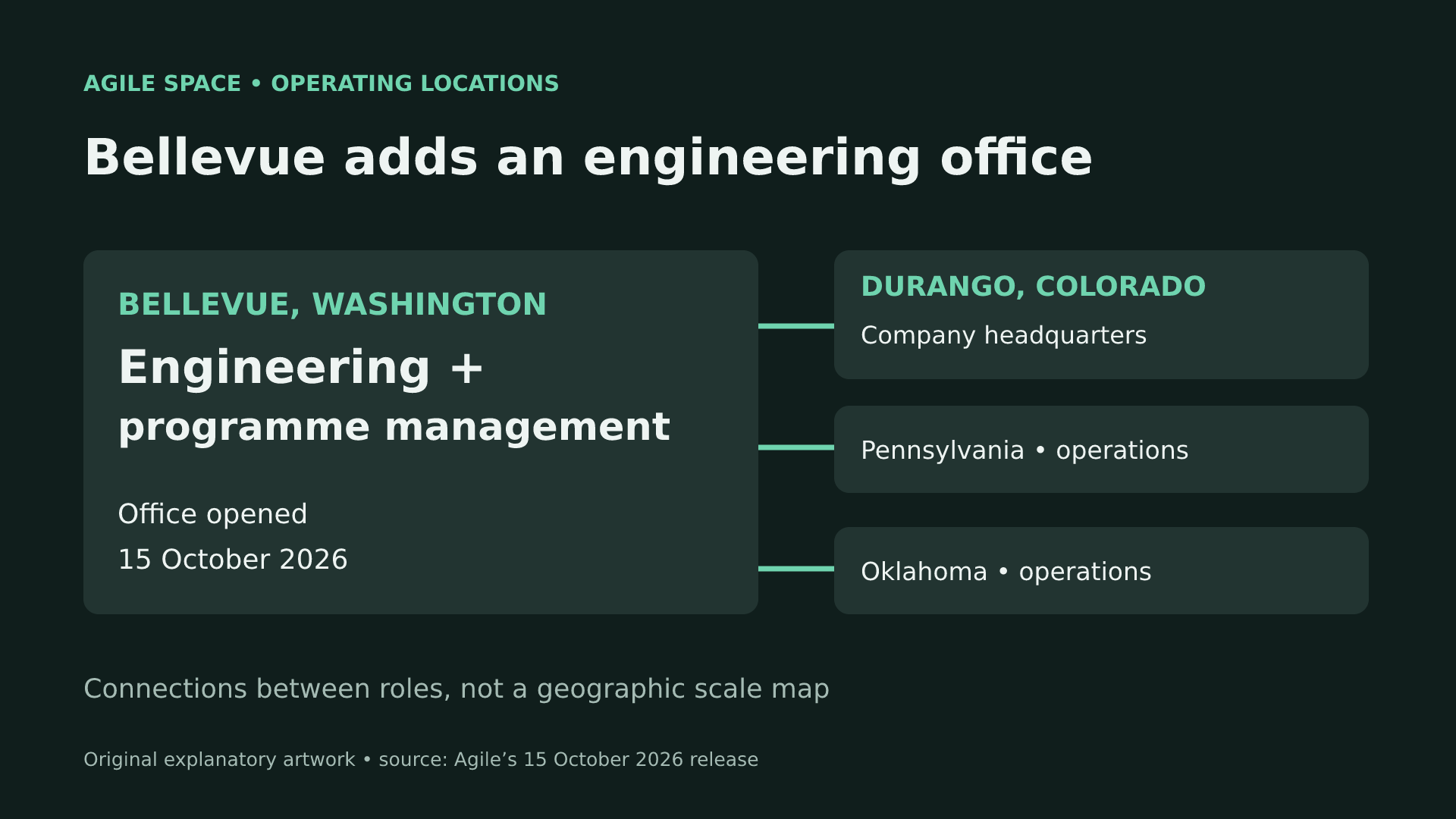
Agile Space Industries has opened an office in Bellevue, Washington, extending its operations into the Seattle metropolitan area. The company’s October 15 announcement says the location will focus on engineering and programme management for its in-space chemical propulsion business.
Chief technology officer Jake Mills will be based at the office, according to Agile. The new location joins its headquarters in Durango, Colorado, and operations in Pennsylvania and Oklahoma. The company presents the expansion as a way to access regional expertise and strengthen industry relationships.
The distinction between an office and a production facility matters. This announcement does not establish a new engine-manufacturing line in Bellevue, a new propulsion qualification or a newly awarded customer contract. It identifies an engineering and leadership presence. Future growth is described as an expectation rather than a completed hiring result.
The hard part is connecting the locations
For a hardware company, adding access to talent can be useful without moving every function to the same place. The operating challenge is making the resulting organisation work as one programme rather than a collection of addresses.
A design decision can affect testing, manufacturing and delivery elsewhere. If responsibility for that decision is unclear, a distributed team can spend time reconciling different assumptions rather than resolving the engineering problem. This is a general organisational risk to manage, not a finding that Agile has encountered it.
A founder planning a similar expansion could therefore start with a map of decisions rather than a map of office space. Which work belongs in the new location? Who can approve a change? Which teams need to see its consequences? How is the accepted version of a design or programme plan recorded?
Those questions are particularly relevant when the new office includes programme management. That function has to connect the work being designed with the commitments being delivered. More engineering capacity is valuable only if the programme can absorb it and maintain a clear account of what is ready, what is being tested and what remains unresolved.
A distributed engineering office needs connections
Local work
Assign engineering and programme-management responsibilities.
Shared decisions
Keep design changes and ownership visible across locations.
Programme delivery
Follow actual work outcomes separately from office capacity.
An opening now, a growth plan to follow
Agile says the Bellevue presence is intended to support technical expertise, customer relationships and partnerships. Those are stated objectives. The office opening should not be used as evidence that the objectives have already produced a commercial result.
The most useful follow-up would distinguish actual team additions and delivered programme work from the capacity the office could eventually accommodate. It would also identify the work performed in Bellevue rather than crediting every company milestone to the new location.
That is a restrained way to read an expansion announcement, but not a dismissive one. Establishing a leadership and engineering base is an operational choice with real organisational consequences. The next test is whether the new location makes those consequences useful: clearer programme ownership, effective collaboration and work that reaches the next stage of delivery.
Sources
- Agile Space Bellevue opening release ↗ Agile Space Bellevue opening release · Primary source
- Independent report: www.geekwire.com ↗ Independent report: www.geekwire.com
Have additional information? Request a correction.