The founder story is about translating a tissue-testing platform into a product researchers can assess, with the award kept separate from scientific claims.
The prize and the product are not the same achievement
Intero Biosystems has won Startup Battlefield at TechCrunch Disrupt 2026, according to the organiser's October 15 announcement. The competition offered a $100,000 prize. That is a concrete founder milestone: the company was selected as the winner after the event's judging process. It is not a new venture funding round, a clinical approval or proof that a research platform predicts every human response.
Keeping those categories apart does not diminish the result. A startup award can bring attention to a business at a moment when it needs people to understand what it sells. The more interesting next question is what that attention is directed toward. In Intero's case, it is a tissue-testing product intended to help researchers examine how compounds interact with a model of the human gut.
A small tissue model with a larger commercial ambition
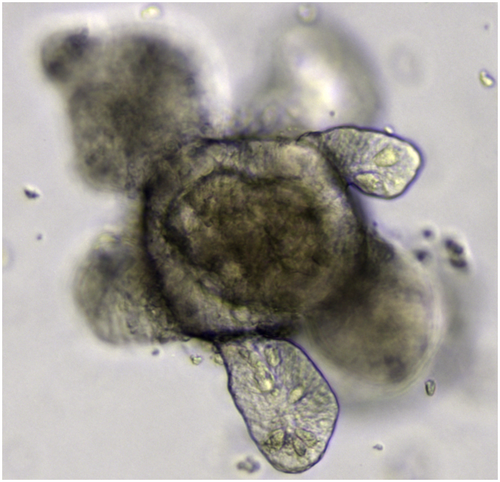
TechCrunch describes Intero as a Denver-based University of Michigan spinout founded by Charlie Childs and Madeline Eiken. The organiser's account says it develops one-millimetre human intestinal organoids and sells its GastroScreen product to organisations studying drugs and other compounds. Intero's own website describes its platform. These sources identify the business and intended use; they do not independently establish every claim about its performance.
The central idea is to offer a research model before a compound is tested in people. That should not be translated into a claim that the model is equivalent to a whole person or removes the need for later testing. A model is useful in relation to the question it can answer. The relevant scientific and commercial assessment therefore depends on the intended experiment, not on the visual appeal of the technology.
For a founder, this creates a specific communication challenge. The product needs to be comprehensible enough for a customer to see where it fits, while remaining precise enough not to imply more than the evidence supports. A broad promise about replacing existing methods would be a different claim from demonstrating value for a defined research task. The award announcement supports neither an unlimited promise nor a conclusion that no useful task exists.
Three kinds of evidence, three different claims
Award
The organiser establishes who won the competition.
Product
Vendor material describes the intended tissue-testing platform.
Validation
Suitability for a specific research use requires its own evidence.
The buyer’s question follows the experiment
Consider an illustrative research team trying to compare several compounds under defined conditions. It would need to know which measurement the platform supports, how the experiment should be run and what an observed difference would mean. This is a hypothetical buying scenario, not a reported Intero customer study. It explains why a tissue-testing product cannot be assessed merely as a novel object.
A useful commercial evaluation would preserve the route from experimental setup to interpretation. That might include asking about the evidence for repeatability and the limits of the specific model in the intended application. These are diligence questions, not findings of deficiency. A customer needs them because the business value of a research tool depends on the decisions it can responsibly inform.
A demo opens a conversation; documentation sustains it
The organiser's account provides a route for readers to discover a platform they may not previously have encountered. The next conversation belongs with the company's product information and the evidence for the intended research application. Those materials need to explain what a customer can do, how to interpret the output and which questions require a different method.
For a research-software or biotechnology founder, that translation is itself a product task. A prospective customer should not have to infer an experimental protocol from a pitch. A clear description of inputs, measurements and intended interpretation can help turn broad interest into a conversation about a specific use. It can also help the buyer identify work for which the platform is not the appropriate choice.
The same discipline applies to the prize money. The announced amount is a competition award, not a statement of the company's valuation, total capital raised or future revenue. It can be reported as a resource and a signal of attention, while leaving the business's financial condition and scientific evidence to their own sources.
What the winner has to translate next
Intero's next commercial task, as an analytical matter, is to convert interest in its platform into an understandable research offering. A potential buyer needs to see the intended application, the available evidence and the limits that remain. Clear limits can strengthen a product conversation by helping the buyer identify where the tool actually belongs, rather than inviting a comparison against an impossible universal claim.
The competition result gives the founders a new reason for that conversation to happen. It does not decide the conversation's outcome. The most useful way to follow Intero after the award is to distinguish new customer, product and research evidence from the attention generated by winning. The trophy marks an event that has occurred; the product's value in each research setting remains a separate question to answer.
Sources
- TechCrunch organiser announcement of the competition result ↗ TechCrunch organiser announcement of the competition result · Primary source
- Intero Biosystems official product website ↗ Intero Biosystems official product website · Primary source
Have additional information? Request a correction.