Shared engineering can support expansion, but different markets still require their own customers, qualification and service economics.
An investor can also be a customer—but those are different commitments
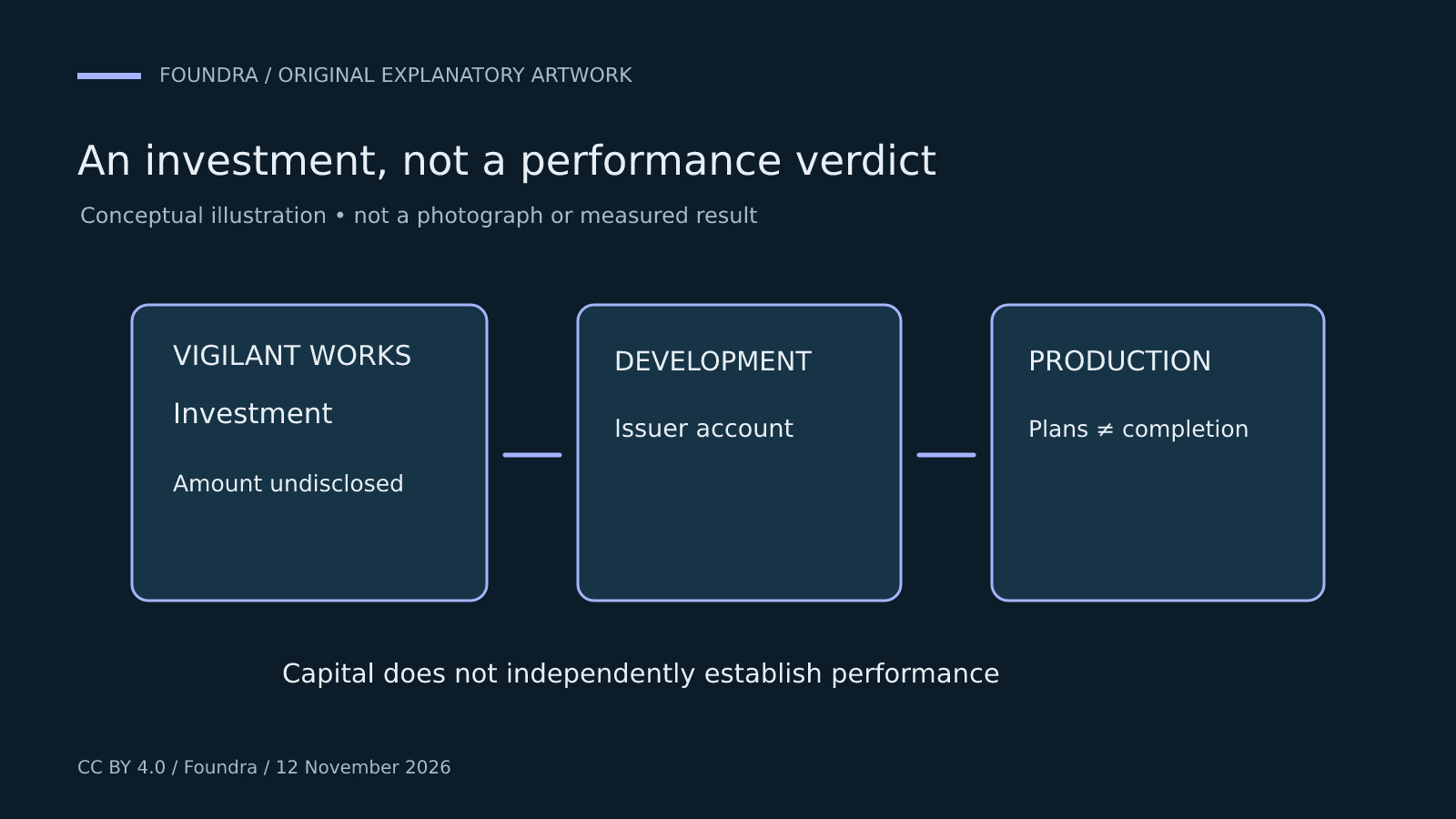
FedEx appears in two parts of Harbinger's financing story. Harbinger's November 5 company release names it among strategic participants in a $240 million Series D. Separately, TechCrunch reports a recently placed order for 2,000 Harbinger trucks valued at more than $300 million. The funding announcement and the reported order describe different relationships: providing capital and purchasing products.
Neither should be used as a substitute for the other. An investment is not itself a purchase commitment. An order is not evidence that all vehicles have been delivered or that its stated value has already become recognized revenue. The order is background reported by TechCrunch; the fresh event selected for this edition is the November 5 Series D.
Harbinger's release names Tiger Global, Capricorn's Technology Impact Fund and Ridgeline as co-leads, a fuller account than the headline's emphasis on Tiger Global. The company says the financing is raised capital and takes its total raised above $650 million. This is not a planned raise described as completed.
Manufacturing capacity remains inside the expansion plan
The round supports continued ramp-up of Harbinger's medium-duty platform manufacturing, according to the release. It also funds expansion across commercial vehicles, energy storage, power generation, autonomy software and defense applications. That breadth changes the question from whether investors will support an electric-vehicle company to how an industrial platform allocates resources among several proposed markets.
The reported FedEx order adds a specific customer dimension to that question. In analytical terms, production capacity has to serve commitments as well as development ambitions. A manufacturer can pursue adjacent markets while still having work to do on its existing platform. The press release does not provide a complete production or delivery schedule, so no schedule is assumed here.
The financing increases the resources available to make those choices. It does not remove the distinction between engineering a product, building it repeatedly and supporting it after sale. Those tasks can require different spending even when they use related technology.
For readers comparing the funding with a reported order value, the numbers should therefore remain on separate lines. The $240 million figure describes new financing. The more-than-$300-million figure is TechCrunch's account of a truck order. Adding them together would not produce a meaningful measure of revenue, cash or company valuation.
Capital and the proposed industrial expansion
Financing
Harbinger announces $240 million raised in Series D funding.
Capacity
The stated uses include ramping medium-duty platform manufacturing.
Adjacent applications
Energy, autonomy and defense are expansion directions, not independently proven commercial outcomes.
The platform thesis depends on real reuse
Harbinger frames electrification as the connecting technology across its industrial expansion. That is management's positioning. A common engineering base could help more than one product, but the economic benefit depends on how much work remains reusable after each application meets its own requirements.
A vehicle platform and a stationary energy product, for example, could draw on related electrical expertise while requiring different installation, operating and service arrangements. This is an analytical comparison, not a description of a particular Harbinger contract. It explains why a technical connection does not automatically create a common customer market.
The platform proposition can consequently be evaluated through the amount of shared development and manufacturing, and the amount of new application-specific work. Reuse that lowers the cost of serving another customer is valuable. Reuse that disappears once every customer needs a bespoke configuration may be less valuable. The announcement does not supply the financial breakdown needed to quantify either effect.
The company's reference to serving the AI economy should be read with the same specificity. It is not a disclosed data-center order book or independent proof of a particular performance advantage. The named expansion areas establish direction; customer orders, delivered products and operating results would establish execution.
A financing milestone with two business tests
The Series D puts additional capital behind Harbinger's manufacturing and multi-market plans. Its strategic-investor list, combined with the separately reported FedEx order, makes the distinction between financial backing and product demand unusually visible.
The business now has two related tests: meeting the demands of its existing platform and deciding which adjacent applications genuinely benefit from shared technology. Neither requires treating every new market as already successful. The financing is significant because it funds those tests at industrial scale, while the customer relationship shows why manufacturing execution remains central to the story.
Sources
- Harbinger company release via PRNewswire ↗ Harbinger company release via PRNewswire · Primary source
- TechCrunch: Harbinger Series D report ↗ TechCrunch: Harbinger Series D report
Have additional information? Request a correction.