A new standalone rendered interface is different from prior native integration; launch models and connectivity conditions remain qualified.
From a supplied catalogue to a drawn interface
The most distinctive part of Spotify’s new Audi app is not that music can play without a connected phone. It is that Spotify is taking control of the interface rendered on the vehicle’s screens. The Verge’s report distinguishes the release from an earlier Android Automotive integration in which Spotify supplied content while Google’s templates shaped the display.
The new application gives Spotify its own native, rendered interface. That is a narrower and more accurate description than saying the service has never previously been integrated into a vehicle’s operating system. The product change concerns who builds the experience around the catalogue, not the invention of in-car Spotify listening.
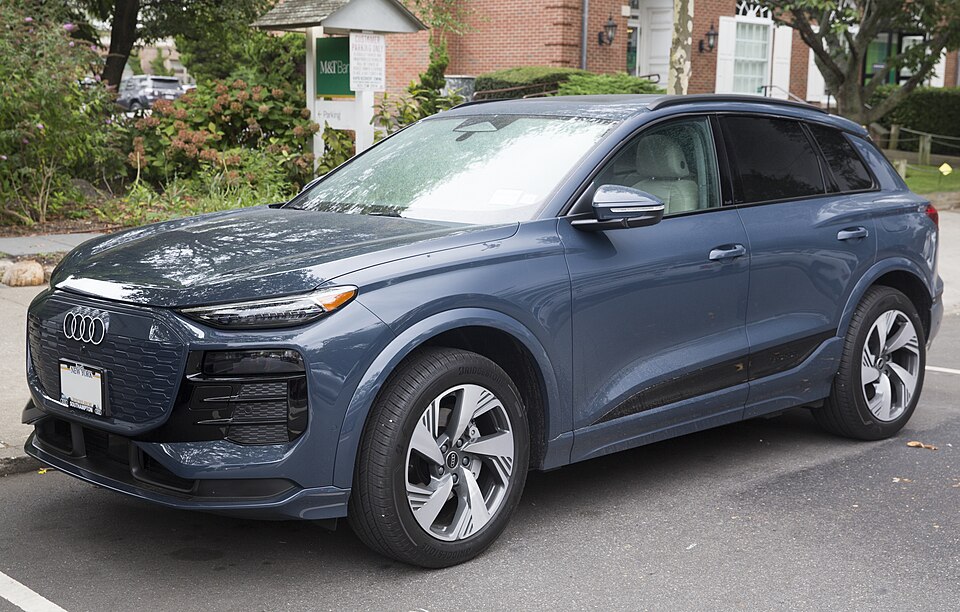
Spotify’s launch announcement dates availability to October 21, 2026. It lists the electric A6 e-tron and Q6 e-tron as well as the A5, Q5 and A6. Both Free and Premium listeners can obtain the app through the Audi Application Store. Availability can vary by vehicle and market, and an Audi connect package may be required. Those conditions belong alongside the headline availability claim.
Spotify says a phone is used to sign in, but playback does not require phone pairing or tethering. That does not eliminate vehicle connectivity requirements or the possible Audi connect package. Phone independence and independence from a service package are different claims; the announcement supports only the former with the stated qualification.
The screen changes with the vehicle’s state
Spotify describes a separation between moving and parked use. While the vehicle is moving, the centre display restricts video and lyrics and emphasises voice controls and simplified navigation. When parked, including during EV charging, the main display can show video podcasts, music videos and lyrics. These are company-described operating restrictions, not safety results independently tested by Foundra.
Supported passenger displays have additional browsing and viewing features. The qualifier matters: the presence of the app does not mean every vehicle has the same display hardware or passenger experience. A launch across several model names still contains differences in the environments where the software runs.
This makes the interface a different design problem from an ordinary mobile app. A phone largely follows the person holding it. A vehicle display has a role determined partly by the car’s state and the seat of the person interacting with it. A feature can be appropriate on a passenger screen or during a parked stop without being appropriate on the driver’s main display while moving.
Owning the rendered interface lets Spotify make more of those choices itself, but it does not give the service control over every vehicle capability. The app still operates within the supported hardware and platform conditions. The release is therefore both an expansion of interface control and a reminder of the constraints attached to native distribution.
The native app has three separate layers
Interface
Spotify renders its own vehicle-native experience rather than the prior template-shaped integration.
Identity
A phone can be used for sign-in and shared-queue participation without tethered playback.
Vehicle
Supported models, displays, market availability and possible Audi connect requirements still constrain use.
A personal account enters a shared space
The car can contain several listeners even when one account is signed in. Spotify’s announcement describes passengers joining an in-car Jam through a QR code and contributing to a shared queue. That is a concrete adaptation to a shared listening environment, not simply a larger version of the phone screen.
The account and the vehicle nevertheless remain different kinds of ownership. A recommendation history belongs to a listener, while the display and controls may be used by several people. Clear sign-in, sign-out and queue state can matter for a shared car. These are product considerations arising from the setting, not reports that Spotify has mishandled them.
The Free and Premium entry point similarly does not erase differences between subscription experiences. Availability says who can install or access the app on a supported vehicle. It does not establish that every listener receives identical features or that the service’s commercial tiers have changed.
This is why native distribution should be assessed as a new arrangement among account, interface and vehicle rather than as a single compatibility switch. The player can be built into the car while identity remains personal and some participation remains phone-based. Those layers can coexist without contradicting the claim that playback does not require tethering the phone.
A launch list, not a universal switch
Spotify says the upcoming Q7 and Q9 will follow at their market launch. That is a roadmap statement, not availability today. It also says more automotive partners are planned over the coming year. Neither statement should be turned into a completed rollout to all Audi or Android Automotive vehicles.
The Verge’s account also makes clear that Spotify is not abandoning phone projection. CarPlay and Android Auto remain distinct ways to present the service. The native app adds an option with a different allocation of interface control; it does not establish that every driver will prefer it or that existing approaches have ceased to be supported.
The October 21 release is consequently a specific product change with specific conditions. Spotify can render a fuller vehicle-native experience on named Audi models, subject to vehicle, market and possible package requirements. Its product challenge is to make that control useful across driving, parked and shared-listening states while keeping the boundaries understandable. That is more informative than calling the launch either a universal replacement for projection or the first time Spotify has lived inside a car.
Sources
- Spotify: native Audi app launch ↗ Spotify: native Audi app launch · Primary source
- The Verge: Spotify native car app ↗ The Verge: Spotify native car app
Have additional information? Request a correction.