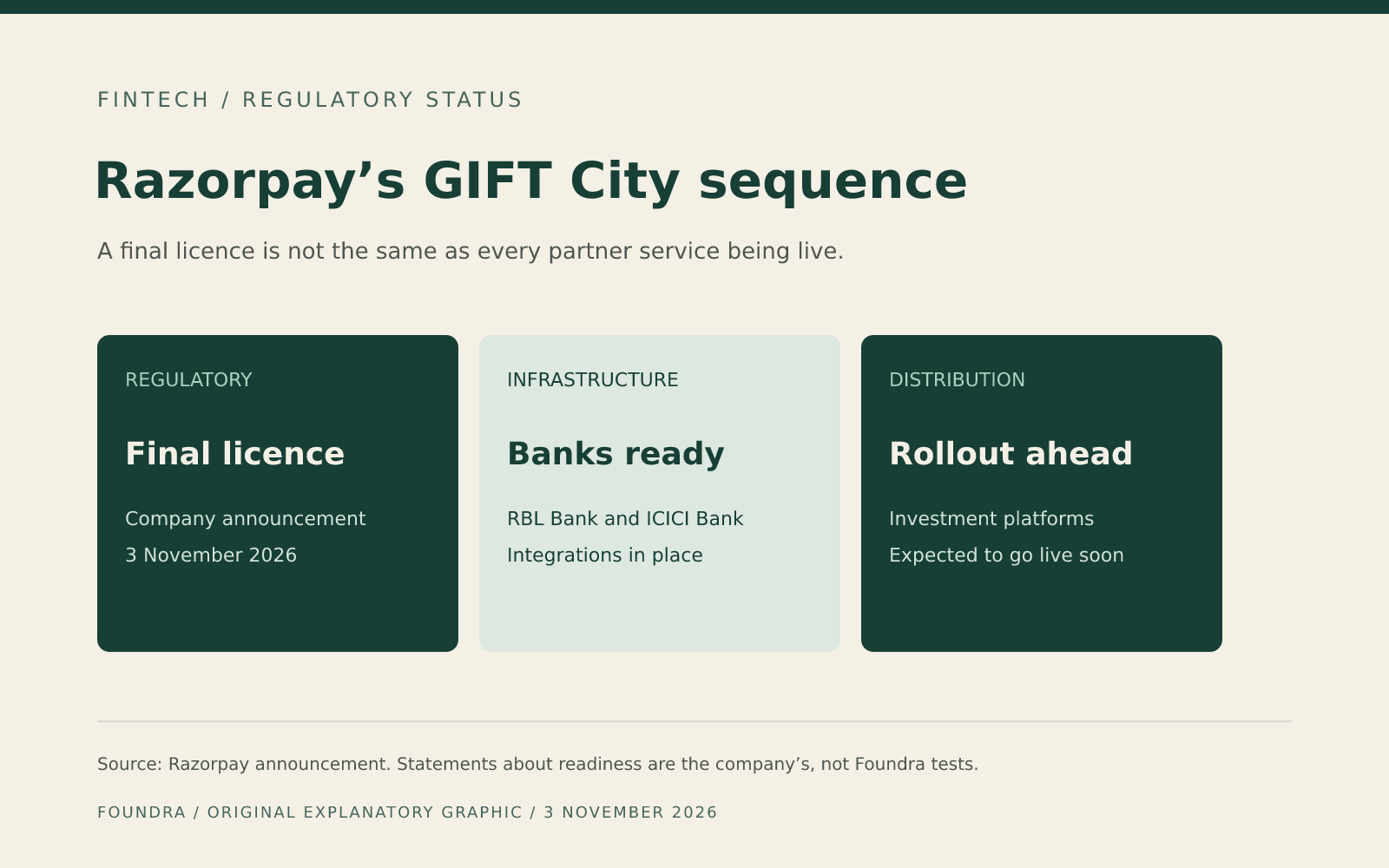
A final licence, a working integration and a customer-facing launch are different states.
Clearance, readiness, distribution
Three milestones can sit inside the same fintech announcement without occurring at the same moment: a regulator grants permission, infrastructure becomes ready and customers gain access through a partner. Razorpay’s GIFT City news is a useful example of why they should remain separate.
In Razorpay’s November 3 licence announcement, the company says it has received its final Payment Service Provider licence from the International Financial Services Centres Authority to operate in GIFT City. It describes the licence as following an in-principle approval in April 2026. That is a final-licence announcement, not another preliminary approval. Foundra has read the company’s statement; we have not independently inspected the underlying regulatory instrument.
The same statement says banking integrations with RBL Bank and ICICI Bank are in place, while key investment platforms are expected to go live soon. Those sentences describe different states. A reader should not leave with the impression that every proposed global-investing service has already launched for every eligible customer. The announcement itself leaves a distribution step ahead.
Razorpay presents the GIFT City infrastructure as a framework for cross-border money movement, encompassing international collections, settlements, multi-currency capabilities and global investing. Its stated proposition is to bring activities that otherwise involve multiple integrations under a more unified infrastructure.
That may be attractive to an investment platform weighing how to add an overseas service. But the licence does not answer every implementation question. Our analysis is that a platform still needs to know which flows its agreement actually supports, how eligibility is checked, which institution holds funds at each stage and how a failed transaction is resolved. These are procurement questions, not allegations that Razorpay lacks the controls.
The company also describes integration timelines of two to three weeks. That is a vendor claim, not a delivery time Foundra has measured. A potential customer should ask what the timing includes and excludes: technical connection, compliance review, testing, commercial agreements and launch approval can be different parts of a project. A headline about faster integration should not become a promise that a complex financial service will be available after a fixed number of days.
The licence is not the user experience
Imagine an investor initiating an overseas transfer from a partner app. A good experience would need to explain the amount debited, the amount received, relevant charges, the status of the transfer and the route for resolving a problem. This is a hypothetical user journey, not a description of a live Razorpay-powered platform we have tested.
The reason to examine that journey is that infrastructure and distribution divide responsibility. A customer may see only the partner’s interface, even when several organisations are involved beneath it. Clear status messages and support ownership become part of the financial product, not optional polish on top of a regulated backend.
Likewise, a multi-currency capability should not be read as unlimited freedom to move money for any purpose. The appropriate customer, transaction and regulatory conditions still need to be understood for the specific service offered. Nothing in this article is investment advice or a statement that the announcement creates a new exemption from applicable rules.
The three states in the company’s announcement
Final licence
Razorpay says the final IFSCA PSP licence follows its April 2026 in-principle approval.
Existing integrations
The company identifies banking integrations with RBL Bank and ICICI Bank.
Expected rollout
Investment platforms are expected to go live soon; the release does not say every proposed service is already live.
A more useful test for platform builders
For a startup considering the infrastructure, the first useful comparison is between an announced capability and the transaction it wants to enable. A platform for overseas investing may have a different operational requirement from a business collecting international payments. The company’s broad description is a starting point; the actual supported flow is the unit to evaluate.
A second comparison is between technical readiness and operating readiness. A connected bank is evidence of an integration the company says exists. It is not proof of every partner’s support process, reconciliation system or ability to recover from a failed transfer. Buyers could ask for a documented end-to-end test of their intended flow and the responsibility assigned to each participant.
A third concerns observability after launch. A service can appear straightforward in a demonstration while leaving customers uncertain when a payment is delayed. We would look for visible transaction states, consistent records and a clear escalation path. These are suggested acceptance criteria, not verified deficiencies or capabilities of Razorpay’s current implementation.
The next milestone is a named live service
The November 3 announcement is meaningful because Razorpay says the permission is final and identifies existing bank integrations. It also gives readers a clear boundary: investment-platform launches remain expected rather than completed in the source we reviewed. That boundary should survive both the headline and the product discussion.
The next development worth following is a partner service that is actually live, with a defined audience and a documented transaction journey. Until then, the strongest supported description is an infrastructure provider announcing regulatory clearance and readiness for a further rollout. Keeping those stages distinct makes the news more useful to builders than treating a licence, an integration and a customer launch as interchangeable achievements.
Sources
- Razorpay — original final-licence announcement ↗ Razorpay — original final-licence announcement · Primary source
Have additional information? Request a correction.