The October 29 weights release is distinct from the earlier preview. Coding and security claims remain vendor-reported; self-hosting creates responsibilities as well as options.
An October 30 plan sets a Q1 2027 production window for modular Sonic Pods. The original product dates to August, while factory throughput, site readiness and useful AI service are different measures.
The Hyderabad startup’s pre-seed announcement backs a retrofit approach to physical AI. Compatibility, bounded tasks and site acceptance still need deployment-specific evidence.
Two October 28 reports describe raised funding for the enterprise-AI startup. Its AI-plus-developers proposition makes ownership, exception handling and support part of the product decision.
The October 29 company announcement introduces built world models. Earlier investor involvement and unverified performance claims mean this is a public debut and funding disclosure, not proof of a same-day capital close.
The voice-AI companies say the framework will stay open and vendor-neutral, with an independent foundation being established. Governance and commercial services are different questions.
New ready-to-use artifacts cover work such as citation checking, contract playbooks and matter tracking. They package a first pass, not an independently verified legal conclusion.
Bessemer leads the financing. The company’s endpoint-to-cloud ambitions raise a practical question: which observations can safely become automated actions?
Randomly assigned agent preferences influenced professional analysts in a controlled task. The result is not a measurement of how all AI-assisted work behaves.
Dallas Venture Capital leads the Series B, with NVIDIA participating. The startup’s proposition is operational flexibility; its performance claims still need workload-specific scrutiny.
The pre-Series B includes new capital and shareholder liquidity. Its enterprise challenge is making an automated decision traceable, not merely making it faster.
The debt-and-equity Series A backs an Indian preventive-health platform. Scan volumes and early-detection ambitions are not proof of improved patient outcomes.
Thomas Dohmke’s startup introduces Trails, distributed hosting and persistent session context. Its speed claims are not independently benchmarked here.
The company says 155 responses exposed cross-customer request data during an August–September incident affecting one model. The October disclosure is new; the remediation is not.
Opera One offers an opt-in early preview on specified Windows PCs and Apple-silicon Macs. Models download only after activation; future browser rollouts are not current availability.
The rival AI developer reports a rare blocked upload attempt and publishes traces. Its observed test and steered follow-up experiments answer different questions.
A proposed 10,000-kilometre network puts the connection between data centres alongside the computing capacity inside them. The announced investment is a plan, not a completed build.
The investor announces a strategic investment in InMobi-backed Glance. Distribution across screens is the starting point; repeat purchasing and useful recommendations remain separate questions.
The Singapore vision-AI company says its Series A will support expansion across APAC, the United States and the Gulf. Its safety claims need a different kind of evidence from its financing.
The Siemens collaboration starts with facilities operations, not an independently verified autonomous chip factory. Consolidation and broader global integration are described as staged work.
General Catalyst leads the pre-Series A round. The harder questions concern subscriptions, international play and a proposed expansion from playing games to creating them.
An Apollo-managed entity is set to finance NVIDIA equipment. Closing conditions and a 2027 delivery schedule separate the announcement from operating AI capacity.
The October 26 earnings announcement brings a $1.8 million quarterly profit. Reported-dollar growth, constant-currency growth and company-described AI usage are not the same result.
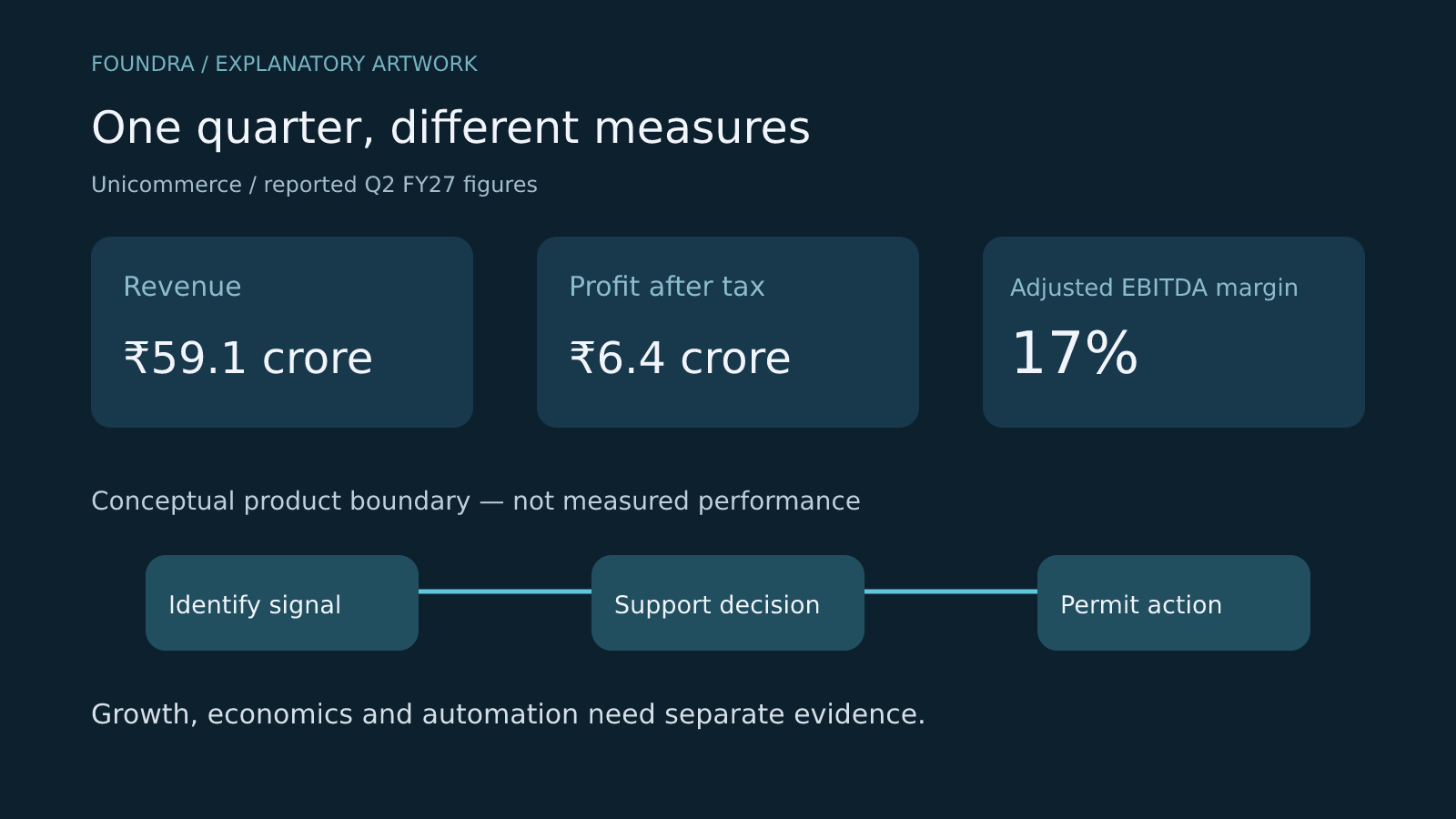
The October 23 results pair 15% revenue growth with a 17% adjusted EBITDA margin. The second-generation DNA companion adds a product question to the financial one.